Peer-to-peer networks
General
- Motivation
- Share resources in volatile and decentralized network of independent and autonomous peers
- Key features
- Decentralized
- Self-organizing
- Direct data transfer between peers
- Advantages
- Low costs (usually no extra hardware needed)
- High scalability / flexibility
- Important issues
- Resource discovery
- Network organization
- Data transfer
- Shareable resources
- Information (file/documents)
- Bandwidth (load balancing/shared bandwidth)
- Storage space (DAS, NAS, SAN)
- Computing power
Definition
- P2P network is a virtual overlay network
- Identify network as graph
- Based on TCP-Connections between peers
- Characteristics
- Independent from physical network (no relation between physical and overlay edges)
- Separate addressing and routing scheme
- Topology properties / Classification
- Centralized/decentralized
- Structured/unstructured (specific topology)
- Flat/hierarchical
Bootstrapping
- Process of a node joining a network
- Techniques
- Bootstrap cache (nodes from last session)
- Stable node (permanently online)
- Bootstrap server
- Request list of active nodes
- Return least recently connected nodes
- Alternative: Randomly pick recently connected node (no loops, but can be outdated)
- Broadcast IP layer (IP broadcast, limited to local network)
- Bootstrap list (List of potential bootstrap servers outside network, e.g., from awebsite)
History
- Enabling technology: Performance increase
- Computers
- 1992 (HDD 0.3 GB, 100 MHz)
- 2002 (100 GB)
- 2007 (3 GHz, 320 GB)
- Internet
- 1990 (56 kbps)
- 1997/1998 (10 Mbps)
- 1999 (DSL: 8.5 Mbps)
- 2000+ (Bandwidth no problem, plentiful / cheap)
- Innovations
- 1960 (ARPANET, research project of DARPA)
- 1979 (UseNet protocol)
- 1999 (WWW at CERN by Tim-Berners Lee)
- 1999 (Napster lawsuit)
- 2001 (Napster convicted)
- P2P Applications
- File sharing (e.g, music/video)
- Software updates (e.g., patches, linux distributions)
- Routing/bridging (avoid bottlenecks, e.g., Skype)
- P2P unicast (replicate index to peers)
Unstructured peer-to-peer
- First generation
- Centralized directory model
- Pure peer-to-peer
- Second generation
- Hybrid peer-to-peer
Centralized directory model
- First generation
- Examples: Napster, PeerJS, Skype, Gnutella
- Classification: Centralized, unstructured, flat
- Central entity/index server
- Works as bootstrap server
- Peers connect to index server (join network)
- Works as bootstrap server
- Advantages
- Fast/complete lookup
- Central managing/trust authority
- Easy bootstrapping
- Guaranteed lookup
- Routing complexity \( O(1) \)
- Disadvantage
- Central entity: Single point of failure
- Bad scalability
- Node state complexity at server: \( O(N) \)
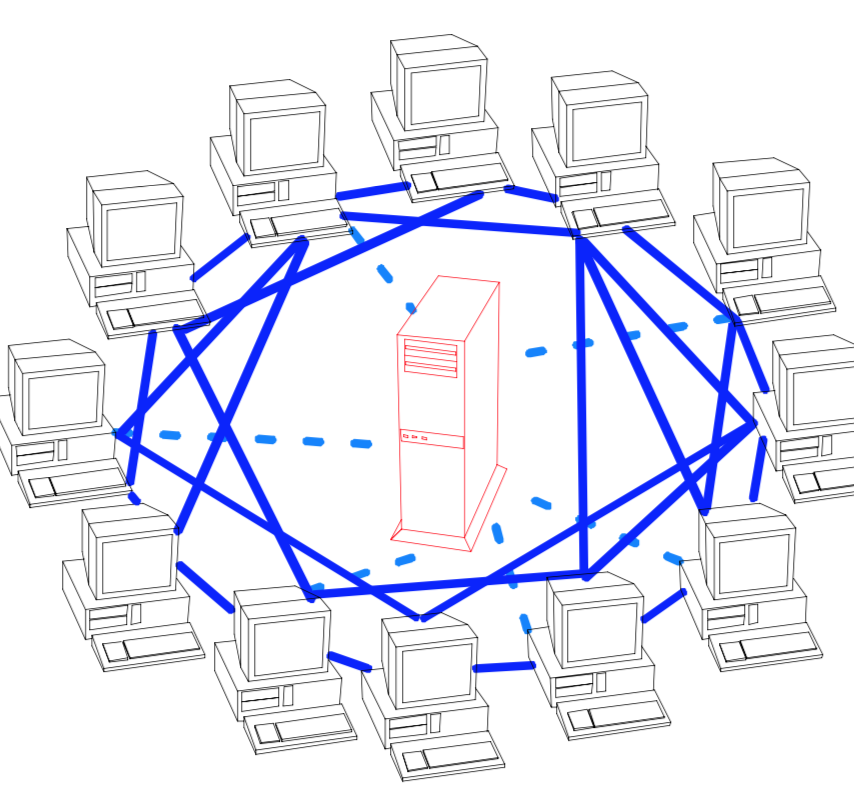
Node arrival
- Node connects to central server
- Node sends file list (content announcement)
Routing
- Routing table (file-to-peer-mapping)
- Workflow
- Peer queries index server
- Result: List of peers providing content
- Peer connects to providing peer
- Protocols
- Peer and central entity
- Special P2P protocol
- Registering to overlay network
- Query content
- Update content information
- Update routing tables
- Peer and peer
- HTTP
- Peer and central entity
Pure peer-to-peer
- First generation
- Example: Gnutella 0.4
- Characteristics
- Decentralized (no central entity, no content index)
- Unstructured (random overlay network, peers are equal)
- Flooding (used for routing)
- Bootstrapping (no central node known)
- Advantage
- No single point of failure
- Adaptable to physical network
- Anonymity (possibly)
- Node state \( O(1) \)
- Disadvantage
- No guaranteed lookup (false negative)
- Unscalable (flooding, low-bandwidth peers are useless, random network)
- High network traffic (flooding)
- Communication overhead \( O(N) \)
- Low-bandwidth-node: Bottleneck
- Overlay not optimal (no coordinator)
- Possible zig-zag-routes, loops
- Peers are not really equal (performance)
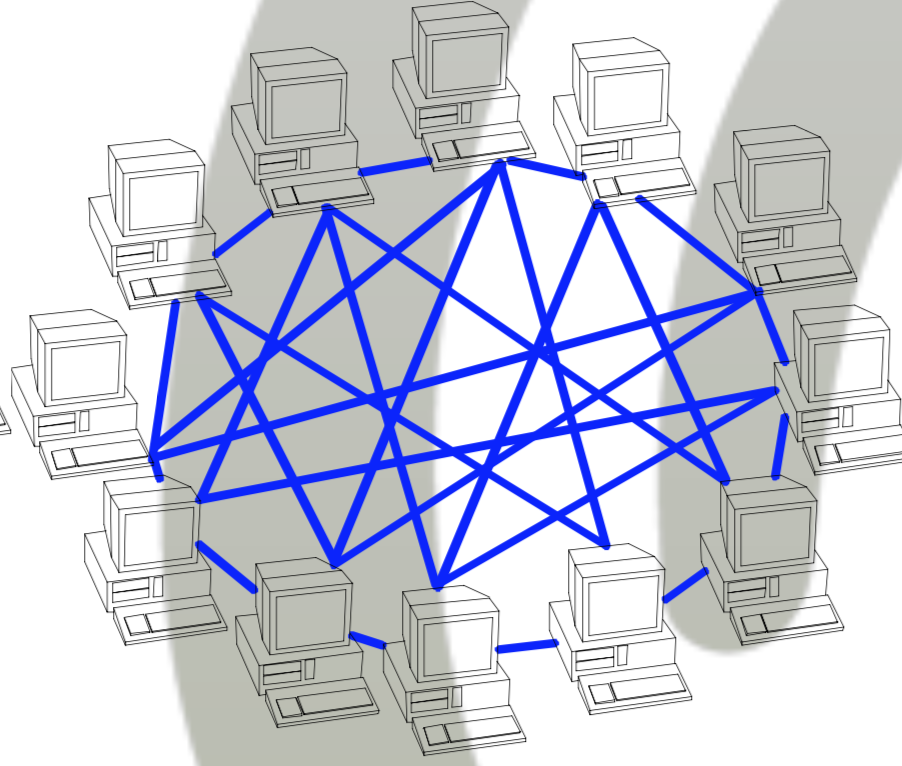
Routing
- Based on flooding
- Request
- Send requests to neighbors
- Neighbors forward request
- Response
- Send result notification to requesting node
- Use caches for back-tracking
- Problem: Network overload
- Solution: Time-to-live + hop counter
- Increase hop counter each hop
- TTL is maximum number of hops
- Problem: Cycles
- Solution: Cache messages for short time
- Do not forward if request is cached
- Effects
- No guaranteed lookup
- Unscalable (too many messages)
Gnutella 0.4
- Goal: Avoid weaknesses of Napster
- Classification: Fully decentralized, unstructured, flat (pure P2P)
- Network type: Scale-free network
- Components
- Router service
- Flooding of requests (TTL)
- Routing of responses (e.g., keep-alive messages, exploration-messages)
- Lookup service
- Initialize query request
- Keep-alive-requests (ping-pong)
- Download service (direct connection)
- Router service
- Workflow
- Use bootstrap to find peers
- Send Exploration-Ping-Pong to explore neighborhood
- Send query to neighbors
- Receive response (QUERYHIT)
- Connect to peer to download file
- Disadvantage
- Free-riding possible
Ping-Pong Message
- Ping message is responded by a pong message
- Types
- Keel-alive-ping-pong
- TTL=1
- Test of neighbor is available
- Exploration-ping-pong
- Explore/gather information of nodes
- Pongs contain information of peers (uptime, bandwidth, number of files)
- Store in peer cache
- Keel-alive-ping-pong
- Ping-pong cache
- Select stable peers for next bootstrap (uptime, etc.)
- Boost connectivity (additional links to strong neighbors)
- Compensate neighbor failure (reconnect to other neighbor)
- Problem: Bandwidth-intensive
Header structure (unnecessary)
- GnodeID (host ID)
- Function (ping/pong/search)
- TTL
- Hops
- Payload length
Hybrid P2P
- Second generation
- Example: Gnutella 0.6, KaZaA, eDonkey
- Idea
- Use advantage of more powerful peers
- Combine centralized and pure P2P
- Aspects
- Network topology
- Node arrival
- Routing
- Advantages
- No single point of failure
- Anonymity possible
- Node state complexity \( O(1) \)
- Disadvantages
- High signaling traffic (decentralized super peer layer)
- No guarantees
- Overlay topology not optimal (no coordinator)
- Routing complexity \( O(N) \)
Network
- Classification: Scale-free
- Hierarchical network layout
- Super peers
- Form pure P2P network
- Distributed file index (content from leafs)
- Queries distributed among super-peers
- High node degree (degree >> 20)
- Leaf peers
- Attach to at least one super peer (degree < 7)
- Centralized P2P
- Super peers
- Hub-based network (super peers)
- Reduced signaling load (ping-pong only in super peer layer)
- Super peer selection (voluntarily, statistics, evolving)
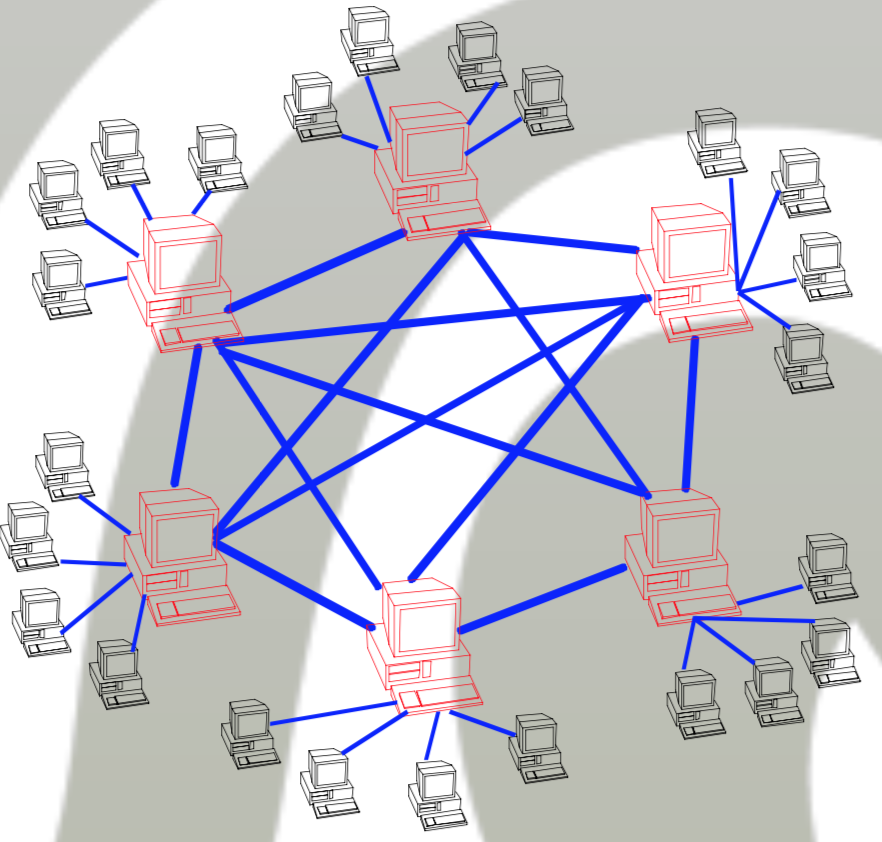
Node arrival
- Leaf node registers at super peer
- Send shared files
- Super peer updates routing tables (file-peer-mapping)
- Super peer
- Load balancing (redirect leaf peer, suggest promotion for super peer)
Routing
- Based on flooding
- Routing table
- Mapping between file name and node address
- Partly decentralized
- Leaf node sends request to super peer
- Super peer checks if content in its routing table
- Super peer distributes request in super peer layer (flooding, pure P2P)
- Send leaf node address back (backward routing)
- Hybrid protocol
- Reactive: Download connection on demand
- Proactive: Content announcement on node arrival
Network connections (unnecessary)
- Signaling connections
- Stable
- Protocol: TCP-based
- e.g., keep-alive-ping-pong, content search
- Content transfer connection
- Temporary
- Protocol: HTTP
- Out-of-band (directly between peers, not using signaling routes)
Structured peer-to-peer
- Idea: Index data with Distributed Hash Table
Hash tables
- Data structure
- Lookup \( O(1) \) (worst case \( O(N) \))
- Components
- Bucket array (fixed-size \( m \))
- Hash function \( h \)
- Operations
- Insert (hash value and add to bucket)
- Lookup (hash value and scan bucket)
Hash function
- Mapping \( h: U\rightarrow [0,m-1] \)
- Properties
- Low cost
- Determinism
- Uniformity
- Assumption: Objects distributed uniformly
- Uniform distribution
- Reduce collisions
- e.g., Load balancing
- Range variability (Variable hash range)
- Avalanche or Continuity (behavior for small changes on key)
- Avalanche property
- Change one bit in key, change 50 % of the hash bits
- Cryptographic applications
- Distribute objects robustly
- Example: SHA-2 (224/256/384/512 bit)
- Continuity property
- Small change in key, small change in hash
- Similarity searches
- Example: Adler32
- Example functions
- Modulo hash (\( h(x) = x \mod k \)
- Cryptographic hash (variable input size, avalanche, no reverse-computing)
Distributed Hash Tables
- Classification: Decentralized, structured, flat
- Idea
- Distribute hash table over multiple nodes
- Usual assumptions
- Fixed hash range
- Node is responsible for certain interval
- Route requests along the hash range
- Use Interface (exchange implementation)
- Advantages
- Simple/efficient
- Efficient routing \( O(log(N)) \) (exponential finger table)
- Storage per node \( O(log(N)) \)
- Guaranteed results
- Resilient to failures (repair routing table)
- Load balancing (uniform distribution of keys)
- Self-organizing
- Supporting wide spectrum of applications
- Disadvantages
- Lookup not in \( O(1) \)
- Repair overhead
- Examples: CHORD, CAN, Pastry, Symphony, Tapestry, Kademlia, P-Grid
Design decisions
- Hash function
- Storage location of objects (direct, indirect)
- Responsibilities of nodes (random, hashing, evolving)
- Routing of queries
- Dealing with failures
Hash function
- Hash range a lot bigger than number of stored objects
- Question: What are good keys? (application-dependent)
- Common keys
- Filename/filepath (early approach)
- Keywords (hash multiple times)
- Info digest/meta data (file length, settings)
- Peer identification (peer ID, IP/MAC address)
Storage location of objects
- Direct storage
- Node stores actual content
- Use shipping
- Problem: Large content (high traffic, expensive join/leave)
- Problem: Loss of ownership (e.g., malicious node)
- Good for storage space load balancing
- Indirect storage
- Node stores link (physical address) to object
- DHT announces availability of object
- Flexible for large content (easy joining/leaving)
- Minimal communication overhead
Responsibility
- Usual assumption: Hash space is ring
- Node knows predecessor and successor
- Node responsible for certain arc
- Arc ending at nodes hash value (hash ID, IP, MAC)
- Additional heuristics can be used for responsibility (must be dynamic)
Routing
- Workflow for querying
- Send to query to any node
- Hash key
- Route query to responsible node (key-based routing)
- Transfer data from peer to peer
- Types
- Direct routing
- Central server knows responsibility
- Fully-meshed ring (each node knows each node)
- Routing complexity \( O(1) \)
- Node state complexity \( O(N) \)
- Linear routing
- Start query at some node
- Route query along ring (successively)
- Routing complexity \( O(N) \)
- Node state complexity \( O(1) \)
- Finger table routing
- Node knows additional nodes (but not all)
- Stored in finger table/routing table
- Routing complexity \( O(log(n)) \)
- Node state complexity \( O(log(n)) \)
- Direct routing
Load balancing
- Common assumptions:
- Uniform key distribution (uniform hash function)
- Equal data distribution (uniform data size)
- Equal query distribution (uniform query load)
- Problem:
- User queries are not equally distributed (power law)
- No uniform distribution
- Significant difference of load distribution
- Definition optimally balanced
- Load of each node: \( \frac{1}{N} \)
- Definition Heavy/overloaded node
- Load significantly greater than \( \frac{1}{N} \)
- Definition Light node:
- Load significantly lower than \( \frac{1}{N} \)
- Algorithms
- Power of two choices
- Virtual Servers
- Thermal-Dissipation-based approach
- Simple address-space/item balancing
Power of two choices
- Byers, 2003
- Idea:
- Choose node with lowest load
- Use soft states (adapt for changing load)
- Multiple hash function
- \( h_0 \) for nodes
- \( h_1,...,h_d \) for data
- Options
- Data stored on one node only
- Data stored on one node, other nodes store a pointer
- Data insertion (periodically, due to soft states)
- Calculate results of \( d \) hash functions
- Store data on the node with the lowest load
- Optional: Store pointers to node on all other nodes
- Data retrieval
- Data stored on one node only
- Calculate results of \( d \) hash functions
- Query all nodes in parallel
- Data is stored on one node + pointers
- Calculate one hash result
- Query node (retrieve link or data)
- Data stored on one node only
- Advantages
- Simple
- Lower load than Virtual Servers
- Disadvantages
- Message overhead for inserting
- Search overhead (no pointers)
- Administration overhead (with pointers)
- Theoretically, nodes without load
Virtual servers
- Rao, 2003
- Idea:
- Node responsible for several intervals
- Each interval is called virtual server
- Virtual server can be created/transferred
- If node is too heavy, transfer to another node
- Transfer rules
- Transfer from heavy to light
- Receiving node must have enough capacity
- Transferred virtual server is the lightest that makes the heavy node light
- If there is no transferable node, transfer the heaviest one
- Schemes
- One to one
- Light node picks random node \( x \)
- Receive virtual if \( x \) is heavy
- One to many
- Light nodes report load to directories
- Heavy node select light node from directory
- Many to many
- Directory manages transfer
- Directory contains load of all nodes
- One to one
- Advantages
- Easy load shifting (whole virtual server)
- Theoretically, every node has load
- Disadvantages
- Increased administrative/message overhead (finger table)
- A lot of load shifting
- Higher load than Power of two choices
Data durability
- Definition k-resilience: \( k-1 \) nodes can crash without data loss
- Strategies
- Indirect storage and soft states
- Replication: Successor list
- Replication: Multiple noes
Indirect storage
- Use Soft states
- Each key-value pair has a lifetime (decay timer)
- Content providers (application) periodically republishes content (create new or reset lifetime)
- Node failure: Content available after certain time
- Content provider failure: Content disappears after certain time
Replication: Successor list
- Replicate data to \( k-1 \) next nodes
- Node failure:
- Stabilize function repairs routing
- Replicate until \( k \) nodes contain data
- Advantage
- No instant copying needed if node fails
- Disadvantage
- Higher data load (node stores \( k \) intervals)
- Message overhead during repair (find new successors, replicate to new successors)
Replication: Multiple nodes
- Address range shared by at least \( k \) nodes
- Node arrival
- Connect to successor
- Receive copy of all data
- Split range after threshold (e.g., \( 2k \))
- Finger table to other nodes in same interval
- Alternative: Pass node to next interval if full (interval is divided)
- Data insertion
- Replicate to all nodes in interval
- Node failure
- No copying necessary
- Stabilize function
- Advantage
- No instant copying needed if node fails
- Dynamic interval size
- Query load balancing possible (\( k \) nodes)
- Disadvantage
- Less number of intervals (\( \approx \frac{1}{k} \))
CHORD
- MIT, 2001
- Topology: Partially meshed ring
- Goals
- Routing complexity \( (O(log(N)) \) (key-based-routing)
- Node complexity \( O(\log N) \)
- Self-organization
- Robustness (node arrival/departure/failure)
- Node responsibility: Modulo ring
- Concepts
- Finger table
- Neighborhood table
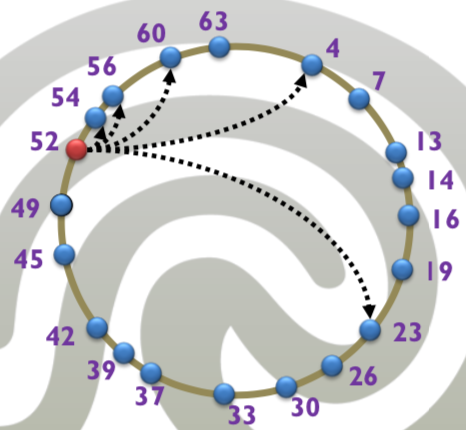
Hash function
- Hash range \( 2^m-1 \) (usually SHA-1, 160 bit)
- Node ID: hash IP address and port
- Data ID: hash data name or hash payload (how?)
Routing
- Use finger table
- Routing
- \( m \) entries (with SHA-1 use 160 entries)
- Exponentially increasing distance to finger node
- Entry stores distance, target ID, node ID
- Build finger table
- Compute target IDs (\( targetId = (currentId + 2^i) \mod 2^m \))
- Query successor for target node IDs
- Querying
- Route query to most distant finger node with an target ID lower than the queried ID
- Routing complexity \( O(log(N)) \) (binary search)
Organization
- CHORD fully self-organized
- Cases
- Node arrival
- Node departure
- Node/network failures
- Goal
- Maintain routing features (available target node should be reachable)
- Durability for stored data (handled by the application)
- Use neighborhood table
- Maintenance
- Contains the \( k \) direct successors/predecessors
Node arrival / join
- Node hashes itself
- Contact any DHT node (bootstrapping)
- Contact node responsible for new node ID (normal routing)
- Split arc (move key-value-pairs to new node)
- Construct neighborhood table
- Use already connected node
- Request successor/predecessor list
- Construct finger table
- Use normal queries
Stabilize / Maintenance
- Maintain neighborhood table
- Each node regularly executes stabilize function
- Contact first direct successor
- \( pred(succ(x)) = x \)
- Erweiterung mit \( k>1 \)
- Contact the k-th successor
- \( pred(succ_k(x)) = [x, succ_1(x), ..., succ_{k-1}(x)] \)
- If not, new node was inserted (tables are outdated)
- Repair with neighborhood table/predecessor list of outdated successor
- If no connection, node failed
- Repeat with second direct successor
- Tell second direct successor to take over the responsible arc
- Problem: All direct successor failed (no solution)
- Each node regularly executes stabilize function
- Maintain finger table
- Important to guarantee routing
- Repair mechanism
- Select finger node \( v \)
- If node \( v \) can’t be reached, ask direct successor to contact a node with the same distance as the previously selected node: \( w \)
- Assumption: Finger target \( w \) already repaired neighborhood
- Finger target \( w \) knows correct finger node for \( v \)
- Active maintenance
- Periodically execute repair mechanism
- Less often than normal stabilize
- Issue: Maintenance traffic
- Passive maintenance
- If contacting finger fails, forward to previous finger
- Execute repair mechanism for broken finger
- May fail, no \( O(log(N)) \) guarantee
Node departure / leave
- Assumption: Departure = failure
- Detected by stabilize function
- Repair tables
Data durability
- Data durability usually handled by application
- Simple CHORD implementation uses no replication
- Indirect storage using Soft states
- Simple replication technique
- Successor list
- Multiple noes
Load balancing
- Power of two choices
- Virtual servers
CAN
- UC Berkeley, 2001
- Topology: d-dimensional space (use multi-dimensional hash function)
- Node responsibility
- Each node for certain region (no specific coordinate)
- Node state complexity: \( O(d) \)
Routing
- Routing table
- Store physical address of neighbors
- Store region coordinates of neighbors
- Logical extent of region
- Routing algorithm:
- Idea: Forward request to region closest to destination
- Multiple paths exist
- Routing complexity:
- \( O(d N^{\frac{1}{d}}) \)
- Inferior to CHORD \( O(\log n) \)
- Superior to Pure/Hybrid P2P \( O(n) \) (e.g., Gnutella)
Node arrival
- Randomly choose coordinate
- Send join request to responsible node for this region (bootstrap node required)
- Reject request: Pick new coordinate (e.g., local load balancing)
- Accept request
- Split region + content
- Update routing tables of neighbors
Pastry
- Microsoft, 2001
- Hash space: Ring
- Important: Small world property
- Routing
- Three finger tables
- Leaf table (nodes with direct key space proximity)
- Routing table (random nodes with high key space distance)
- Neighborhood table (direct network proximity, determined by broadcast)
- Workflow
- Route request to node with most similar/closest hash key
- Use physical network properties (cheap communication)
- Use small world properties
- Leaf table: Short distance links
- Routing table: Long distance links
- Three finger tables
Symphony
- Stanford, 2003
- Hash space: Ring
- Idea: Use properties of small world
- Finger table
- Random construction using PDF
- Probability distribution function
- \( \frac{1}{d \log N} \)
- \( d \): Distance along ring (???)
- \( N \) nodes (unknown, estimate)
- Estimation of \( N \)
- Assumption: Equal node distribution along ring
- Use normalized arc length \( x_n=\frac{x}{2^m} \)
- \( N\approx \frac{1}{x} \)
- Result: Multiple short distance links, several medium distance links, some long distance links
- Route queries to closest node
Kademlia
- Similar to Pastry
- Topology: Ring (Small world)
- Hash function: SHA-1 (160 bit)
- Uses replication
- Data stored in the next \( k \) nodes
- Node state:
- Node maintains information about files, keywords from nodes close to it
- Soft state: Nodes must refresh key-value pairs (usually all 24 hours)
- Advantage
- Routing complexity: \( O(\log N) \)
- Replication
- Resilient to attacks
- Dynamic network
- Disadvantage
- Complex routing table: \( O(k*\log N) \)
Routing
- Tree-based (prefix-tree of hashes)
- Closeness measure: \( d(n_1, n_2) = n_1 \oplus n_2 \)
- Effect: First differing bits result in greater distance
- Routing table
- 160 entries
- Each entry address range from \( 2^i \) to \( 2^{i+1} \)
- Each entry contains \( k \) peers within that distance (called k-bucket)
- k-bucket starts with least recently seen
- Parameter \( k \)
- \( k \) nodes should not fail within an hour (usually \( k=20 \))
- Result: A lot of near nodes stored, a few distant nodes
- Setting \( k=1 \): Similar to CHORD
- Query
- Node computes distance to key (XOR)
- Query all \( k \) nodes in the respective bucket (or sub-tree)
Network theory
- Motivation
- Prove specific properties
- Desirable system properties
- Decentralized
- Self-organizing (maintenance without authority)
- Scalability
- Efficient searching/retrieving (small number of hops)
- Reliability (robust w.r.t. node failures)
- Desirable graph properties
- Connectedness
- k-Connectedness with large \( k \)
- Low diameter \( d(G) \) (ensure reachability)
- Low average path length \( d_{avg}(G) \) (efficient routing)
- Low average node degree \( deg(G) \) (limit size of routing tables)
- High average cluster coefficient (failure resistance)
- Decision
- Navigable in decentralized fashion: Small-world using Kleinberg
- High risk of attack: Small-world with low node degree
- Small/secure context: Scale-free
Graph basics
Directed graph
- \( V \): Set of nodes
- \( E\subseteq V\times V \): Set of edges
- \( n=|V| \)
- \( m=|E| \)
Neighbors set of node
- \( N(v) = \{w\in V \mid (v,w) \in E\} \)
Node outdegree
- \( deg^+(v) = |N(v)| \)
Node indegree
- \( deg^-(v) = |\{w\in V \mid (w,v)\in E\}| \)
Node degree
- \( deg(v) = deg^+(v) + deg^-(v) \)
Path
- \( P(v,w) = (v_0,...,v_k), v_0=n, v_k=w, \forall 0 \leq i < k: (v_i, v_{i+1})\in E \)
- Path length: \( |P(v,w)| - 1 \)
- Distance \( d(v,w,) \): Shortest path between \( v \) and \( w \)
Connectedness
- \( \forall v_i, v_j\in V: P(v_i, v_j) < \infty \)
- k-Connectedness
- Removal of \( k-1 \) nodes leaves the graph connected
Graph bisection width
- \( bsw(g) \)
- Minimal cohesion
- Minimaml number of edges to remove to split graph into two unconnected subcomponents
Graph diameter
- \( d(G) = \max_{v,w\in V}(d(v,w)) \)
- Maximal distance of any pair of vertices
Average path length
- \( d_{avg}(G) = \frac{\sum_{(v_i,v_j)\in E} d(v_i, v_j)}{n(n-1)} \)
Graph degree
- Outdegree
- \( deg^+(G) \)
- Average outdegree of all nodes
- Indegree
- \( deg^-(G) \)
- Average indegree of all nodes
Clustering coefficient
- Degree of interconnectedness of neighbors
- \( e(N(v)) \): Number of connections of neighbors of \( v \)
- \( C(v) = \frac{e(N(v))}{deg^+(v)(deg^+(v)-1)} \)
Random network
- Generative model
- Erdös-Rényi random graph
- Gilbert random graph
- Examples:
- Pure peer-to-peer
- Dynamo with p=1
Erdös-Rényi Graph
- \( g_{n,m} \) model
- \( G_{n,m} \) set of all graphs with \( n \) vertices and \( m \) edges
- Select instance of all graphs \( G_{n,m} \) with equal probability
- \( |G_{n,m}| = \binom{\binom{n}{2}}{m} \)
- Generation
- No suitable
- Extremely high number of possible graphs (\( |G_{6,6}|=5005 \))
Gilbert graph
- \( g_{n,p} \) model
- Edge has probability to be added
- Probability is fixed
- Assumption: Edges are independently
- Useful for generation
- Construction
- Start with \( n \) vertices and no edges
- Add edges iteratively
Asymptotical observation
- \( n\rightarrow \infty \)
- Assume \( m = f(n) \)
- No fixed number of edges
- New nodes create new connections
- Gilbert and Erdös-Rényi behave asymptotically equivalent
- For large number of edges
- \( \lim\limits_{n \to \infty} \binom{n}{2} p = m \)
- Graph properties
- Phase transitions
- Depend on probability \( p \)
- Certain properties are extremely probable in certain phase
Connected components
- Case: \( n*p<1 \)
- Rarely any component larger than \( O(\log n) \)
- Mainly unconnected
- Threshold: \( m\leq 74 \)
- Case: \( n*p=1 \)
- Giant Connected component of size \( O(n^{\frac{2}{3}}) \)
- \( m = 75, n=150, p=\frac{1}{150} \)
- Appears if \( deg(G) = 1 \) (average node degree)
- Case: \( n*p>1 \)
- Only one component
- Other components at most \( O(\log n) \)
Connectedness
- Case: \( p<\frac{ln(n)}{n} \): Disconnected
- Case: \( p>\frac{ln(n)}{n} \): Connected
Degree distribution
- Modeled by Poisson distribution
- Node degrees: \( \mathbb{P}(X=k)=\frac{\lambda^k}{k!} e^{-\lambda} \)
- Expected value: \( E(X) = \lambda \)
- \( \lambda = (n-1) * p \)
- Large \( \lambda \): Normal distribution
Diameter
- \( G \) must be connected
- High probability: Diameter in \( O(\log n) \)
Clustering coefficient
- Asymptotically equal to \( p \) for \( n\rightarrow\infty \)
- With high probability
- Low clustering coefficient
Small-world network
- Many naturally networks are robust/efficient
- Examples:
- Social network
- Neural network
- Citation graph
- P2P Networks
- CHORD
- Kademlia
- Pastry
- Symphony
- Freenet
- Six degrees of separation
- 1967: Stanley Milgram
- Task: Send letter from Kansas to Massachusetts
- Observation: Only 6 mediators on average
- Called small-world graph
- First steps: Geographically largest
- Later steps: Closing to target
- Observation of natural networks
- Power law degree distribution
- High average cluster coefficients
- Low average path length
- Definition Small-world graph
- Graph with dense local structure
- Diameter comparable to random graph \( O(\log n) \)
- Homogeneous node degree
Watts-Strogatz graph
- Generative model for small-world graphs
- Properties
- Low average path length \( O(\log n) \)
- High average cluster coefficient
- Homogeneous node degree
- Generation
- Formalization
- \( g_{ws; n,k,p} \)
- \( n \): Number of nodes
- \( k \): Neighborhood degree
- \( p \): Rewrite probability
- Build ring of \( n \) vertices
- Connected each vertex with its \( k \) predecessors
- Rewrite edge with probability \( p \) (keep source, select new target)
- Formalization
- Properties
- Case: \( p\rightarrow 0 \)
- Clustering coefficient: \( C=\frac{3}{4}, p\rightarrow 0 \)
- Diameter: \( O(n) \)
- Case: \( p\rightarrow 1 \)
- Regular random graph
- Clustering coefficient \( C=\frac{k}{n} \)
- Diameter \( O(\log n) \)
- Node degree:
- Homogeneous
- Low variance
- Clustering coefficient
- Homogeneous
- Higher than random
- Case: \( p\rightarrow 0 \)
Scale-free network
- Naturally occurring
- Large infrastructure
- Strong hub-topology
- Power grid
- Internet
- Examples:
- Gnutella 0.4 (connect neighborhood, prefer strong nodes)
- CAN
- Definition scale-free graph
- Graph with power-law node degree distribution
- Properties
- Most nodes have small degree
- Few nodes have extremely high node degree (hubs)
- Robustness against random failure (random node hits low-degree node)
- Sensitive against attacks (Hub attack can harm network)
- Formalization
- Probability, that node connects to \( k \) other nodes:
- \( P(k) \sim k^{-\gamma}, 2<\gamma\leq 3 \)
Barabási-Albert graph
- Generational model for scale-free graphs
- Formal
- \( g_{ba; n,m} \)
- \( n \): Number of nodes
- \( m \): Number of edges per timestep
- Initial graph:
- \( n_0 \geq 2 \) nodes
- \( deg(v) \geq 1 \)
- Discrete time modeling
- In each step, add a node
- Connect new node to \( m \) other nodes
- Stop when graph contains \( n \) nodes
- Preferential attachment
- Edges are added to higher-degree nodes
- Probability
- \( \Pi(v) \sim deg(v) \)
- \( \Pi(v) = \frac{deg(v)}{\sum_{w\in V} deg(w)} \)
Comparison
- Node degree
- Random: Low
- Small-world: Homogeneous
- Scale-free: Power-law, hubs visible
- Cluster coefficient
- Random: Low
- Small-world: Homogeneous
- Scale-free: Power law, lower than small-world
Swarming
- Scenario: Distribute large amounts of data
- Early approach: Download complete file directly from peer
- Problems:
- Low reliability (connection problems, re-download)
- Poor performance (asymmetric upload/download rate)
- No load distribution (popular files high demand, low download speed)
- Solution: Swarming strategy
- Example: BitTorrent, Avalanche
Swarming strategy
- Defintion Chunk
- Split large files into chunks
- Use hash value for identification and transfer protection (checksum)
- Defintion Swarm
- Group of nodes (seeder + leecher) that share a torrent
- Parallelization
- Download chunks from different sources simultaneously
- Advantages
- Increase throughput (use upload-rate from different nodes)
- Resilient (peer failure no problem)
- Important aspects
- Chunk selection (Order of chunk selection, keep throughput high)
- Fairness
- Ensure fair usage
- Avoid free-riding (peer should contribute)
- Bandwidth balancing (no idling peers)
DETOUR: Game Theory
- Theory of strategic behavior
- Players maximize their gains
- Application
- Modern economics
- Decision theory
- Multi-agent systems
- Neumann/Morgenstern
- Zero-sum game (summarized outcomes are zero)
- John Nash
- Non-zero-sum game
- Nash equilibrium (1950)
- No player gains advantage when changing strategy
- Knowing other players strategy
- Harsayi/Selten
- Incomplete information
- Dominant strategy (strategy independent on opponent’s strategy)
- Example: Prisoners Dilemma
BitTorrent
- Protocol for swarming file distribution
- Goal: decentrally/quickly distribute content
- Questions:
- Which chunk to download next?
- Which peer to select for downloading/uploading?
Architecture
- Components
- Torrent site
- Web server for search
- Torrent: Available content, contains metadata
- Tracker
- Peer coordination
- Centralized service maintaining the peer swarm
- Torrent site
- Chunks
- Size: 32 KB - 4 MB
- Identification: SHA-1 (160 bit)
- Role of peers
- Seeder (have all chunks, upload to swarm)
- Leecher (have not all chunks, download from swarm, upload to swarm)
- Torrent file
- Tracker URL(s)
- File name(s)
- File length
- Chunk size / piece length
- SHA-1 hash of chunks (for integrity check)
- Creation data
- Info hash (uniquely identify torrent)
Workflow
- Search for torrent file (on torrent site)
- Connect to tracker (URL in torrent file)
- Join swarm (register with tracker and torrent)
- Receive list of peers with the torrent
- Connect to peers from the swarm (receive list of chunks)
- Download chunks
Chunk selection
- Question: Which chunk to download next?
- Priority actives (finish active chunks?)
- Rarest first (improve availability of rare chunks)
- Random first piece (get first chunk quickly to contribute)
- Endgame mode (request last chunks from all peers to finish quickly)
Peer selection
- Goals:
- Avoid free-riding
- Optimally use available resources
- Reward cooperation
- Issues:
- Seeder: Who gets the chunk?
- Leecher: From whom to download chunk?
- Strategy: Tit for tat (“Zug um Zug”)
- Implementation: Choking-mechanism
Tit for tat
- From Game Theory
- Strategy for repeated games
- A initially cooperates
- If B was cooperative, A is cooperative
- If B wasn’t cooperative, A isn’t cooperative
- Conditions
- Agent cooperates unless provoked
- If agent is provoked, agent retaliates
- Agent forgives quickly
- Repeated game
Choking as leecher
- Mechanism for “Tit for tat” strategy
- Idea:
- Prefer bi-directional communication channels (i.e., upload to peers which offer chunks)
- Prevent free-riding (punish peers which don’t upload)
- Leecher exchanges missing chunks with another peer
- Choke peer if it doesn’t upload for one minute
- Refuse upload to peer
- Keep downloading
- Keep TCP connection open (no costs, congestion control)
- Problem: Swarm health
- New leechers instantly choked (due to no upload)
- Peer choked due to network failures
- Solution: Optimistic Unchoking
- Randomly start uploading to a new/unconnected leecher
- Randomly unchoke a choked connection (let peers return to swarm)
- Anti-snubbing: Initiate a lot of unchoking connections (if previously choked by all peers)
Seeding policy
- Problem: Limited upload-capacity
- Question: Which peer to upload to?
- Upload to peers with best upload/download ratio (peer with high ratio has download capacity)
- Idea:
- Ensure faster replication of chunks
- Improve bandwidth usage
- Problem: upload/download ratio hard to estimate
- Central bookkeeping
- Bookkeeping on own measures
- Issue: Cheating?
Decentralized tracker
- Problems centralized tracker:
- Single Point of Failure
- Single Point of Attack
- Scalability (e.g., PirateBay tracker overloaded, 5 mio. peers)
- Solution: Decentralized Tracker (use DHT)
- Example: Kademlia
- Node may join the DHT tracker (compatible client)
- Mapping: Infohash to swarm peer list
Multi-tracker
- Goal:
- Increase performance
- Increase resilience of torrent
- Solution: Use multiple trackers
- Optimal case: Multiple trackers specified in torrent file
- Complex case: Peer Exchange (PEX)
- Ask every peer in swarm for additional trackers
Anonymity
- Problem: BitTorrent not anonymous
- Peer list, IP address, port, upload/download-ratio
- Track user behavior (privacy problem)
- Legal issues
- Problem: Real anonymity complicated (communication must be known)
- Solution: Dark nets
- Limit number of known nodes to trusted nodes (friend nodes)
- Only communicate to friends
- Friends forward any message anonymously to their friends (friend-to-friend routing)
- Systems
- Freenet (pure P2P, small-world, anonymous routing)
- OneSwarm (BitTorrent extension, friend-to-friend routing)
- Friend-to-friend routing
- Request failed message: TTL expires or no neighbors
- Success message: File is replicated on routing nodes, sending node’s address stored in routing table because pure P2P
- Full routing table is full: Evict entries (Least-recently used strategy)
LOCKSS
- Lots of copies keep stuff safe
- Used by libraries
- Goals:
- Disaster-proof long-term preservation of digital content
- Access and preservation of digitally replicable material
- Idea: Distribute copies over network (easy access)
- Dissemination to an archive:
- Archives contain items which are hard to replicate
- Archives have strong access control to ensure preservation
- Central question:
- Ensure that copies are not compromised and never lost?
- Solution: P2P audit/repair protocol
Design goals
- Affordability (cheap hardware, open-source, low administration)
- High data resilience (replication)
- Scalability (to rates of publishing)
- Accessibility (allow search)
Architecture
- Globally distributed P2P (hosted by libraries)
- Commodity hardware / reduce maintenance costs
- Replicate content (reduce correlations between sites)
- Audit replicas proactively (detect damage)
- Regularly migrate content (new hardware, new formats)
- Avoid external dependencies (vendor, DRM)
- Plan for data exit (?)
Issues with long term storage
- Large-scale disaster
- Non-technical faults
- Human error
- Economic faults
- Organized attack
- Technical problems
- Media faults
- Component faults
- Hardware wear
- Software/format wear
- Lost context/metadata
Audit/repair protocol
- Goal: Make it hard to change consensus of population
- Workflow
- Runs between peers (each peer is poller/voter)
- Peer periodically audits own content
- Run more frequently than hardware failure
- Check integrity
- Opinion poll to other peers every three months
- Get repair from other peers
- Raise alarm if attack detected (correlated failures, IP address spoofing, system slowdown)
- Peer contains list of peers which share documents
- Periodically start poll (send document hash to subset of peers)
- Compare votes
- Agreement (70%)
- Disagreement (30%): Repair
- 30 % to 70 %: Alarm
- Re-poll after repair
- Probability of irrecoverable damage
- Up to 35 % for 40 % of damaged peers
Special purpose databases
- Problem with all-purpose databases
- Massive high query load (limited scaling)
- Global application (latency, data should be close to users)
- High availability constraint (hot-standby not enough)
- Query types
- OLTP
- OLAP
- NoSQL systems
OLTP
- OnLine Transaction Processing
- Business backend-data storage
- Focus on data entry/retrieval
- Usually prepared statements
- High transaction load
- Small transaction
OLAP
- OnLine Analytical Processing
- Business Intelligence queries
- Load transaction load
- Big transaction (complex, multi-dimensional)
- High runtime
NoSQL systems
- Principle: KISS (Keep it stupid simple)
- Possible features
- Massive scaling
- Massive distribution
- Extreme high availability
- Extreme high OLTP performance
- Sacrifices
- Not all-purpose
- No relational model
- Relaxed ACID
- No SQL
- No typical query interfaces (JDBC)
- Base motivations
- Extreme requirements
- Alternative data model
- Alternative implementation
- Trends
- Distribute single-thread minimum-overhead shared-nothing parallel main-memory database (OLTP, VoltDB)
- Sharded row store (OLAP, MySQL Cluster, Greenplum)
Extreme requirements
- Extreme availability (using global replication)
- Guaranteed low latency (data should be close to users)
- Extremely high throughput (e.g., Amazon four million checkouts during holidays)
Alternative data model
- Origin of NoSQL (from community)
- Idea: Simple data model improves performance
- Document store
- Consists of multiple key-value pairs and a payload
- Example: CouchDB, MongoDB
- Interface: low-level, one-record-at-a-time
- Key-value store
- Each record is key-value pair
- Simple get- and put-operations
- Usually used on distributed hash table
- Example: MemcacheDB + Amazon Dynamo
- Interface: low-level, one-record-at-a-time
- XML store
- RDF store
- Object-oriented store
Alternative implementation
- OLTP overhead reduction
- Idea: Avoid overhead (classic OLTP has a lot of overhead)
- Overhead
- Logging (17 %, log forced, duplicate writing)
- Locking (21 %, ensure consistency, transaction must wait)
- Latching (19 %, update to shared data structure, short-term lock)
- Buffer management (35 %, receive block from disk)