The Cloud
General
- Goal: Data center usage
- Problem: Classic approach not scalable enough for massive load (too expensive/inflexible)
- Idea: Combine DDMBS and peer-to-peer
- Nice-to-have features
- Elasticity
- Linear scalability
- High availability
- Low-end/cheap hardware
- Flexible schemas
- High fault-tolerance
- Unified service interfaces
Cloud computing
- Definitions
- Centralized, on-demand, pay-what-you-use provisioning of computation resources
- Centrally unify computation resources
- Self-service model (designed for failure)
- Resources
- Raw storage/CPU
- Low-level services (runtime platform, abstracted storage space)
- Software services (functionality provided by Cloud)
- Full software functionality
- Base problem:
- IT infrastructure expensive (IT staff, server maintenance, hardware, software)
- Load/utilization issue (required hardware, handle scaling, handle spike-loads)
- Provide everything as a service
- Service:
- Provide strictly defined functionality
- Service-level agreement (guarantees, e.g., latency, availability)
Types
- Public cloud
- Traditional cloud computing
- Offered via Internet for general public
- e.g., AWS, Google AppEndine
- Features: Quick setup, scalability, flexibility, automated management
- Target group: Start-ups
- Problem: Security/compliance
- Problem: Reliability (2010, Amazon S3 down for six hours)
- Private cloud
- Use behind cooperate firewall
- Provided internally
- Advantage
- Fine grained control
- More secure
- Disadvantage
- Hardware investment
- Required for internal experts
- Hybrid cloud (public + private)
Provided properties
- Agility (resources are quickly available)
- Costs (operational costs)
- Independence (availability everywhere/for any device)
- Multi-tenancy (large number of users, reduced costs, load distribution)
- Reliability (durability, replication)
- Scalability (provide new resources easily)
- Low maintenance (maintain by specialized staff, low costs for user)
- Transparency (costs directly visible, pay-what-you-use)
Software-as-a-service
- Service/full application on demand
- e.g., Word, Gmail
- Administration/maintenance by Cloud provider
Platform-as-a-service
- Resources/Software platform on demand
- e.g., JRE, .NET
- Customers run application on platform
- No server maintenance necessary
Infrastructure-as-a-service
- Physical assets/raw computation as service
- e.g., virtual servers, Amazon EC2, VMWare cloud, Microsoft Azure
- Provider can host multiple virtual servers
- Use virtualization
- Abstract physical hardware
- Hypervisor (e.g., Xen, HyperV)
- Task: Allocate available resources to VM
- Dispatch/relocate VMs to machines
- Problem virtual server: Limited size (limited through physical machine)
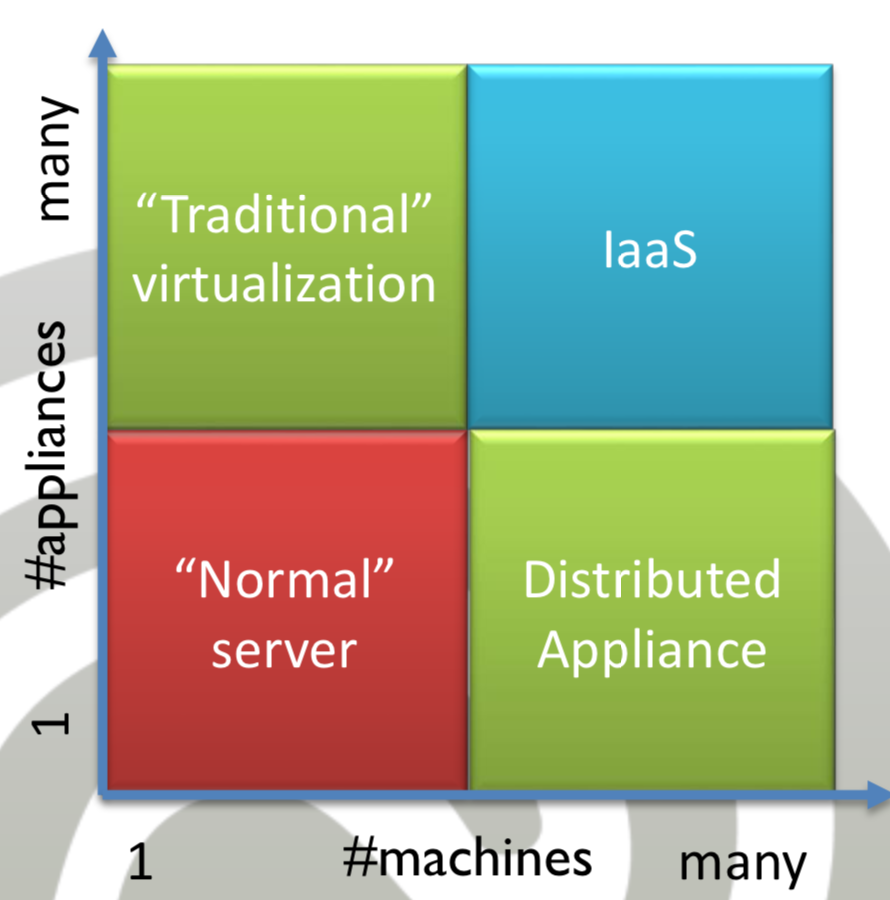
- Solution: Use Pods
Pods
- Deploy applications in Pods
- Pod: Group of machines that are tightly networked
- Pod runs copies of given virtual servers with application and OS installed
- Pods are responsible for disjoint part of workload
- Scatter pods across availability zones (data centers, physically separated)
- Important applications should have multiple copies per availability zone
- Example: GMail
- Load balancer assigns Pod for user session
- Pods stored in GFS
- Architectures (SAN, DAS, NAS)
- SAN Pod
- Servers have no own secondary storage
- Advantages
- Access to same data
- Disadvantage
- Expensive
- Higher latency than DAS
- DAS Pod
- Server has own set of hard drives
- Data from another server is difficult
- Advantage
- Cheap
- Low latency
- Disadvantage
- No shared data access
- Hard for live-migrate applications
- Use abstractions: GFS, HDFS, Amazon SimpleDB
- SAN Pod
Applications
- Amazon EC2
- Elastic compute cloud (public IaaS cloud)
- Customer can rent virtual server (pay by CPU usage)
- Virtual server can be configured
- Google AppEngine
- PaaS: Python or Java Runtime
- Host application directly on AppEngine
- Access resources to fixed maximum
- Amazon SimpleDB
- PaaS
- Simple table-centric database engine
- Similar to BigTable
- SalesForce
- SaaS customer-relationship-management (CRM) software
- Features:
- Customer database
- Call center
- Knowledge base
- Customer portal
Vector clocks
- Goal:
- Detect conflicts using version numbers without central authority
- Detect causality violations
- Generate partially ordered labels
- Formal
- \( N \) processes/nodes
- \( V_i\in \mathbb{N}^N \)
- Knowledge of process \( i \) about state of process \( j \): \( V_{i,j} \)
- Send message at \( i \)
- \( V_{i,i} = V_{i,i} + 1 \)
- Send complete timestamp with messages
- Receive message \( (m, V'_j) \) at \( i \)
- \( V_{i,i} = V_{i,i} + 1 \)
- \( V_{i,j} = \max(V_{i,j}, V'_{i,j}) \)
- Definition causally-related \( A\rightarrow B \)
- \( \forall 1 \leq i \leq n : A_i \leq B_i \land \exists k : A_k < B_k \)
- Definition concurrent \( A \parallel B \)
- \( \neg (A\rightarrow B) \land \neg (B\rightarrow A) \)
Big Data Trade-Offs
- Drawbacks Dynamo
- No guaranteed consistency
- No complex data model (key-value store)
- No transaction support
- Drawbacks BigTable
- No guaranteed consistency
- No complex query language
- No transaction support
- Main problems: Replica consistency + transaction support
- Common approaches for replica consistency
- Synchronous Master-Slave replication
- Asynchronous Master-Slave replication
- Optimistic replication
- Core problem: If a system crash happens in asynchronous replication, which state is correct?
- Master-Slave: Master is correct
- Optimistic: No global order
- Requirement: Consensus
- Solution: The Paxos Protocol
Synchronous Master-Slave replication
- Master has primary copy
- Mutations are pushed to slaves/replicas
- Acknowledge mutation iff slave mutated successfully
- Advantage
- Replica always consistent
- Disadvantage
- Not partition-tolerant
- No high availability
- Bad scalability
- Master Single Point of Failure
Asynchronous Master-Slave replication
- Master pushes mutation to at least one slave/replica
- Acknowledge mutation iff acknowledge by slave (wait for more to ensure consistency)
- Push mutations to other slaves (e.g., BigTable)
- Advantage
- Used for efficient transactions
- Disadvantage
- Dirty read possible
- Data loss/inconsistency possible
- Complex repair after master failure (consensus protocol)
Optimistic replication
- Homogeneous nodes
- Any node can mutate data
- Push to other replicas (e.g., Dynamo)
- Acknowledge with Quorum
- Advantage
- High availability
- Low latency
- Disadvantage
- Consistency problems
- No transaction protocol (order unknown)
Google hardware
- Details revealed in 2007/2009
- Servers:
- Custom-built
- Estimation 2007: One million servers
- Connections:
- Connected to each other
- Connected to internet hubs
- Rack: 40-80 commodity-class x86 PCs
- Outdated hardware
- Unstable / cheap
- Challenge: 100 % global uptime without data loss
- 7 % of all internet traffic generated by Google
- Annual operation costs (2007): 2.4 billion Dollar
CAP-Theorem
- Proposed by Brewer, proven by Gilbert/Lynch
- Limitation of the design space of highly-available systems
- Assumption: Highly-scalable distributed storage system with replication
- Consistency
- Consistency of replicas
- CAP consistency similar to ACID atomicity
- All nodes see the same data
- Availability
- Service is available and fully operational
- Always write, always read
- Partition-tolerance
- Fault-tolerance: No network failures (except total crash) causes incorrect responses
- Assumption: Short-term network partitions form frequently
- Definition Partition: Set of connected nodes
The theorem
- Assumption: Highly-scalable distributed storage system with replication
- Claim: It’s only possible to archive at most two of the three properties
- Degree is continuous (not binary)
- Usually consistency is dropped
- Drop only if partitions have formed
- Use partition recover algorithms
- Cases
- Drop availability (C + P)
- Synchronize all replicas (unscalable, e.g., DDBMS)
- No replication (no high availability, bad latency, unscalable, e.g., CDBMS)
- Drop consistency (A + P)
- Keep one replica in each partition
- Asynchronous messages for operations
- Eventual consistency (versioning conflicts)
- Example: Dynamo, BigTable, Cassandra
- Drop availability (C + P)
BASE paradigm
- Follows from CAP thereom
- Motivation
- Huge number of concurrent transactions
- ACID problem: Lock contention thrashing
- Sacrifice strict consistency
- BASE transaction paradigm
- Basic Availability (always available)
- Soft-state (allow inconsistencies)
- Eventual consistent
- ACID-BASE is continuum
- ACID: transactional consistency, scalability issue
- BASE: eventual consistency, high scalability
The PAXOS Protocol
- Problem:
- Reach consensus/data consistency for a value in distributed system that tolerate non-malicious failures
- Paxos
- Protocol family for solving consensus problem
- Network of unreliable processors (non-malicious)
- Byzantine Paxos: Malicious setting
- Use case
- Distributed log problem
- Replicate transaction log
- Use PAXOS to find consensus in log entries
- Example: https://angus.nyc/2012/paxos-by-example/
- Applications using PAXOS
- Google Megastore, 2011
- Google Chubby, 2006
- Petal (distributed storage), 1996
- Fragipani (scalable distributed FS), 1997
- Advantage
- Scalable (against belief it’d be unscalable)
Chosen value
- Choose value iff majority of acceptors accept value in accept-phase
- Abort decision
- Conflicting prepare-messages from proposers
- No majority/quorum
- Finally: Restart with higher number
- Learning the value
- Inform learners directly
- Inform proposer who broadcasts value to learners
Properties
- Guarantees:
- Safety
- Only consensus on value that is present in system
- Choose one value only at a time
- Only chosen values are learned (e.g., replicated)
- Liveness
- No deadlocking
- Eventually choose a value
- Each node learns about chosen value
- Safety
- Important properties
- Proposal number is unique
- Any two set of acceptors have at least one acceptor in common (ensure that no two proposals are accepted simultaneously)
- Value in accept-message sent from proposer in phase two is the highest-numbered proposals of all responses in phase one
Agents
- Independent from nodes
- Proposers
- Gets mutation request
- Starts voting (proposal)
- Coordinator
- Acceptors
- Vote on item
- Form multiple quorums (i.e., subset of acceptors)
- Quorums share at least one member
- Learners (replicate item)
Algorithm
- Prepare-phase
- Proposer sends prepare requests to acceptors
- Contain proposed value
- Contain proposal number \( n \) (monotonically increasing)
- Acceptor \( a \) receives prepare request
- Proposal number \( n \)
- If \( n \) is the highest number, promise to not accept any lower number
- If \( a \) has accepted a prepare-request with lower number, send old proposal number and value to proposer (only during phase 1)
- If \( n \) is lower than any previous accepted number, decline
- Proposer sends prepare requests to acceptors
- Accept-phase
- Proposer receives valid majority of promises
- If any acceptor accepted a different proposal with smaller number, use the majority of returned proposals
- If no previous proposals have been accepted, use own proposed value
- Send accept message with chosen value to acceptors
- Acceptor receives accept-message
- Accept only of not promise was made to accept a higher-numbered proposal
- Register value
- Send accept-message to learners/proposer
- Proposer receives valid majority of promises
Amazon Dynamo
Amazon Infrastructure
- Service-oriented architecture
- Each functionality encapsulated in a service (e.g., shopping cart, catalog, render)
- Service level agreement
- Description of each service (e.g., input, output)
- Quality guarantees (e.g., maximum latency, response time)
- 99.9 % of users must have an internal page render below 300 ms
- Service: stateful/stateless
- Amazon company
- 6 million sales per day
- Globally accessible/operating
- Highly scalable
- Services must be always available
- Insight: RDBMS unsuitable
General
- Low-level distributed storage system
- Requirements
- Strict 99.9 % latency
- Always writeable
- User-perceived consistency (due to sloppy quorum)
- Low cost (use commodity hardware)
- Scalability (incrementally add nodes)
- Tunable (tune trade-offs between costs, latency, consistency, conflict resolution strategy)
- Design
- Key-value-store (sufficient, no complex data model)
- Nodes are non-malicious (trusted environment)
- Nodes are altruistic (no personal agenda, e.g. not like peers in BitTorrent)
- Dynamo cluster can be created by every service
- Advantages
- Highly available
- Guaranteed low latencies
- Incrementally scalable
- Dynamic tuning
- Disadvantages
- No infinite scaling (fully meshed ring)
- No real OLTP support (high load vs. inconsistencies)
- Application must provide conflict resolution strategies
Implementation
- Similar to CHORD
- Topology: Ring
- Hash-based primary horizontal partitioning
- Hash function
- Hash nodes + data
- MD5 (128 bit)
- Assumptions
- Nodes don’t join/leave
- Ring stays manageable (~ 10000 nodes)
- Responsibility
- Anti-clockwise arc
- Load balancing
- Virtual servers
- Transfer completely
- Scheme: Many-to-many (central controller)
- Durability
- Replication
- Each item has a coordinator
- Replicas on nodes from the preference list (e.g., the successor list)
- Multiple nodes per virtual server
- Advantages
- Flexible storage
- Balanced storage
- Durable storage
Routing
- Full finger table
- Fully connected ring
- Routing complexity \( O(1) \)
- Asynchronous propagation after write
- Usually one Dynamo node per session
- Dynamo node selection
- Generic load balancer (simple)
- Client (partition-aware library, more complex, less communication)
Request execution
- Route to coordinator
- Use first \( N-1 \) healthy nodes from preference list
- Quorums (\( R+W>N \))
- \( (3,2,2) \): Consistent durable, interactive user state
- \( (n,1,n) \): High performance read engine
- \( (1,1,1) \): Distributed web cache (not durable, not consistent, very high performance)
- Read operation
- After \( R-1 \) responses, forward to user (only send unique results)
- Client handles conflict resolution
- If versions are causally-related, Dynamo can resolve the conflict (last-write-wins)
- Write operation
- Coordinator writes locally
- Buffering possible (trade-off durability and performance)
- Sloppy quorum (consider only healthy nodes)
- Successful write if \( W-1 \) nodes confirm
Conflicts and consistency
- Partition Mode
- Branches may evolve
- Use version numbers on items (vector clocks)
- Causes for multiple version numbers:
- No failure: Update in progress
- Failure: Ring partitioned/massive failures
- Conflict detection:
- During client read/replication/anti-entropy protocol
- Quorum
- Anti-entropy protocol (detect inconsistent item)
- Conflict resolution:
- Use vector clocks
- Start after conflict detection (handled by application or Dynamo if desired)
- Strategies (application-dependent):
- Last-write-wins (discard older branches)
- Merging
Anti-entropy protocol
- Conflict detection
- Based on Merkle trees
- Execution time:
- Node re-joins the network after a failure, check if virtual server is consistent
- Merkle tree
- Used for integrity checking large files
- Idea:
- Leaf nodes are hashes of data blocks
- Inner nodes are hashes of concatenation of leafs
- Advantage: Parallel execution
- Node has Merkle tree per virtual server
- Exchange Merkle roots to check consistency
- Inconsistency detected: Recursively check tree
- Complexity
- Merkle tree: \( O_{worst}(N), O_{avg}(\log n) \)
- Hash list: \( O_{worst}(N), O_{avg}(N) \)
Versioning
- Use vector clock for versioning
- No global system time
- Each node has
- Logical clock (initially zero)
- Global clock (small copy, clock from all reladed nodes)
- Data item tagged with vector clock
- Vector length
- Dynamic (only the number of writing nodes)
- Maximum: Ten entries (rarely more than ten are needed)
Google File System
- Distributed file system
- Runs on standard POSIX-compliant linux file systems
- Design and requirements
- Run on commodity hardware
- Handle large files (100 MB - 10 GB)
- Optimize for append-operations
- Optimize bandwidth (not latency)
- Simple & extendible API
- Guarantees
- Atomic namespace mutation (using locks, log must be flushed to disk)
- Relaxed consistency model for data mutations (chunks should be consistent and defined)
Operations
- Append operations
- Most files: WORM
- Map Reduce: Naturally append
- GFS optimized for append-operations
- Perform in parallel
- Problem: Append-data too big for chunk
- e.g., webcrawlers
- Ratio append-to-write: \( 8:1 \)
- Write operations
- Provide exact range
- Problem: Collisions with other clients (locks could solve the problem)
- Read operations
- Sequential streams (large data, caching is useless)
- Random reads (small data)
Architecture & Implementation
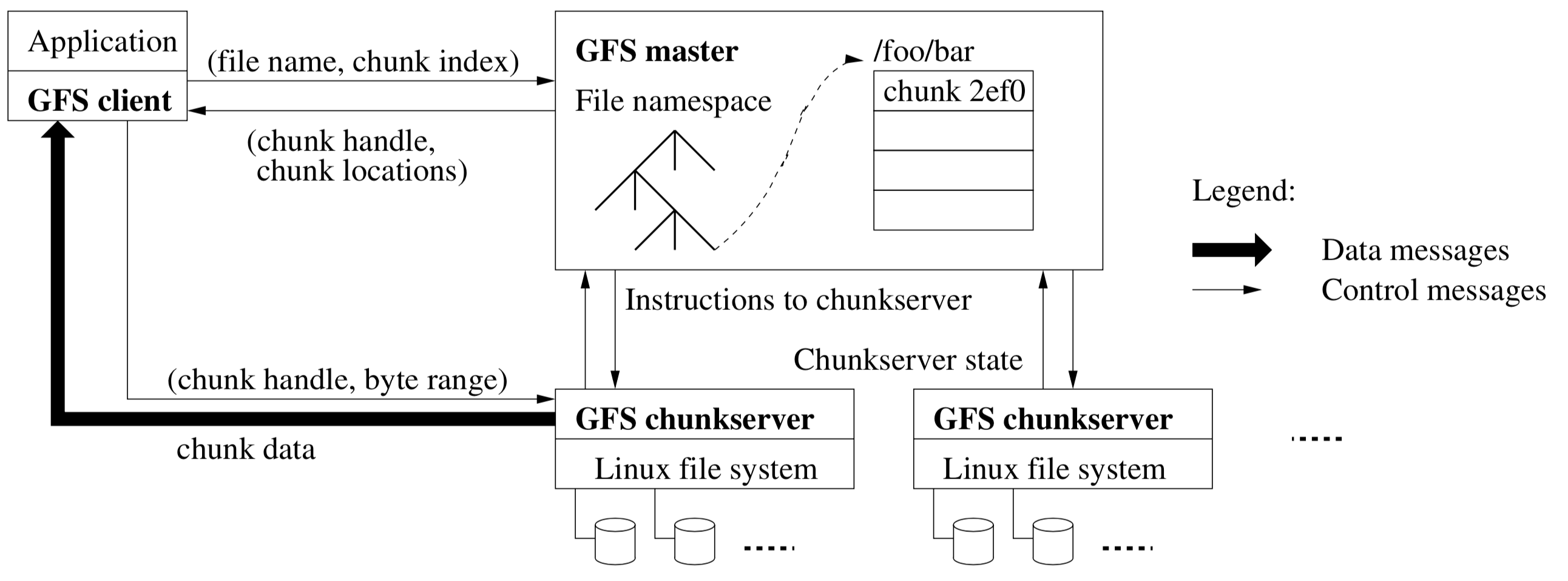
- GFS Cluster
- Represents single file system
- Single master server
- Multiple chunk servers
- Types of operations
- Control flow
- Data flow
- Why?
- Optimize bandwidth (assume nearest replica has highest bandwidth
- Lighten load of master server
- File System API
- Flat file name space (no directories)
- Not POSIX-compatible
Files
- Split into fixed-sized chunks (like FS-blocks)
- Replication: Three times
- Metadata
- Namespace
- Access control information
- File-chunk-mapping
- Chunk location (with replicas)
- Chunk version numbers
Chunks
- Size: 64 MB
- 64-bit unique global ID
- 64 Byte metadata
- Stored at chunk server
- Definition consistent chunk
- All clients see the same data
- Definition defined chunk
- All modification are visible
- Advantages
- Less requests
- Less network overhead
- Less metadata
- Easy caching of metadata
- Disadvantages
- Possibility for hot spots
- Increased risk for fragmentation
Master server
- Single server
- Important: Low load on master (no bottleneck)
- Maintain file metadata
- In main memory
- Use soft-states
- Use Heartbeat-messages to chunk servers to keep metadata up to date (append leases, see below)
- Tasks
- Load balancing
- Migrate chunks to other chunk servers
- Replication (three times)
- Queries
- Return chunk location
- Return chunk locations following the requested
- Chunk deletion
- Delete metadata (chunk becomes stale)
- Chunk becomes stale if chunk server fails an update
- Garbage collection (physically delete stale chunks)
- Chunk creation
- Chunk allocation (Heuristic-based)
- Servers with below-average disk space utilization
- Limit the creation per time on chunk server
- Spread across racks (physical)
- Load balancing
- Fault tolerance
- Operation log
- Log modifications to metadata (not frequent)
- Log is replicated
- Checkpoints for fast recovery (timeline)
- Recovery: Shadow master + hot-standby (can be used to answer read queries)
- Operation log
- Leases
- Master grants lease for each chunk
- Chunk server with lease is primary chunk server
- Lease lasts one minute (append to heartbeat-message)
Chunk server
- Multiple chunk servers per master
- Contain chunk data
- Primary chunk server
- Receive lease from master for a certain chunk
- Responsible for mutation operations
- Request lease extension (in case of chunk mutation)
Workflow for mutation operations
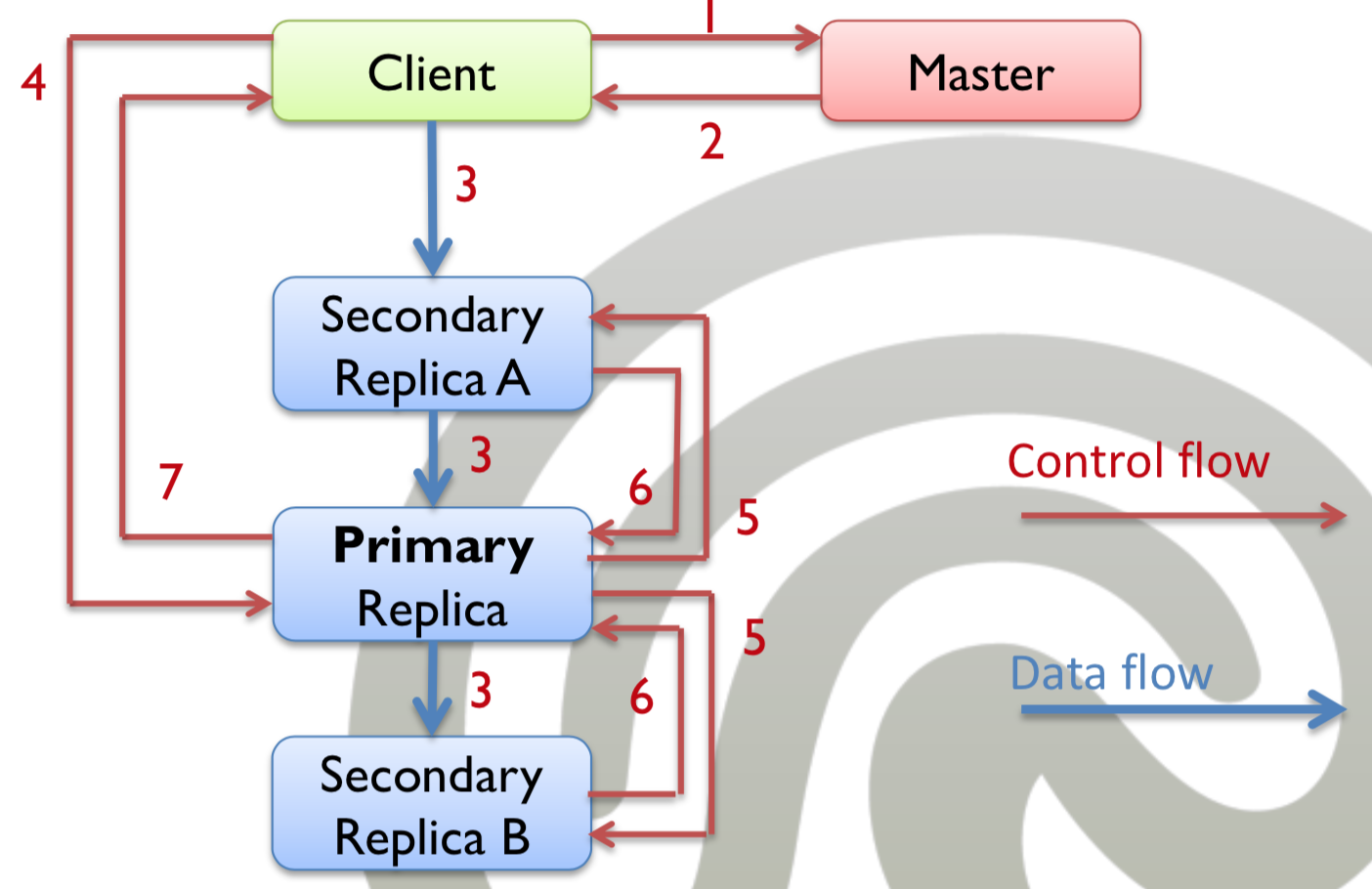
- Client sends write request to master
- Client knows chunk size
- Client splits file into chunks
- Message: (filename, chunk index)
- Master sends chunk handle + replica locations (primary, secondary)
- Client sends data to best replica
- Best replica: e.g., clostest, highest bandwidth
- Message: Payload + address range
- Data stored in internal buffer (not written to disk)
- Serially pipeline data to all replicas
- Client sends write request to primary chunk server
- Primary writes data atomically to disk
- Primary determines serial order for data fragments
- Primary sends write request to secondary replicas
- Secondary replicas write in same order as primary
- Inconsistent replicas for a short time
- Secondary replicas notify primary replica
- Primary notifies the client
- Errors are reported to the client
- Resolving error: Retry failed steps
- Chunks may become inconsistent
Google BigTable
- Challenges
- Store (semi-)structured data (URLs, geographic data)
- Data is large scale
- High-performance NoSQL cluster-level structured storage system
- Requirements
- Continuous + asynchronous updates/processing
- High read/write rates
- Effective scanning
- Scalability (incremental scaling)
- Self-managing (auto load balancing)
- Fault tolerance
- Persistence (handled by GFS)
- Cheap hardware
- Environment
- GFS (distributed fail-safe file system)
- Chubby (distributed lock manager, bootstrapping)
- MapReduce (programming model, parallel computing)
- Drawbacks
- Single table data model (no joins, no foreign keys, no constraints)
- No complex query language (scan, direct key access)
- Applications using BigTable
- Google Analytics
- Google Earth (row: geographic segment, column family: source)
- Google Maps
- Personalized Search (row: user ID, column family: action type)
- Open-source BigTable clone: Hbase (Apache Hadoop project)
Data Model
- Focus on appends
- Specialized to GFS
- Rows are frequently added, not updated
- Row update: Row append with new timestamp
- Multi-dimensional sparse map
- Cell: (row name, col name, timestamp)
Rows
- Unique name (string)
- Row access is atomic
- Lexicographically ordered (similar rows are in nearby fragment)
- Rows are not split
Columns
- Two level name structure
- Family name + qualifier name
- Column family (same datatype, part of schema, ~100)
- Individual columns possible (flexible data model)
Timestamps
- 64 bit integer
- Used for versioning
- Update to cell creates new version with current timestamp
- Versioning options:
- Keep \( n \) copies
- Keep version with max. age \( x \)
API
- Simple (Python, C++)
- No complex query language
- Features
- Create/delete tables/column families
- Modify metadata
- Modify access control rights
- Single-row transactions (no multi-row transactions)
- Look up
- Iterate over subset of rows
Tablet
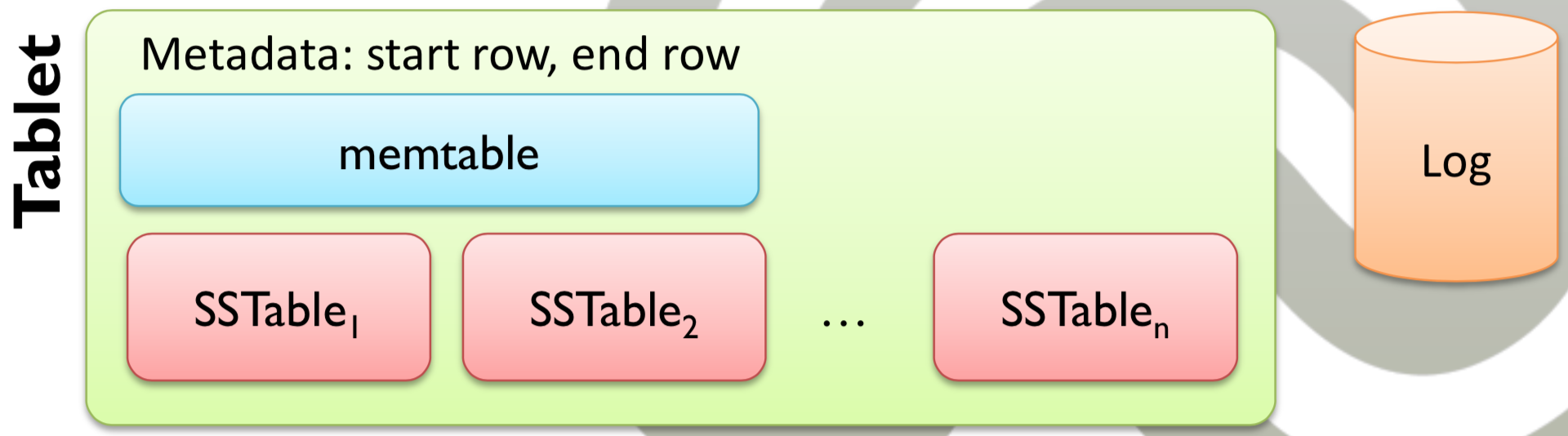
- Fragment of a table
- Contain contiguous range of rows (locality)
- Tablet contains full rows (never split rows)
- Disjoint
- Size: 1 GB (multiple GFS chunks)
- Base unit for load balancing/partitioning
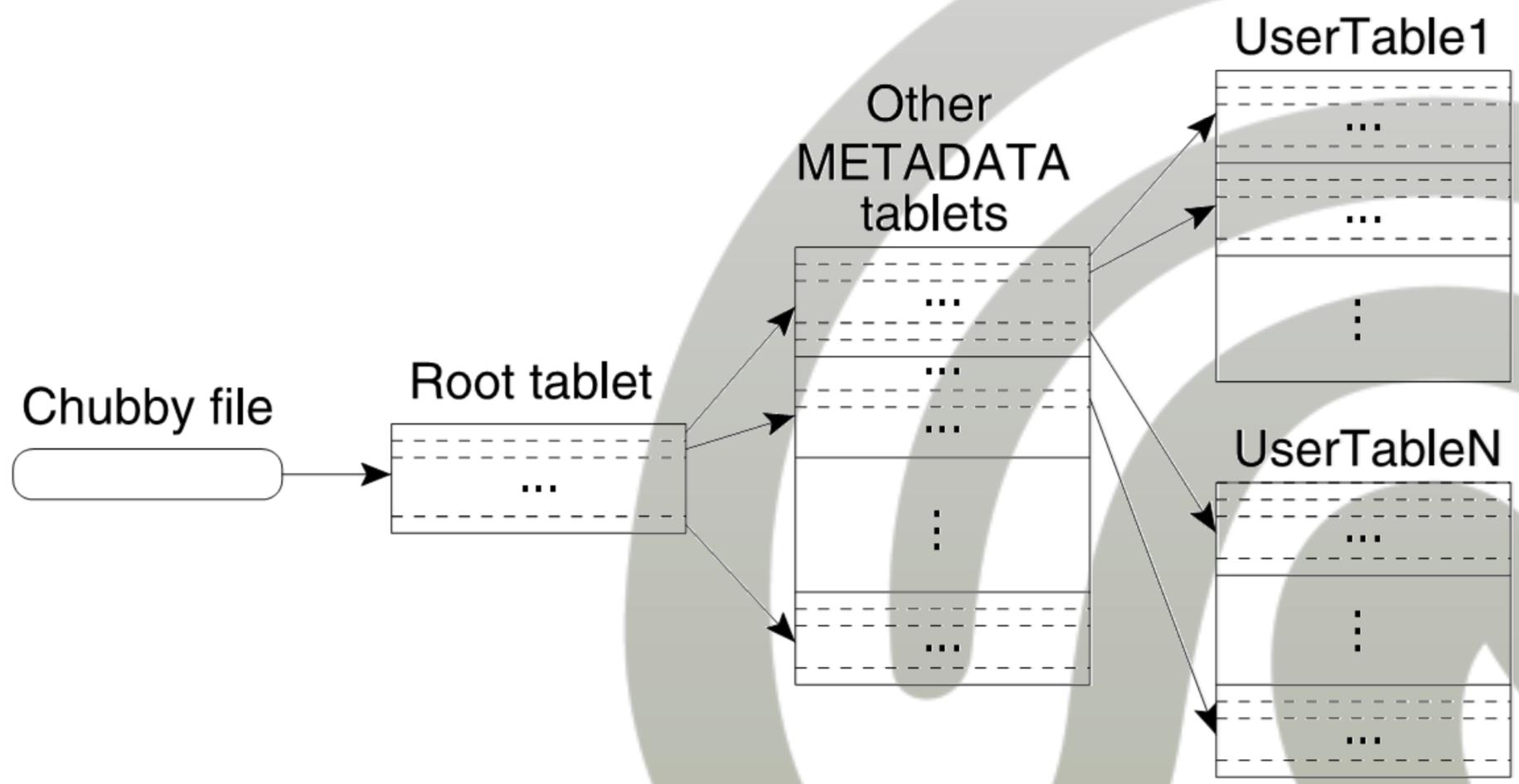
- Distributed tablet index (3-tier hierarchy)
- Chubby file
- Entrypoint (persistent, indestructible)
- Point to tablet server with root tablet
- Root tablet
- Chubby file
- Entrypoint
- Never split
- Link to metadata tablets
- Store name range of metadata tablet
- Metadata tablets
- Index file
- Store name range of data tablet
- Links to data tablets
- Data tablet (tablet containing the data)
- Chubby file
Implementation of tablets
- Assigned to exactly one tablet server
- Components
- Memtable
- Log
- Multiple Sorted String Table (SSTable)
- Important aspects
- Bloom filters
- Minor compaction
- Major compaction
- Optimizations
Bloom filter
- Space-efficient data structure to probabilistically test set membership
- Idea:
- Bit array with length \( N \)
- Use \( k \) different hash functions \( h_1, ..., h_k \)
- Insertion of \( x \)
- Hash each element with all \( k \) hash function
- Mark the buckets \( h_1(x), ..., h_k(x) \) with \( 1 \)
- Test membership of \( x \)
- Hash each element
- If one bucket contains is \( 0 \): No membership
- If all buckets are \( 1 \): Possible membership
Memtable
- All writes performed on memtable
- Stored in main memory (volatile)
- Sorted lexicographically
Log
- Persistent append-only
- Log for all write operations
- Shared with all tablets of tablet server
- Stored in GFS (persistent)
Sorted string table
- Immutable ordered maps (easy traversing)
- Contains tablet data (key-value pairs)
- Keys: (row, column, timestamp)
- Value: Payload
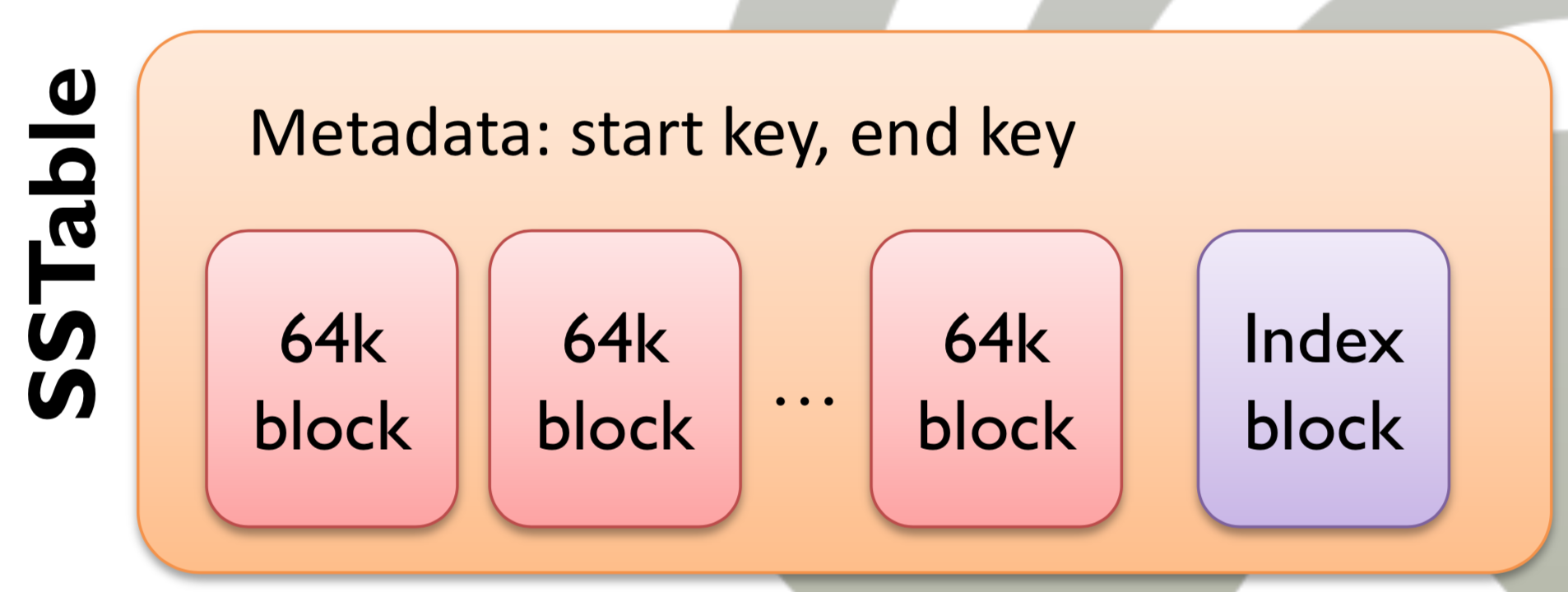
- Stored in GFS (exactly one chunk)
- Defined start/end key
- SSTable ranges may overlap
- No consistency problems (immutable, no locks)
- SSTable can only be deleted completely (during compaction)
- Structure
- Multiple blocks of data (64 KB disk block, ordered map)
- Single index block (mapping: key ranges to block number)
- Metadata: Start key, end key
- Major compaction
- Perform periodically
- Background maintenance
- Compact the overlapping SSTables and memtable into non-overlapping SSTables
- Delete records which are marked for deletion
- Advantage: Increase performance (less merging, less accesses)
Write operation
- Goal: Ensure atomicity
- Control flow
- Check permissions (done with Chubby)
- Generate log record
- Content inserted into memtable (copy-on-write)
- Case: Memtable reaches threshold (64 KB)
- Freeze current memtable
- Create new memtable
- Serialize memtable to disk (minor compaction, overlapping SSTables)
- Commit to log
Read operation
- Control flow
- Receive key/key range
- Check permissions (done with Chubby)
- Find blocks with matching range (using index block and key range)
- Merge blocks into unified view
- Efficiently
- Use merge-sort
- SSTable is sorted
- Binary search on merged view
- Problem: Access blocks even if queried rows are not present
- Goal: Minimize physical access
- Solution: Bloom filter (efficient in-memory technique to check if tuple is in SSTable)
Delete operation
- Mark row as deleted
- Rows are deleted in major compaction
Optimizations
- Locality groups
- Group related columns together (same/close SSTable)
- Semantic knowledge (manually by developers)
- Example: PageRank, WebCrawler
- Use for compression (see below)
- Compression
- Most data easy-compressible (e.g., HTML)
- Compress SSTable blocks individually
- Locality group compression (e.g., two pages share components)
- Two-pass frequent term compression
Architecture
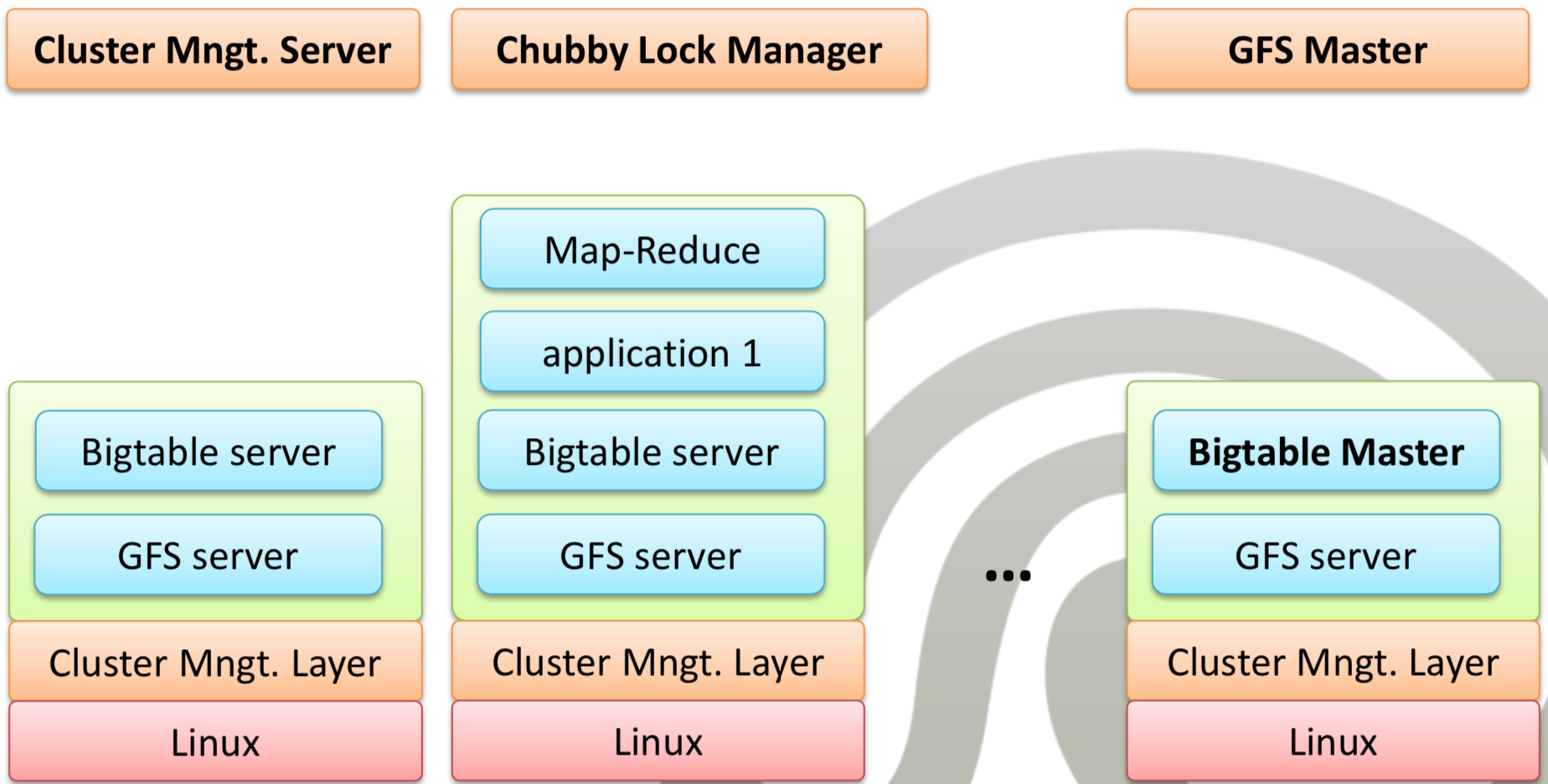
- Runs on standard Google server nodes
- Server runs multiple services
- Application
- Map and reduce worker
- GFS chunk server instance
- Bigtable server
- Bigtable cluster/cell
- Single master server
- Multiple tablet server
- GFS cluster (GFS master + Chunk server)
- Chubby Lock Manager
- Cluster Management server
Master server
- Never contacted by client
- Tasks
- Control/maintain tablet server
- Assign/merge/split tablets
- Add/remove servers
- Garbage collection
- Load balancing
- Schema maintenance
- Monitor unassigned tablets (check metadata tablet)
- Detection of tablet server arrival
- Monitor directory with tablet server lock files
- Contact new servers
- Detection of tablet server departure
- Periodically obtain lock files of tablet servers
- Lock is lost -> Node departed
- Re-assign tablets
- Restore membtable with logs (start with last minor compaction)
- Delete tablet server lock file
- Chubby file of master
- Identification for master server
- Periodically re-aquire master lock
- If lock is granted to another master, master kills itself
- If lock is freed, master has failed
- Master server arrival
- Load tablet assignment from root table
- Check all tablet servers
Tablet server
- Maintain multiple tablets (10-1000)
- Load all tablets into memory
- Clients know responsible tablet server
- Failure: Each other node must take one tablet
- Tablet server should be GFS primary replica
- Tablet server runs GFS server
- Tablet server requests the GFS lease for each tablet file
- Advantage: Directly write to local disk
- Node arrival
- Register with Chubby
- Create ID file
- Request volatile lock for ID file
- Periodically re-aquire lock
- Master monitors directory with ID files
- Register with Chubby
- Node departure
- ID file/lock expires
- Noticed by master
Google Megastore
- History
- Designed for Google AppEngine
- Developer’s requirements
- Classic DB features (schema, indexes, joins, transactions)
- Google infrastructure (high scalability, BigTable, GFS)
- Idea:
- High availability
- Scalability
- ACID semantics
- Low latency
- Keep read-modify-write-idiom
- Architecture:
- Based on BigTable/Chubby
- Mix scalability with ACID
- Synchronous replication using Paxos
- Per-replica NoSQL datastore for log file
- Megastore is geo-scale structured database
- Features
- Schemas (semi-relational tables)
- ACID transactions (within entity groups, sloppy consistency spanning multiple entity groups)
- Indexes
- Log replication (Paxos)
- Synchronous replication across data-centers (Paxos)
- Drawbacks
- Limited scalability
- No powerful query language
- Manual partitioning
Schema
Structure
- Schema has set of tables
- Table has set of entities
- Entity has set of strongly typed properties
- Required / optional / multi-valued
- Options for tables
- Entity group root table
- Entity group child table (single foreign key to root table)
- Entity group: Root entity with related child tables (forms a fragment)
- Support for multiple root tables (result in multiple entity group classes)
Mapping to BigTable
- Entity mapped to BigTable row (primary keys for locality)
- Entity groups are stored consecutively
- BigTable column: Megastore table name + Megastore column name
IN TABLE x: Store Megastore table in BigTable tablex
Index levels
- Local index
- For each entity group
- Stored in group
- Updated consistently/atomically)
- Global index
- Across all entity groups
- No guarantee for consistency
- Consistent update (?)
- Requires latching (index locking, expensive)
Transactions
- Goal:
- Geo-replication (across/within data centers)
- Shard data by user location (locality)
- Within data center all nodes are equal (better performance/availability)
- Replication
- Data center closest to user is the master datacenter
- Transaction management in master datacenter
- Push changes to replication server
- Replicate each entity group independently
- Synchronous across data centers
- Use low-latency Paxos (Variation of Paxos)
- Each entity group has own write-ahead log
- ACID
- Assumption: Entity group is mini-database (most operations performed on entity group, e.g., Users)
- Serializable ACID within entity group (stronger than strict consistency)
- Loose ACID across entity groups
- Write-operation: Single-roundtrip in data center
- Read-operation: Single-roundtrip pass in data center
- Use MCVV-protocol
- MultiVersion Concurrency Control
- Increase concurrency (read old while work on newer versions)
- Use timestamps (works because handling in one data center)
- Write new version (timestamp) instead of updating
- Used by BigTable, SAP HANA, PostgreSQL
- Transactions:
- Multiversion two-phase-commit
- Multiversion timestamp ordering
- Read-operation: Select correct value (depends on application)
- Read consistency (Three levels)
- Current (wait until all writes committed, using WAL)
- Snapshot (read last committed value)
- Inconsistent (read from nearest node, dirty read possible)
- Write consistency
- Get timestamp and log position of last committed transaction (current read)
- Determine next available log position
- Create log entry with the new value to write
- Use Paxos for consensus of appending the new log entry (proposal number = timestamp)
- Write to BigTable (learner)
- Mutation within entity group: Sync (2PC)
- Mutation across entity groups: Queues (async) or 2PC
Google Spanner
- Highly available global-scale distributed database
- Architecture
- Software stack
- Directories
- Data model
- TrueTime
- Features
- Schema (semi-relational data model)
- SQL-like query language
- Global timestamps (TrueTime API)
Architecture
- Backend: Colossus (successor of GFS)
- Two levels of servers:
- Universe: Spanner deployment (universemaster)
- Zones: Units of physical isolation
- Cell: \( (key, timestamp) \rightarrow string \)
- Spanserver:
- Part of Zone, similar to BigTable master
- For each tablet: Paxos state machine
- Paxos Group: Set of replicas
Data model
- Directory
- Unit of data placement
- Set of contiguous keys sharing a prefix
- Same replication settings
- Can be sharded
INTERLEAVE IN PARENT: Store foreign key members after the foreign key owner
TrueTime
- Distributed globally synchronized time
- Based on GPS + atomic clocks
- TrueTime API
now(): TTInterval(contains absolute time of invocation)after(t: TTInterval): booleanbefore(t: TTInterval): boolean- Time uncertainty below 6 ms
- Datacenter
- Majority: Time master with GPS antenna
- Minority: Time master with atomic clock
- Time daemon periodically (30 s) updates time
- Query time master (nearby and far-away data centers)
- Reach consensus
- Time uncertainty \( e \): Increasing after a synchronization
- Advantage: Globally meaningful commit timestamps (if A happened before B: \( ts(A)<ts(B) \))
Google Map & Reduce
- Why?
- Large-scale data processing
- Computation cluster
- Features
- Automatic parallelization/distribution
- Fault tolerance
- I/O scheduling
- Monitoring/status update
- Google use case:
- Web crawling (build index, compute PageRank)
- Idea:
- Large amount input data (key-value-pairs)
- Split processing into map- and reduce-task
- Software clones
- Pig (Yahoo)
- HBase
- HIVE (Facebook)
- Dryad (Microsoft)
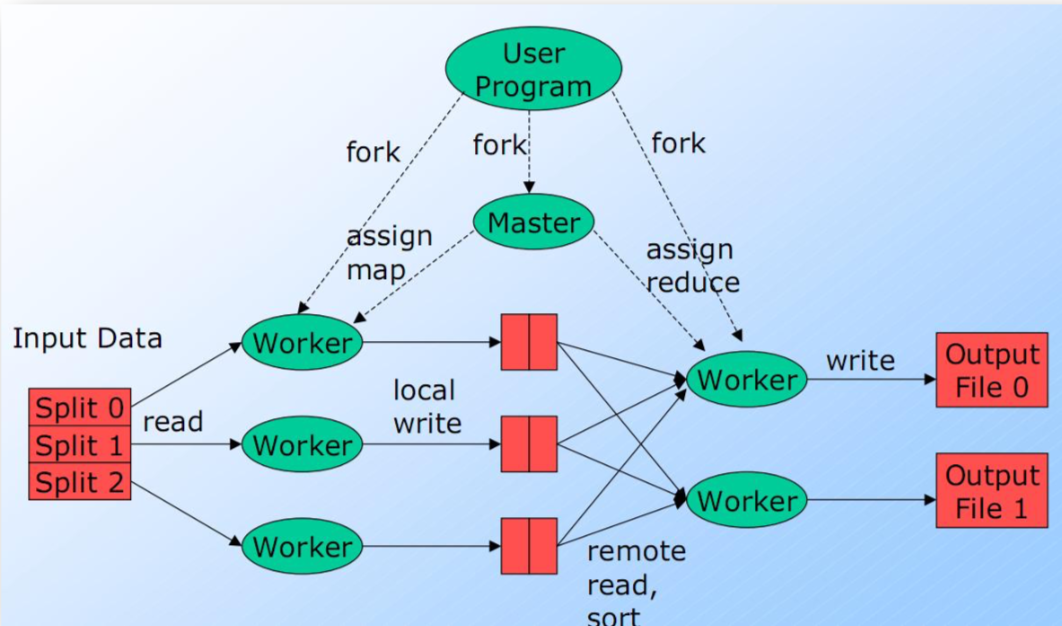
Map operation
- Input: Key-value-pair
- Output: Set of intermediate key-value-pairs (could be another key than input)
- Execute on single node (easily parallelize)
- Central controller distributes job
Reduce operation
- Input: Intermediate key-values-pair
- Output: Final output (usually one tuple)
- Run on set of intermediate map results (with same key)
- Optimization: Sort/group map output data (equal keys are contiguous)
- Improvement: Combiner
- Mini-reducer
- Run in-memory after map-phase
- Use group rare map keys into larger groups (e.g., others)
- Goal: Reduce network traffic/overhead
Master server
- Assign map/reduce tasks to workers
- Assign map-tasks in batches (called split) (reduce communication/latency)
- Split implemented with hash function (distribution)
- Assign split to worker (start map-task for each key-value-pair)
- Check for node failure
- Worker
- Periodic heartbeats
- Solution: Re-execution (re-execute complete split, re-execute reduce tasks)
- Robust (no problem)
- Master
- No solution
- Worker
- Check for task completion
- Route map-results to reduce-tasks
Example: Google PageRank
- Assign importance weight to websites
- Page linking to another page votes/gives credits
- \( PR(x) = \sum_{i=1}^N \frac{PR(t_i)}{deg^+(t_i)} \)
- Algorithm
- Randomize PageRanks for each site
- Iterate and distribute page ranks
- Algorithm converges
- Using Map and Reduce:
- Map: Distribute credit to link targets (intermediate key: URL, value: credit portion)
- Reduce: Sum up credits
- Repeat
Example: Pig
- Engine for executing programs for Hadoop
- Motivation
- Pig Latin: Language (extremely few lines)
- Data model
- Atoms: Integer, string
- Tuple: Sequence (any type)
- Bag: Collection of tuples (not same type, not unique)
- Map: String-Any-map
Example: Apache Spark
- Open-source processing framework
- Motivation:
- MapReduce a lot of I/O (slow)
- Keep data into main-memory
- 100x faster than disk
- Resilient distributed database (in-memory or disk)
- Operations
- Transformations (sorting, grouping)
- Actions (count, collect)
- More operations than Map and reduce
- More programming environments (Scala, R, Python, Java)