Query processing
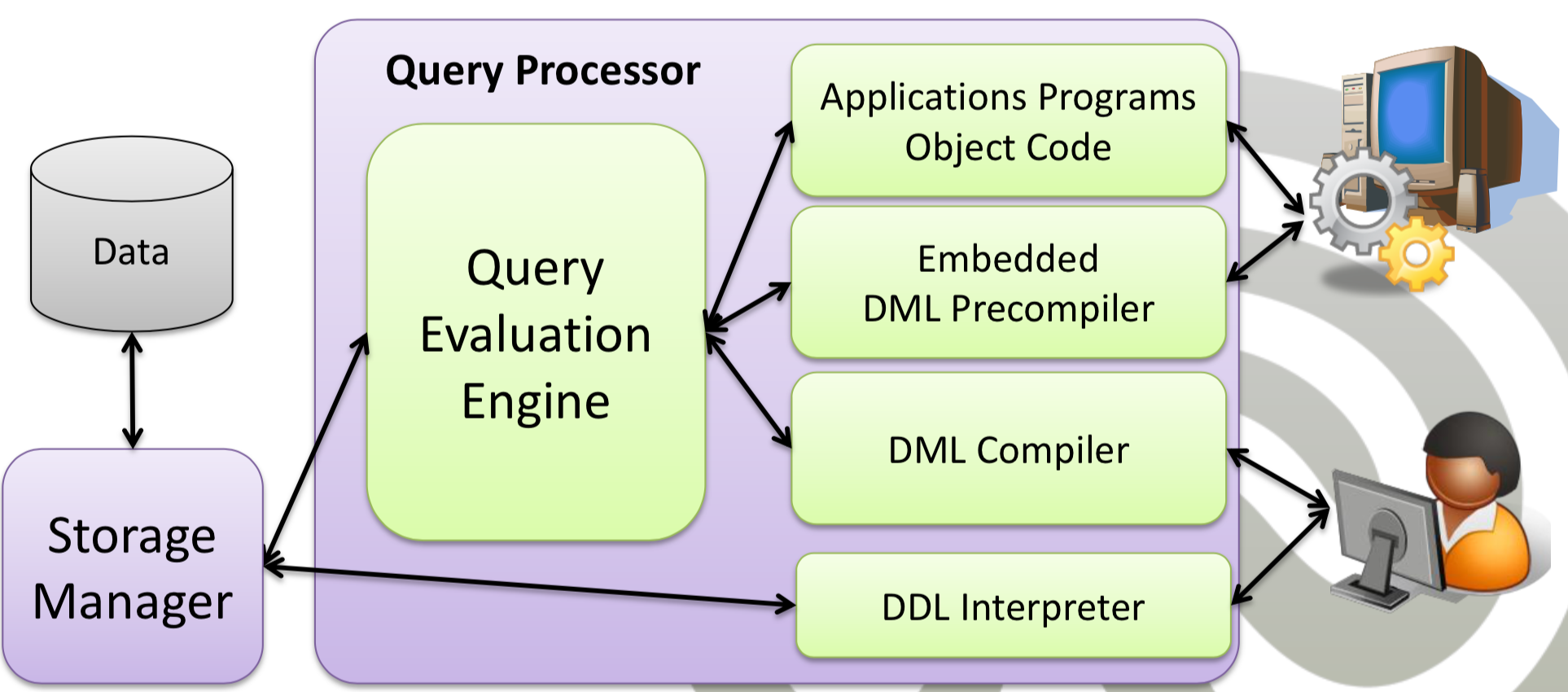
Query Processor
- Query: Declarative DB language (Mapping to RA)
- Evaluation: Translate to execution plan (physical level)
- Physical relational algebra: Extend with primitives for internal structures
Query Parser
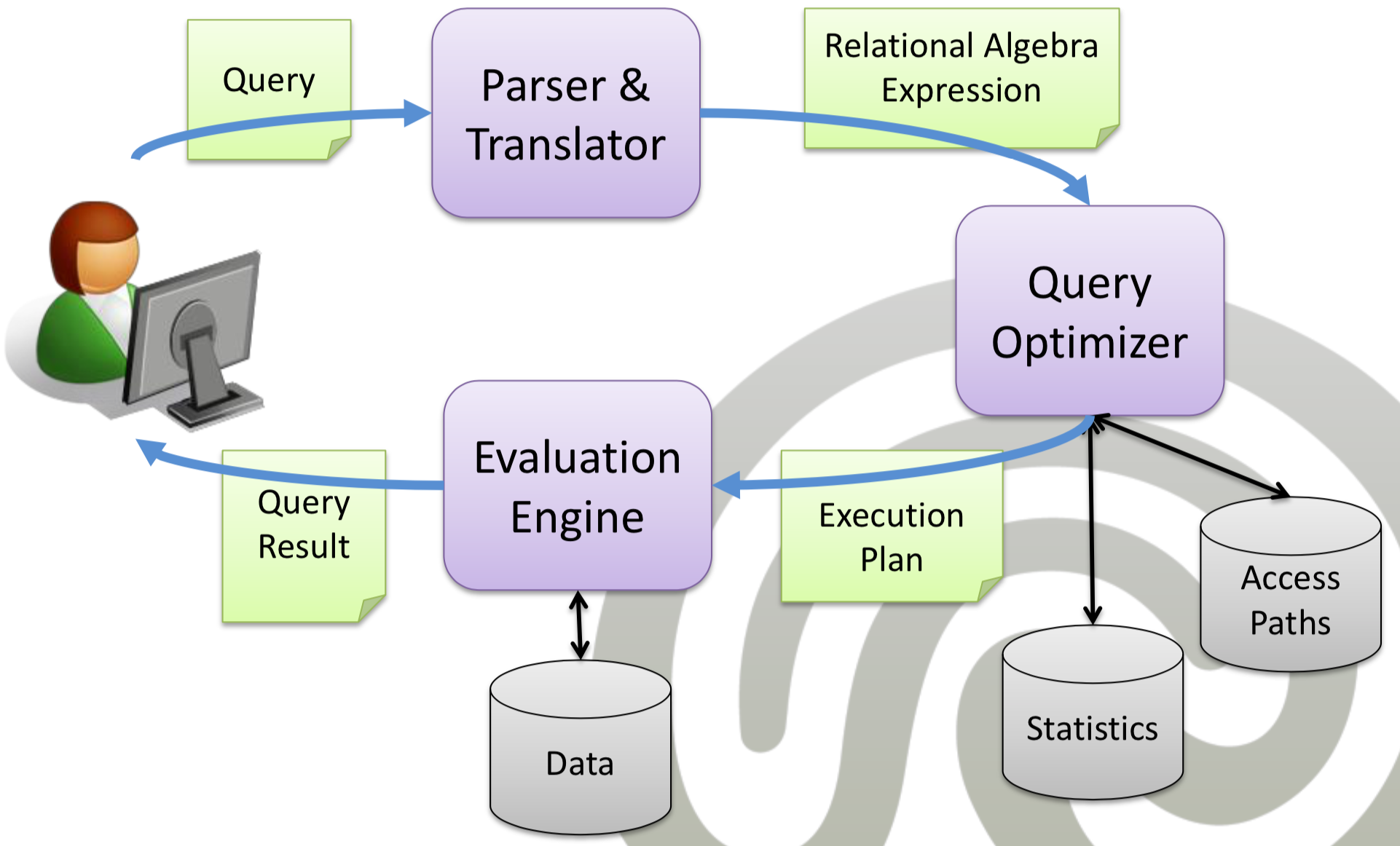
- Translator:
- Translate to internal form (query is declarative)
- Scanner:
- Tokenize query (DB language keywords, table/attribute names)
- Parser:
- Check syntax
- Verify relations
- Attributes
- Data types
- Translation to RA to evaluate query
- RA allows symbolic calculation
- Evaluation primitives: Annotate operators with execution algorithms
Query Translator (cf. VL 06)
- Translation query to RA
- Decomposition into query blocks (1 SELECT, 1 FROM, at most 1 where, group by, having)
- No nesting (optimize subqueries independently -> parallel)
- Query normalization (WHERE in conjunctive normal form)
- RA allows symbolic calculation
- Result: Operator Tree
- Leafs: Relations
- Internal nodes: Operators
Operator execution (cf. VL 06)
- Algebraic operator abstraction of algorithm (=> eval. primitive)
- Operator writes result into temp. table
- Intermediate result can be large
- Materialization expensive
- Evaluation primitives
- Tuple scan
- Tuple selection
- Index scan
- Various join operators (nested loop, block nested loop, index nested loop, merge, hash)
- Sort operator
- Duplicate elimination operator
Relational Algebra
- Edgar Codd in 1970
- Lead to SQL
- Important for Query optimization (undecidability of equivalence)
- Operators: Selection, Projection, Cartesian Product, Set Union, Set Difference, Rename
- Important: Union-compatibility
- Joins: Theta Join <- Equijoin <- Natural join
Query Execution
- Task: Evaluate operator tree
- Challenge: Each operator different algorithms
- Evaluation plan: Annotated with evaluation strategy
- Operator cost: Total elapsed time (disk access, CPU time (often ignored), network)
- Disk access
- #Seeks * avg. seek cost
- #Block reads * avg. block read cost
- #Block writes * avg. block write cost (higher because of reading for verification)
- Operator result: temporary file (expensive but sometimes necessary)
- Usually: Algorithms for sequences of operations (joins, dynamic algorithms)
Select operator
- Primitives:
- Relation scan
- Index scan
- Relation scan with comparison
- Complex selections
Relation scan
- Linear search
- Fetch all pages —> scan each record
- Cost: #Pages with records (0.5 * #Pages for PK)
- Binary Search (ordered attribute, equality select)
- Assumption: Continuously stored
- Fetch median page for start
- Cost estimate: \( \log_2(\text{\#pages with records}) \) (cost for first tuple)
Index scan
- Selection condition on search key
- Equality selection on primary index:
- Height of tree / 1 for hash index
- Equality selection on cluster index:
- Height of tree / 1 for hash index + #pages overflow list
- Equality selection on secondary index:
- Not stored continuously
- Cost unique attribute: Height of tree / 1 for hash index
- Cost non-unique attribute: Height of tree / 1 for hash index * #Records
Comparison scan
- Simple scan/binary search
- Primary index available
- \( > \): Find first and scan rest of relation
- \( < \): Scan relation until found
- Secondary index available
- \( > \): First first value and scan rest of index (find pointers)
- \( < \): Find pointers until value found
- EVERY records must be fetched
- Linear scan can be cheaper
Complex selection
- Use of junctors: AND, OR, NOT
- Combination of simpler selections
- Conjunction: Start with smallest selectivity
- Disjunction: Only fetch blocks once
- Negation: Linear scan necessary
Sorting
- Why?
- ORDER BY
- Increase performance for more complex algorithms
- Secondary index on sort key
- Read in-order
- Inefficient
- Relation in main memory: No problem -> Quicksort
- Relation too big -> External sorting
- Solution: Merge-Sort / n-ary sort
- Divide relation into runs, sort each run, write run to disk
- Read runs -> integrate to result
Projection operator
- Projection on each tuple
- Complete relation scan (relations horizontally split, row storage)
- Duplicate elimination for non-unique fields
- Sorting -> Identical records adjacent
- Merge-Sort: Eliminate duplicates in runs
Set operations
- First sort relations
- Scan relations
- Create result
- Union: return just one record
- Intersection: Only records in both
- Difference: Retain only records that are absent in other relation
- Cost: #Pages first + #Pages second + Sorting cost (if necessary)
- Alternative implementation:
- Partition using hash function
- Build in-memory hash index
- Scan first partition, use hash index to find record
Join operators
- Special type cartesian product
- Two relations
- Only record with counterpart in other relation is in result set
- Size estimation: Selectivity of condition, overlap of distinct values
- Implementations
- Nested loop join
- Block nested loop join
- Index nested loop join
- Merge join
- Hash join
Nested loop join
- Simplest join
- Algorithm:
- For each record r1 in T1 (outer loop)
- For each record r2 in T2 (inner loop)
- Compare
- For each record r1 in T1 (outer loop)
- Cost buffer size = 1: #Num records left * (#num blocks right + 1)
Block nested loop join
- Idea: Reduce block reads with prefetching with window w
- Algorithm:
- For every w records in T1
- 1.1. Prefetch w records into windows
- 1.1.1. For each record r1 in window
- 1.1.1.1. For each record r2 in T2:
- 1.1.1.1.1. Compare
- Cost b=1: \( |T_1|/2 * (|T_2|+1) \)
Index nested loop join
- Idea: Use index for inner loop (avoid scanning)
- Index can exist/temporary/just be created
- Use with block nested algorithm (window)
- Algorithm
- For each record r1 in T1 (outer loop)
- Compare r1 with index lookup on T2
Merge join
- Idea: Adapt technique from merge-sort, only for equijoin/natural join
- Algorithm
- Sort T1 and T2
- Linear scan and compare
- Cost: Sorting + Blocks of both (depends on buffer)
Hash join
- Idea: Only useable for Equijoin/natural join
- Algorithm
- hash tuples from T1 and T2 on join attribute
- For each bucket b
- Compare tuples from T1 with T2
- For each bucket b
- hash tuples from T1 and T2 on join attribute