Basics
- Motivation:
- Available information grows exponentially (e.g., number of new publications)
- Help users to filter the information
- Goal:
- Gain intelligence/knowledge from data
- Knowledge-based System:
- “A knowledge-based system (KBS) is a program that reasons and uses a knowledge base to solve problems” (Wikipedia)
- Two key components:
- Knowledge base (model knowledge explicitly)
- Inference engine (derive new knowledge, also called reasoning system)
- Usually, based on formal logics
- Refers to the architecture
- Types of KBS:
- Expert System
- Semantic Web (knowledge-based internet system)
- Reasoning:
- Apply logics and formally create new knowledge/draw conclusions
- Inference:
- Inference are steps in reasoning
- Lecture content:
- Different kinds of formal logic
- Syntactic basics of first-order logic
- Interpreting logical expressions
- Efficiently evaluating logical expressions in a database
- Design a KBS using different formal logics
- Semantic Web (all KBS ideas are reborn)
- Linked Open Data (and its connection to the semantic web)
- Question Answering (related to Linked Open Data)
- Vision of knowledge-based systems
History (Dreams of AI)
- 400 BC:
- Wooden pigeon
- First intelligent machine invented
- 1950: Turing Test
- 1956: Dartmouth Conference
- Founding of AI Labs
- Investment of much money
- Creation of the research field Artificial Intelligence
- 1967:
- Marvin Minsky: “Within a generation … the problem of creating ‘artificial intelligence’ will substantially be solved.”
- 19XX:
- Ronald A. Katz invented the first automatic reasoning system for call centers
- 1972: Critique of Hubert Dreyfus (UC Berkeley)
- Knowledge is embodied and not explicit
- e.g., muscle memory
- Expertise can not readily be extracted
- 1974–1980: AI winter (no research)
- 1980-1987: Expert Systems
- Focus:
- Do not imitate full human brain
- Find intelligent algorithms (weak AI)
- Well-defined problem domains
- Idea:
- System draws conclusions to support people
- Simulate human expert
- Leads to expert systems
- Useful application areas:
- Medical diagnosis
- Production/machine failure diagnosis
- Financial services
- Focus:
- 1987–1993: Second AI winter
Deductive Databases
- Deduce new facts using rules (leading to inference chains)
- Most systems use first-Order logic
- Knowledge derivation:
- Apply inference rules on specific data (facts)
- Support for uncertainty (e.g, Almost all birds can fly)
- Recursion: Inference may take several steps
- Usually, based on symbolic calculation (logic programming languages)
- Deductive Database System: Database system with limited support for reasoning
- Features of databases (transactions, recovery, etc.)
- Recursive views
- Efficient query evaluation
Datalog
- Question:
- Build a deductive database on top of an RDBMS?
- RDBMS (SQL)
- Answer to a query are the tuples satisfying WHERE-condition
- SQL-92 does not support recursion
- Idea: Features of SQL + recursion
- Features:
- Re-evaluate query on intermediate results
- Subset of Prolog (logical programming language)
- No predicates as arguments allowed (forbid second-order logic)
- Evaluate using fix-point iteration
- Efficient bottom-up evaluation
- Recursive rules
- Problem: Efficient evaluation
- Search space is combinatorial, bad idea?
- Example: Public Transport
- Database contains connections of bus stations
- Computation of routes are recursive (connections are transitive)
History
- Former systems did not use RDBMS
- 1984: LDL
- MCC Research, Austin
- Query language using Horn clauses
- Funding was quit after the 5th generation project
- Hardware-supported reasoning system (data mining engine)
- 1988: Coral
- University of Wisconsin
- ACID support
- Exodus storage manager
- 1995: Lola/Butterfly
- University of Passau
- Bottom-up and Top-down evaluation
- Conclusion: Deductive databases were a commercial failure
- Problem:
- No big data was available
- Data mining only works with big data
- Spirit of deductive databases survives
- SQL-99 standardizes common table expression
- i.e.,
WITH-statements (allowing recursive querying)
Expert Systems (D)
- Expert Systems are knowledge-based systems for a certain task (e.g., medicine)
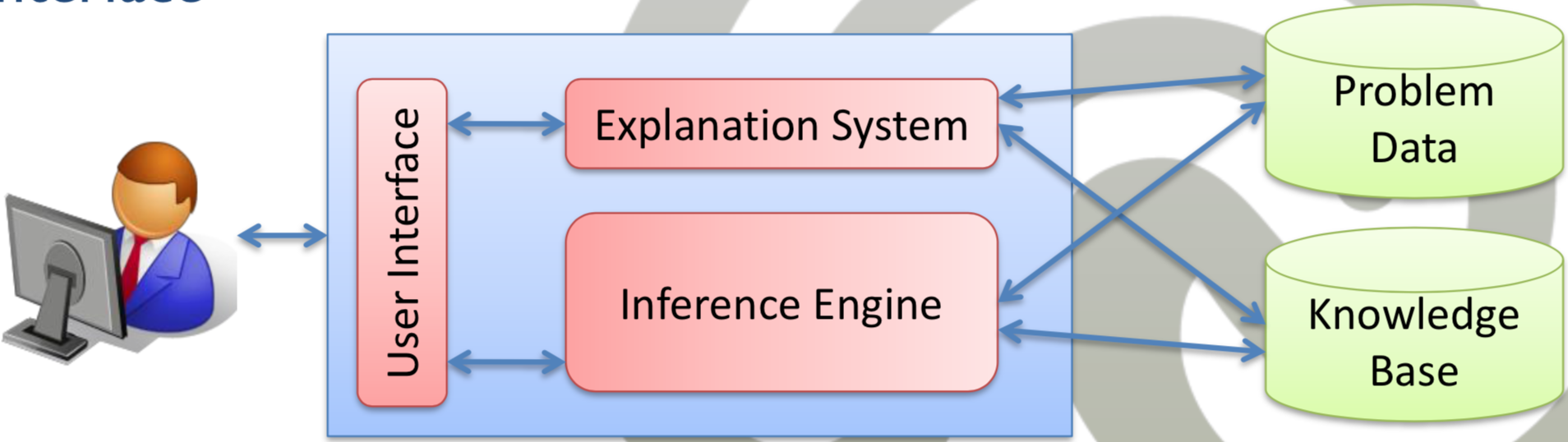
- Architecture:
- User-interface: Question-response-dialog
- Inference Engine: Deduce answer (using knowledge base and problem data)
- Explanation System: Explain answer to the user
- Knowledge Base: Rules/facts
- Problem Data: Facts for a specific problem
- Requirements:
- Keep and manage valuable data in knowledge base
- Support another query type
- Same requirements as normal database system
- 1970: MYCIN
- Stanford Univeristy
- Medical expert system to treat infections
- Containing 600 rules
- Support for uncertainty
- Problem: Too big, never used in practice
- 1980: Dipmeter Advisor
- Schlumberger Doll Research
- Goal: Support oil drilling operations (find correct spot)
- Containing 90 rules
- System was very successful
- 1992: SHINE Expert System
- Spacecraft Health Inference Engine
- Started in 1970 by NASA and JPL
- Multi-purpose inference system
- Detect system failures in complex machines
- System still in use (real-time system)
- Deep Space Network
- Lockheed Martin F-35
- Galileo Space Probe
Semantic Web
- 2001, Tim Berners-Lee
- Vision:
- Semantic Web Agent (SWA) accesses and understands Web pages
- SWA plans complex tasks
- SWA deduces new facts
- e.g., “Asthma is chronic lung disease”, “Pulmonologist is doctor for lung diseases”, “Go to doctor”
- Semantic Web is web of data
- Goal:
- Provide web page in machine-readable form
- NOT: Understand natural language
- Common formats for integration/combination of data
- Schema of a website:
- Structure of a web site (e.g., tags)
- Website is annotated with defined tags
- Different schemas must be matched (schema matching)
- Ontologies:
- Correct name: Ontological models
- Ontologies describes what exists, its relation to other things and categorization
- e.g., all tags
- Offer reasoning capabilities
- Automatic classification
- Extract additional facts
- Modeled using languages (OWL, RDFS, DAML+OIL)
- Ontology contains the data (in contrast to a schema)
- Taxonomy
- Type of an ontology
- Order things into a hierarchical structure
Question Answering
- Application using the semantic web
- Task: Answer natural-language questions
- Question types:
- Factoid question: Asking about facts (e.g, how big is x?)
- Non-factoid questions: How was x?
- Questions:
- QA in RDMBS: Data is well-structured for specific domains
- QA and LOD: e.g., DBpedia
- QA and the Web: Unstructured data, mostly natural language (use IR methods)