Question Answering
- Special field in AI/NLP
- Goal: Answer questions in natural language
- Classification of QA systems:
- Answer Domain: Open/Closed
- Supported Question Types: Factoids/Definitions/Yes-No/…
- Technologies: Shallow QA/Deep QA
- Dissociation to IR:
- IR return relevant documents for keyword queries
- QA should answer complicated questions
Answer Domain
- Closed-Domain
- QA within a single domain
- e.g., medicine, animals, etc.
- Opportunities:
- Exploit domain-specific language
- Use domain-specific ontologies (e.g., MeSH)
- Open-Domain
- QA answering any topic
- Any type of question may be asked (unknown topic and question type)
- Requires different data sources
- Aggregation and selection could become hard
Question Types
- Question Types:
- Factoid
- List
- Definition
- Relationship
- Superlative
- Yes-No
- Opinion
- Cause & Effect
- Answer types:
- Person
- Place
- Date
- Number
- Explanation
- Method
- Question focus:
- Entity being asked by the question
- Question topic:
- Object or event the question is about
- e.g. What is the height of Mt. Everest?
- Focus: Height
- Topic: Mt. Everest
Technology
Shallow QA
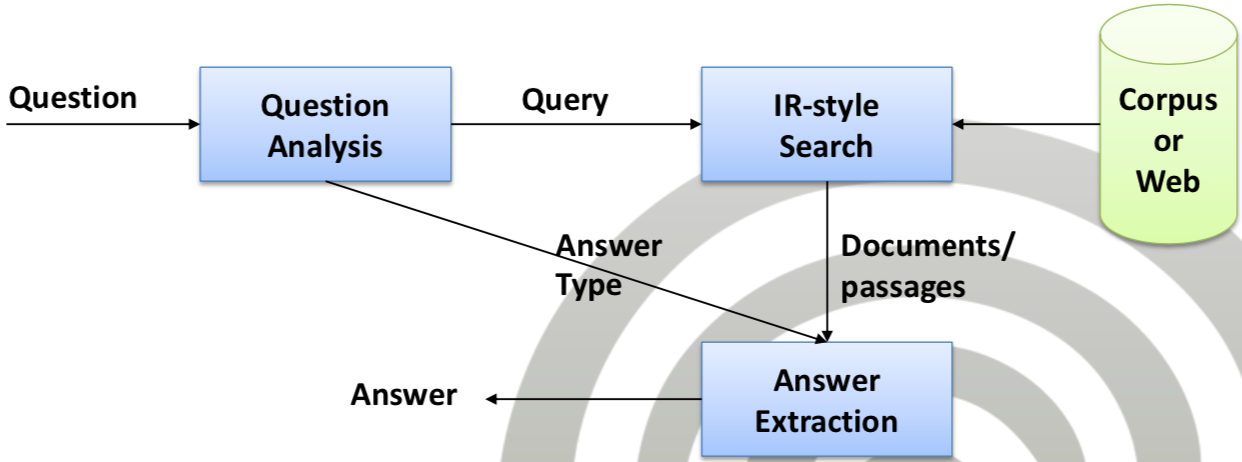
- Uses simple IR methods to find relevant answer documents
- Find a passage directly answering the question
- Keyword-based search (strip filler words)
- Answer: Use templates
- Simple case: Question already answered in the web
Deep QA
- Goal: Answer more complex questions
- Used techniques:
- Part-of-Speech Tagging (POS)
- Named Entity Recognition (NER)
- Ontologies (linked data, Folksonomy, …)
- Reasoning (translate to logical query)
Part-of-Speech Tagging
- Detect grammatical type of words (lexical classification)
- Detect relationship to other words
- Problems:
- Language is ambiguous
- Semantics are hidden/implicit
- Using heuristics
- Classifications (around 150):
- Noun
- Verb
- Article
- Adjective
- Adverb
- Preposition
- Pronoun
- Conjunction
- Interjection
- Training:
- Algorithms are trained on a corpus
Named Entity Recognition
- Identify words representing named entities (e.g., from a domain)
- Usually, entities are tagged with their type
Common-sense Knowledge Base / Ontology
- Related to upper ontologies
- Usually, automatically generated from encyclopedias
- e.g., DBpedia, YAGO
- Contents:
- Ontology of classes + individuals
- Parts, materials, properties, functions of objects
- Locations, duration, preconditions, effects of actions and events
- Use commonsense ontologies to answer queries directly
Showcase: Semi-Shallow Factoid QA
- Semi-Shallow Factoid System:
- Input knowledge: Text documents
- Factoid questions (e.g., when, who, how big)
- Use WWW data sources
- Use IR techniques
- Use some NLP techniques
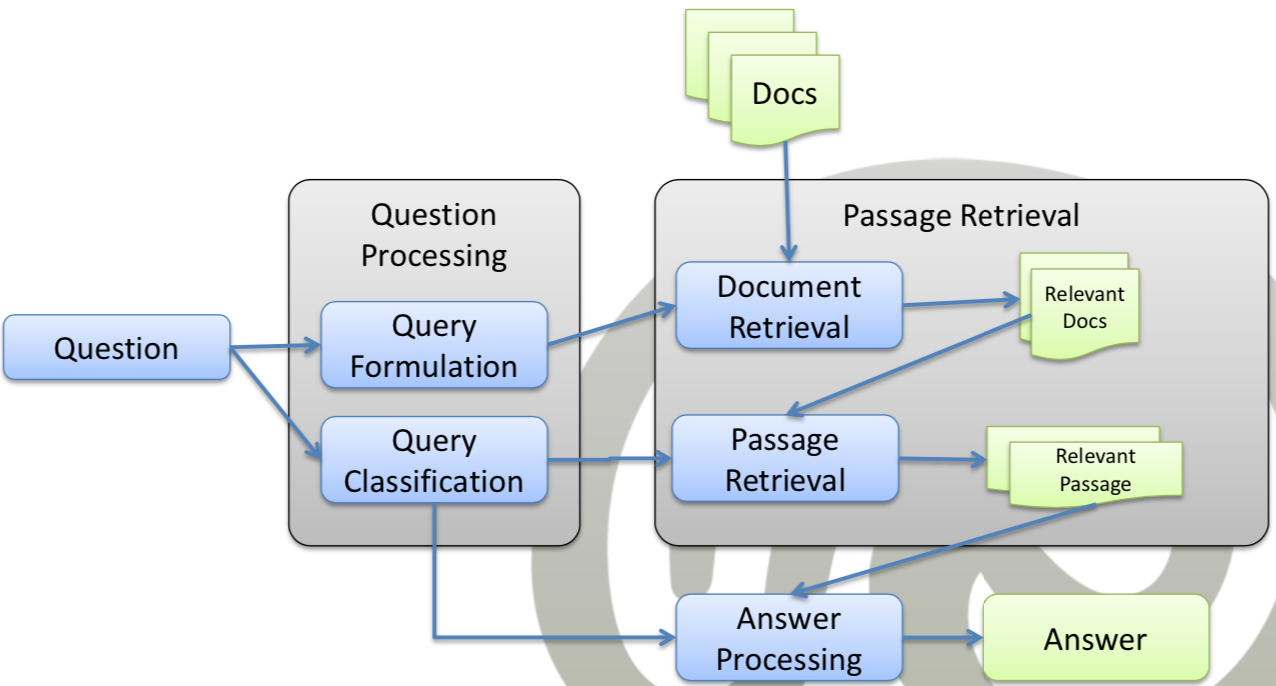
- Steps:
- Query formulation
- Query classification
- Document retrieval
- Passage retrieval
- Answer processing
Query Formulation
- Take the query and create a list of keywords
- Use the bag of words for a normal IR system
- Steps:
- Remove stop words
- Expand query using a thesaurus/ontology (e.g., WordNet)
Query Classification
- Find required answer type
- Use question ontologies to get the questioned property
- e.g., How big relates to size
- Use supervised learning to learn question and answer types
- Detect question topic (e.g., NER)
- Can be used for query formulation
- e.g., combine queried property and entity
Document Retrieval
- Retrieve candidate documents containing the query terms
- Result: Candidate documents
Passage Retrieval
- Find relevant passages
- Remove passages not containing the answer
- Rank using different characteristics:
- Number of named entities of the correct answer type (e.g., for size: meter, feet)
- Number of question keywords/topics
- Sentence proximity between passage and query
Answer Extraction
- From the selected passage, extract the actual answer
- Approaches:
- Answer pattern extraction (designed patters from the answer ontology)
- N-gram tiling (statistical approach)
- Problem: Multiple different answers
- Which to chose?
Watson (D)
- Deep QA project
- Watson beat all in Jeopardy
- Loose money if wrong answer chosen
- Open domain
- Complex and obfuscated questions
- Architecture:
- Parallelized probabilistic evidence-based approach
- Combination of shallow IR and Deep Ontology
- Generate multiple hypotheses
- Find evidence
- Model probabilistic confidences
- Data:
- Seed corpus (encyclopedias, dictionaries, …)
- Create expanded corpus (query internet for related documents)
- Structured corpus (databases, ontologies, taxonomies)
- Question classification:
- Type of question
- Focus and Lexical Answer Type Detection
- Relation detection
- Question decomposition
- Hypothesis scoring (deep QA):
- IR-based scorer
- Ontology-based reasoning
- Geo-spatial reasoning
- Temporal reasoning