Logic
Basics
- Logics are the basics of deductive databases
- How to generate knowledge?
- Axioms: Start with knowledge which is considered true
- Inference: Derive new knowledge
- Types of inference:
- Inductive Inference:
- Draw conclusions from multiple observations
- e.g., natural science
- Deductive Inference:
- Axioms are given
- Generate conclusions (theorems) from true facts (axioms) using rules
- Focus of this lecture
- Inductive Inference:
History
- Sophism
- 5th century BC
- Sophists were like teachers
- Teach rhetoric for money
- Try to convince people using fallacious reasoning
- Use ambiguities of languge
- Aristotle
- 330 BC
- First appearance of formal logics
- Goal:
- Derive new knowledge from old knowledge
- Formal and safe inference
- Logic as tool for valid philosophical arguments
- Discovered Sophists’ tricks
- Fallacy of Equivocation
- Feather is light. Light can not be dark. A feather can not be dark.
- Fallacy of Composition
- Each individual vote is rational. Therefore, combining multiple votes is rational.
- Fallacy of Accident
- Cutting people with knives is a crime. Surgeons cut people with knives. Surgeons are criminals.
- Fallacy of Begging the Question
- Fallacy of Equivocation
Other Logics
Propositional Logic
- Often referred as zero-order logic
- Components:
- Atomic statement: Statement that can not be further divided (true of false)
- Connectives: AND, OR, IMPLICATION (truth function)
- Bivalent logic
- Only true and false
- Counterpart of multi-valued logics (e.g., Fuzzy logic)
- 400 BC: Aristotle
- Wrote the book Metaphysics
- Base of propositional logic
- A statement AND its contradiction can not be true at the same time.
- A statement OR its contradiction has to be true.
- Invented the technique of indirect proofs
- 1847: George Boole
- First sound and complete formalization for truth values with algebraic calculus
- Invented Boolean Algebra
- Graphic representation by Venn diagrams
- 1879: Gottlob Frege
- Formalized first calculus with implications
- 1910: Bertrand Russel
- Refine Frege’s calculus
- Problems:
- Does not investigate the statements themselves
- e.g., for with variables does the statement hold
- Bad for deductive databases
- No quantifiers/predicates
- Does not investigate the statements themselves
Term Logic
- Introduced by Aristotle
- Purpose: Allow deductive inference
Constructs
- Term:
- Word represents something
- Has no truth value
- Just objects (e.g., man, blue)
- Proposition:
- Combination of two terms
- Truth value: Either true or false
- Have Quantity:
- Universal (all)
- Existential/Particular (some)
- Have Quality:
- Affirmative (e.g., is)
- Negative (e.g., is not)
- Combinations:
- Universal affirmative (UA): \( \forall \)
- Existential affirmative (PA): \( \exists \)
- Universal negative (UN): \( \neg\forall \)
- Existential negative (PN): \( \neg \exists \)
- Syllogism:
- Inference where a proposition (conclusion) follows two other propositions (premise)
- \( \text{Minor premise} \land \text{Major premise} \Rightarrow \text{Conclusion} \)
- Components:
- Minor premise: Contains a minor term and and middle term
- Minor term: Subject
- Middle term: Predicate
- Major premise: Contains the middle term and the major term
- Middle term: Subject
- Major term: Predicate
- Conclusion: Contains the minor term as subject and the major term as predicate
- Minor premise: Contains a minor term and and middle term
- Important: The middle term must appear as predicate and as subject
Inference
- Example (UA-UA-UA):
- Minor premise: All Greeks (subject) are men (predicate).
- Major premise: All men (subject) are mortal (predicate).
- Conclusion: All Greeks are mortal.
- Results in 24 valid types of syllogisms
- Based on allowed conversations
- UA-UA-UA
- UN-UA-UN
- PN-UA-PN
- etc.
- Square of opposition:
- Allow for logical conversions
- UA is contradiction of PN
- PA is contradiction of UN
- Problem: No singulars in statements possible
- All terms are universally quantifed
- e.g., Every Socrates is a philosopher (Socrates is only a person)
Port-Royal-Logic
- Arnauld/Nicole, 1662
- Idea: Introduce singulars as universal
- e.g., All Socrates are men.
- Looks awkward/weird
Criticism
- 4th century BC: Eubulides of Miletus
- e.g., A grain of sand is no heap. Adding a single grain does not make a heap. => There is no heap of sand.
- Problem:
- Natural language is not formal (not Aristotle’s fault)
- Term Logic uses unary predicates
- 1879: Gottlob Frege
- Responsible for the downfall of Term Logic
- Recognized the need for quantifiable variables and predicates
- Distinction between object and concept
- Morning Star is Venus
- Venus is a planet
- Subject/object are not reversible => Different is
- Results in predicate logic
Logicism
- Based on Frege, 1879
- Task:
- Axiomatize the new system of logic
- View mathematics as an extension of logic
- Build a mathematical logic for set theory
- Foundation of analytic philosophy
- Analyse philosophical propositions
- Two trends: Neo-Positivism, Ideal language analysis
- 1901: Russel’s paradox:
- Frege’s logic still contained contradictions
- Imagine a barber shaving all people iff they do not shave themselves. Does the barber shave himself?
- Russel constructs a set containing the sets which are not member of themselves
- Modern logical calculus:
- Book Principia Mathematica (by Russel and Whitehead)
- Use axiomatic set theory
- Idea: Find a complete and consistent set of axioms to derive every true theorem of the system
- Results in the Hilbert Program:
- David Hilbert axiomatized all mathematics
- Incompleteness theorem:
- Destruction by Kurt Gödel, 1931
- Complete axiomatization of all mathematics is not possible
- Incompleteness theorems
- If an axiomatic system is consistent, it can not be complete.
- The consistency of axioms can not be proved in the axiomatic system itself.
- But:
- Gödel’s completeness theorem: Completeness of first-order logics
First-Order Logic
Basics
- Central idea:
- Formally deduce from a set of facts
- Which statements are true and which are false
- Works due to the completeness theorem of FOL
- Introduces the concept of predicates
- Predicate: Property (group entities into types, e.g., man/student/strawberry)
- Fine-grained quantification: Existential + Universal
- Formally deduce from a set of facts
- Formalization:
- Language:
- Syntax
- How to valid sentences look like?
- Interpretation:
- Semantics
- When is a statement true/false?
- System:
- Mechanism called Deduction
- What statements can be deduced from a given set?
- Language:
Syntax
- FOL syntax mimics natural language
- Important: Syntax has no meaning (without interpretation)
- Concepts:
- Formula (statement; basic building block)
- Predicate (express sth. about a term)
- Term (represent objects/concepts)
- Constant
- Variable (assign a value)
- Function (apply on term)
- Statement:
- Contains a predicate (something is said about entity, e.g.,
3 is even) - Can be concatenated to a new statement using special connectives, e.g., AND
- Has truth value
- Contains a predicate (something is said about entity, e.g.,
- Quantification:
- Variables can be quantified
- Universal quantification:
- Predicate must be valid for all valid substitutions of the variable
- Particular quantification:
- Predicate must be valid for at least one valid substitution of the variable
- Language
- Formal construction mechanism for statements
Signature
- First-order logic language is quadruple (signature)
- \( \mathcal{L}=(\Gamma, \Omega, \Pi, X) \)
- \( \Gamma \):
- Non-empty finite set of constant symbols
- e.g., a, b, Hector, 3, Frog
- Constants may represent singular entities (but not types/collections)
- \( \Omega \):
- Set of functions
- \( \Omega = \bigcup_{n\in\mathbb{N}} \Omega_n \)
- \( \Pi \):
- Set of predicates
- \( \Pi = \bigcup_{n\in\mathbb{N}} \Pi_n \)
- \( \Pi_n \): Set of n-ary predicates
- e.g., \( P, Q, R \)
- Define sets of elements (constants evaluating predicates to true form a group)
- Evaluate to either true or false
- Substitution:
- e.g., \( P(x|_{x=Hector}) \)
- \( X \):
- Finite set of variables
- e.g., \( x,y,z \)
- Variables may only be substituted by constant values
- Higher-order logic: May substitute with predicates (increases complexity)
- \( \mathcal{L} \):
- Signature of the language
- Signature is application-dependent
- The Universal signature is commonly used
- Contains all predicates and functions of all aritys
Term
- Constant:
- Represents objects or concepts
- Variable:
- Assign a value (objects/concept)
- Gain expressiveness using variables
- Function:
- Can be applied on terms
- e.g.,
3+5 = +(3,5)
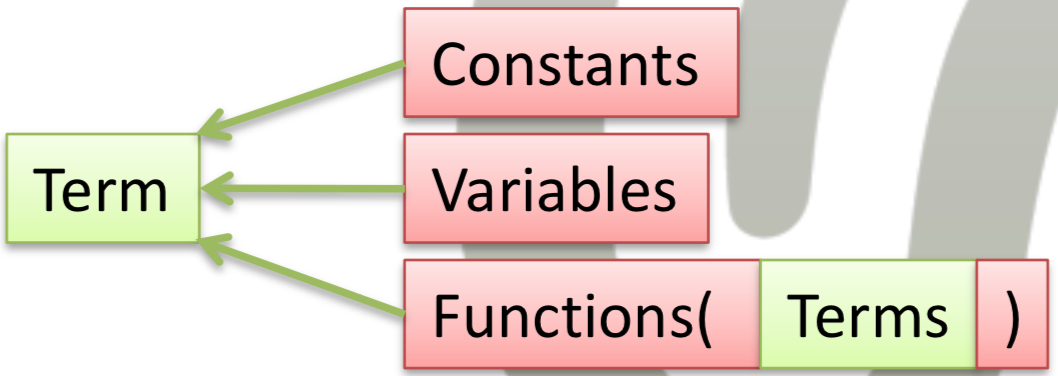
- Term:
- Yet un-interpreted expression
- Built from constants, variables and functions
- Have no truth value, e.g.,
2+6 - Definition \( T_\mathcal{L} \):
- Constant symbols from \( \Gamma \) are terms
- Variables from \( X \) are terms
- Functions \( f(t_1,\ldots,t_n) \) are terms iff \( f\in\Omega_n \) and \( t_1,\ldots,t_n \) are terms
- Ground term:
- Term without any variables
Formula
- Formulae are the basic building block (a statement)
- Inserting terms into predicates are atomic formula
- e.g.,
even(2+6) - Yet un-interpreted statement
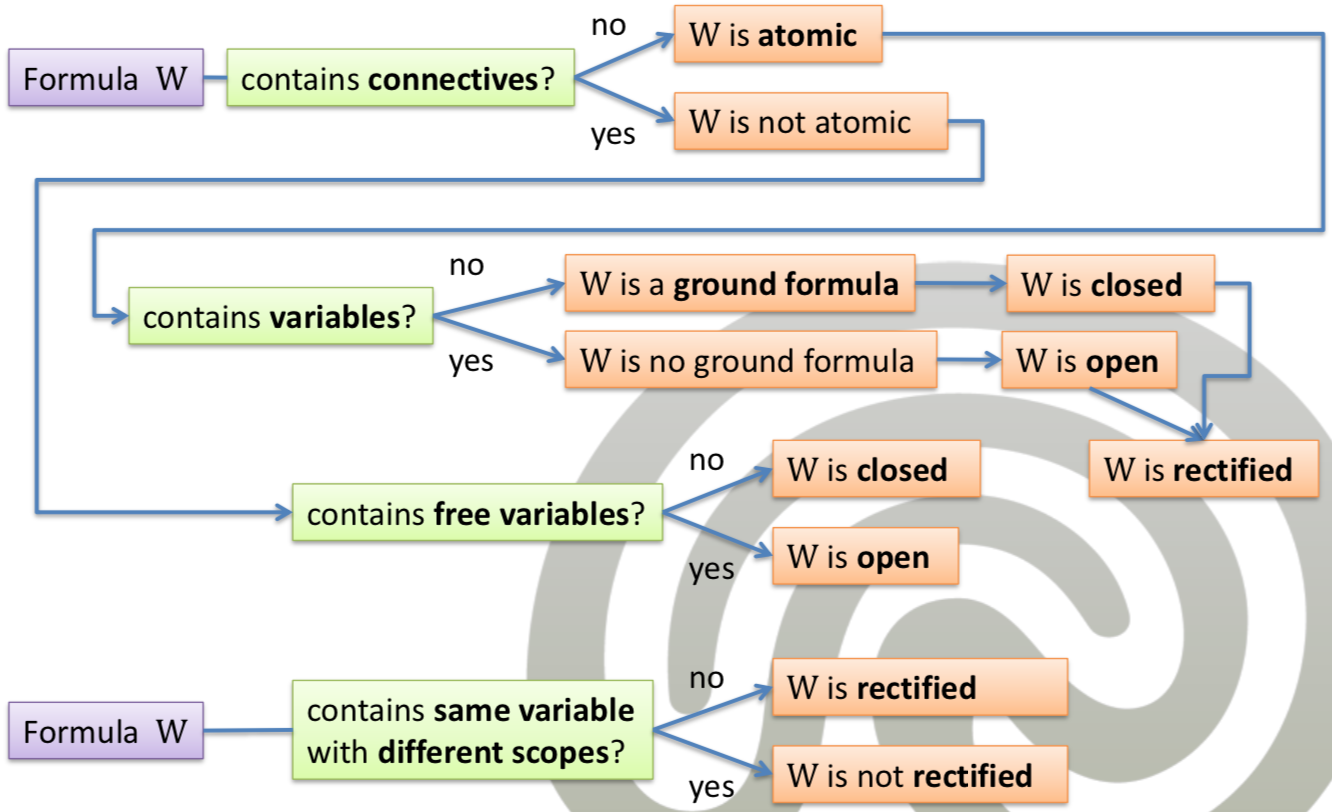
- Classification of formulae:
- Atomic
- Open/Closed
- Rectified
- Grounded
- Set of atomic formulas or Atom:
- \( A_\mathcal{L}=\{P(t_1,\ldots,t_n)\mid P\in\Pi_n, t_1,\ldots,t_n\in T_\mathcal{L}\} \)
- State simple facts, defined by predicates
- Grounded formula:
- Formula without any variables
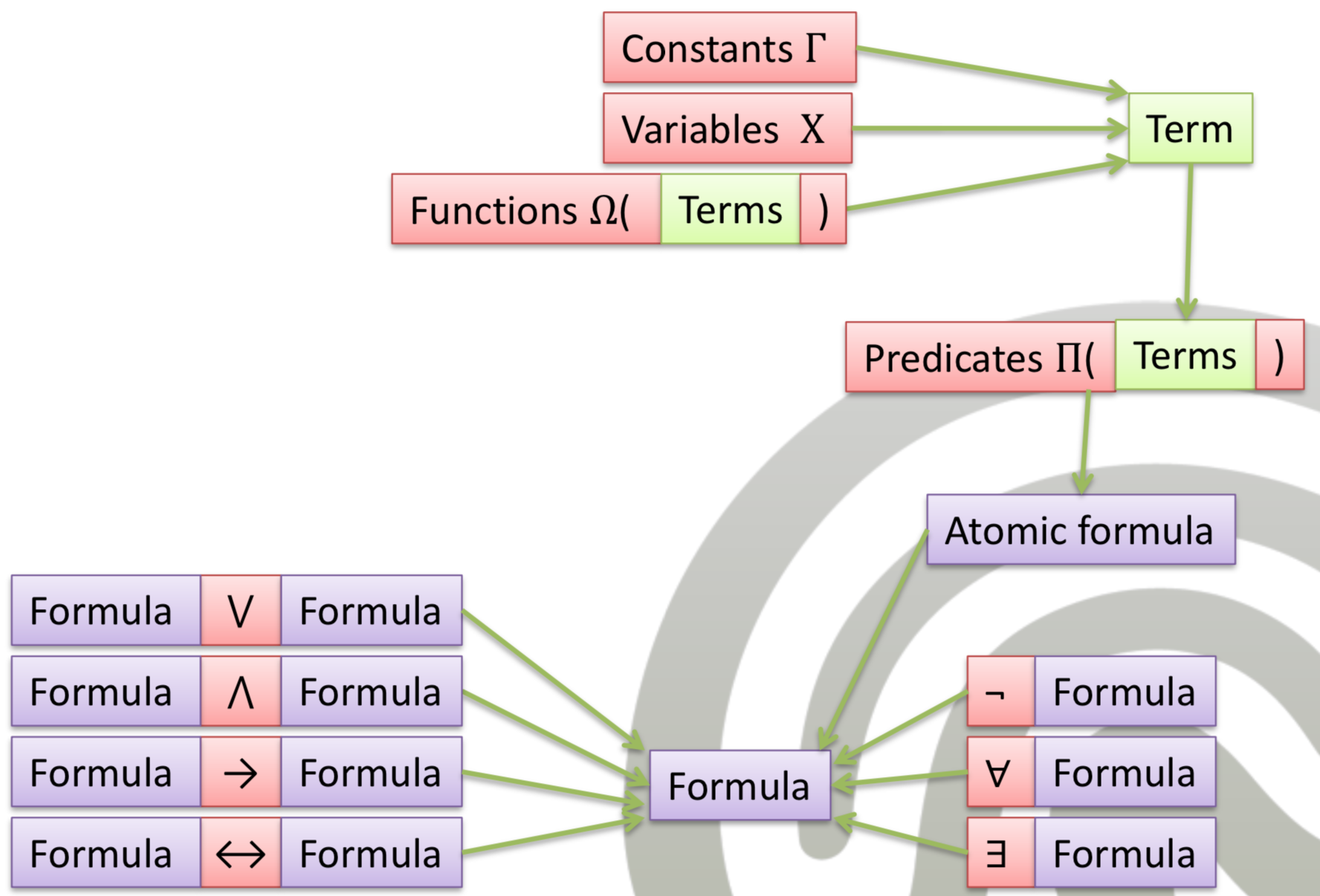
- Recursive definition:
- Atomic formula is a formula
- If \( W \) is formula, \( \neg W \) is a formula
- If \( W_1 \) and \( W_2 \) are formulas, the following are formulas:
- \( W_1 \land W_2 \)
- \( W_1 \lor W_2 \)
- \( W_1\Rightarrow W_2 \)
- \( W_1\iff W_2 \)
- If \( x \) is variable and \( W \) is formula, \( \forall x(W) \) and \( \exists x(W) \) are formulas
Connectives
- Apply on formulae (i.e., connect or modify)
- Have certain hierarchy (to avoid parenthesis):
- Quantifiers (\( \forall, \exists \))
- NOT (\( \neg \))
- AND (\( \land \))
- OR (\( \lor \))
- Implication and Equivalence (\( \Rightarrow, \iff \))
Variable Bindings
- Formula \( W \) has three sets of variables
- Free variables \( free(W) \)
- Bound variables \( bound(W) \)
- All variables \( vars(W)=free(W)\cup bound(W) \)
- Recursive definition:
- Formula \( W \) is atomic:
- \( free(W)=vars(W) \)
- \( bound(W)=\emptyset \)
- Negation \( \neg W \):
- Negation has no effect
- \( free(\neg W)=free(W) \)
- \( bound(\neg W)=bound(W) \)
- Binary connectives \( \land,\lor,\Rightarrow,\iff \):
- Binary connectives merge sets
- \( free(W_1\land W_2)=free(W_1)\cup free(W_2) \)
- \( bound(W_1\land W_2)=bound(W_1)\cup bound(W_2) \)
- Quantifiers \( \forall ,\exists \):
- Quantifiers bind variables
- \( free(\forall x W)=free(W)\setminus \{x\} \)
- \( bound(\forall x W)=bound(W)\cup \{x\} \)
- Formula \( W \) is atomic:
- Classification of formula \( W \):
- Closed iff \( free(W)=\emptyset \)
- Constant truth value
- Depend on the interpretation
- Open iff \( free(W)\neq \emptyset \)
- Truth value depends on free variables (parameters)
- Closed iff \( free(W)=\emptyset \)
- Rectification:
- Bound variables are only valid within their scope
- Variable can be free and bound at the same time (but independent)
- Problem: Confusion
- Rectification: Rename variables
- \( W \) is rectified iff \( free(W) \cap bound(W) = \emptyset \)
- Closures:
- Closure operation: Quantify/bind all free variables
- \( free(W)=\{x_1,\ldots,x_n\} \)
- Universal closure: \( \forall x_1,\ldots,x_n(W) \)
- Existential closure: \( \exists x_1,\ldots,x_n(W) \)
Semantics
- Assumption:
- Formula is syntactically correct
- Meaning of symbols is considered common sense (e.g., 5 means 5, \( \land \) means AND)
- Now: Interpretation of a language (and therefore statements)
- Give meaning to the symbols of the syntax
- Meaning of words/symbols?
- Which values can variables have?
- Interpretation:
- Assigns an element of some Universe of Discourse to each term
- Assigns truth value to each formula (which statements are false/true)
- Capture the semantics of a language
- Universe of Discourse:
- Non-empty set of objects, entities and concepts
- Contains entities/concepts related to our current application
- e.g., subset of real world
Interpretation
- Interpretation of Language \( \mathcal{L} \)
- \( I_\mathcal{L}=(U, I_C, I_F, I_P) \)
- \( U \):
- Universe Of Discourse
- All real objects, entities, concepts
- These are not just symbols or names
- \( I_C \):
- \( I_C: \Gamma\rightarrow U \)
- Mapping of constants to the universe of discourse
- e.g.,
5is the natural number 5
- \( I_F \):
- Mapping of function symbols to real functions
- \( I_F(f_n): U^n\rightarrow U \)
- e.g.,
+means addition
- \( I_P \):
- Mapping of predicate symbols to real predicates
- \( I_P(R)\subseteq U^n \)
- e.g.,
Frog(x)means the type frog from the real world
Variable Substitution
- \( \rho: X\rightarrow U \)
- Assign to each variable a value of the universe of discourse
Term Evaluation
- Each term \( t\in T_\mathcal{L} \) can be interpreted w.r.t.
- (1) an interpretation \( I_\mathcal{L} \) and
- (2) a variable substitution \( \rho \)
- Term evaluation
- \( I^*_\rho(t) = t_I\in U \)
- \( t_I \) is the result of the interpretation of \( t \)
- Informal:
- If term is a constant, use the constant interpretation
- If term is a variable, look up the variable substitution
- If term is a function, evaluate the function
- Definition of \( I^*_\rho(t) \):
- \( t\in \Gamma \Rightarrow t_I=I_C(t) \) (constant)
- \( t\in X \Rightarrow t_I=\rho(t) \) (variable)
- \( t=f(t_1,\ldots,t_n)\Rightarrow t_I=I_F(f)(I^*_\rho(t_1),\ldots,I^*_\rho(t_n)) \) (function of terms)
Formula Evaluation
- Formula evaluation \( I_\rho: F_\mathcal{L} \rightarrow \{\text{true},\text{false}\} \)
- Assumptions
- Closed World Assumption
- “Anything not mentioned in the universe of discourse does not exist”
- Something not appearing in the predicate interpretation evaluates to false
- Open World Assumption:
- Assume UoD is incomplete
- Formulas may be evaluate to unknown
- Problem: Difficult for KBS because a system answering unknown is not very useful
- Closed World Assumption
- Variable substitutions
- Term evaluation does not assign truth values
- Question: For which substitutions is a formula true?
- Start of Logic programming, e.g., PROLOG
Atomic Formula
- Atomic formula \( W=S(t_1,\ldots,t_n) \)
- \( I_\rho(W)=\text{true}\iff I_\rho^*(t_1),\ldots,I_\rho^*(t_n)\in I_P(S) \)
- Using closed world assumption
Non-atomic Formula
- Use sub-formulas to evaluate concatenated formulas
- Interpreting connectives:
- Connective is a boolean, binary function (defined by truth tables)
- \( I_\neg, I_\land, I_\lor, I_\Rightarrow, I_\Leftrightarrow \)
- Definition of \( I_\rho:F_\mathcal{L} \)
- \( I_\rho(\neg W)=I_\neg(I_\rho(W)) \)
- \( \theta\in\{\land,\lor,\Rightarrow,\Leftrightarrow\}:I_\rho(W_1\,\theta\,W_2)=I_\theta(I_\rho(W_1),I_\rho(W_2)) \)
Quantified Formula
- Requires modified substitutions
- Goal: Modify values of a substitution
- \( I_{\rho(x|d)}, x\in X, d\in U \)
- Substitute variable \( x \) with element \( d \), the remaining variables are unchanged
- Idea:
- Formulae \( \exists x(W) \) or \( \forall x(W) \)
- Un-bind variable \( x \) and change its value using a modified substitution until the formula \( W \) evaluate to either true or false
- Particular quantification:
- \( \exists x(W) \) is true if there exists any element in the universe evaluating formula \( W \) to true
- \( I_\rho(\exists x(W)) = \text{true iff }\text{true}\in\{I_{\rho(x|d)}(W) \mid d\in U\} \)
- Using closed world assumption (otherwise statement can not be interpreted)
- Universal quantification:
- \( \forall x(W) \) is false if there exists any element in the universe evaluating formula \( W \) to false
- \( I_\rho(\forall x(W)) = \text{false iff }\text{false}\in\{I_{\rho(x|d)}(W) \mid d\in U\} \)
- Using closed world assumption (otherwise statement can not be interpreted)
Clauses
- Definition Literal:
- Set of literals \( L_\mathcal{L} \) consists of all atomic formulae \( A\in A_\mathcal{L} \) and \( \neg \)
- Positive literal: \( A \)
- Negative literal: \( \neg A \)
- Ground literal: No variable in literal
- Definition Clause:
- A clause is the Universal closure of a disjunction of literals
- e.g., \( \forall L_i\in L_\mathcal{L}:L_1\lor\ldots\lor L_n \)
- Definition Horn clause:
- A Horn clause is a clause with at most a single positive literal
- e.g., \( \forall (\neg L_1\lor\ldots\lor L_n) \)
- Definition Goal clause:
- Horn clause without a positive literal
- e.g., \( \neg A_1 \lor \neg A_2 \)
- Definition Definite clause:
- Horn clause exactly one positive literal
- e.g., \( \neg A_1 \lor A_2 \)
- Definition Fact clause:
- Horn clause with exactly one positive literal and no negative literals
- e.g., \( A \)
- A Horn clause is a clause with at most a single positive literal
- Horn clause as implication
- \( \neg A_1\lor A_2\equiv A_1\implies A_2 \)
- A set of preconditions follows one fact (required for deductive databases)
Models
- Important question: Which interpretation and variable substitution make a formula true?
- Problem: Unlimited possible interpretations and variable substitutions
- Restriction: Use closed formulae
- Variable substitution function irrelevant
- Only rely on quantifiers
- Definition Model:
- Interpretation \( I \) is a model of a closed formula \( W \) iff \( I_\rho(W)=I(W)=true \)
- \( I \) is model of a set of closed formulae \( \mathcal{W} \) iff it is a model for every \( W\in\mathcal{W} \)
- Definition Fact:
- Closed formula \( W \) is a fact w.r.t. an interpretation \( I \) if \( I(W)=true \)
Satisfiability
- Question: Does a set of closed formulae \( \mathcal{W} \) have a model?
- Definition Satisfiable
- \( \mathcal{W} \) is called satisfiable iff \( \mathcal{W} \) has a model
- \( \mathcal{W} \) is called unsatisfiable iff \( \mathcal{W} \) does not have any model
- Stop evaluation of an unsatisfiable set
- Check for unsatisfiability is easier (really?)
- Connection between satisfiability of a set of formulae and inference:
- To infer formulae, we must check for satisfiability
- Principle of indirect proof by Aristotle (reductio ad absurdum)
- Goal: Prove \( W \) using set of propositions \( \mathcal{W} \)
- Assume: \( \neg W \)
- Show contradiction to some statement in \( \mathcal{W} \)
- Thus, \( \mathcal{W}\cup \{\neg W\} \) is unsatisfiable
- \( \mathcal{W}\models W \iff \mathcal{W}\cup \{\neg W\} \text{ is unsatisfiable} \)

Semantic Equivalence
- Question: Describe two concepts the same idea? (redundant rules waste time/space)
- Definition:
- \( W_1 \) and \( W_2 \) are semantically equivalent iff \( \forall I: I(W_1)=I(W_2) \)
- Evaluation of both formulae is always the same
- Can be derived by using tautologies as transformation rules
Semantic Conclusion
- Question: Can a certain fact be deduced from a given set of facts?
- Trade-off:
- Query time vs. size of the IDB
- i.e., store rule (so no conclusion must be drawn) or calculate rule at query time
- Definition:
- \( W \) is semantic conclusion of \( \mathcal{W} \) iff every model of \( \mathcal{W} \) is also a model of \( W \)
- Notation: \( \mathcal{W}\models W \) (\( W \) follows from \( \mathcal{W} \)
Tautology
- Class of formulae
- Every single interpretation is a model
- Definition universal:
- \( \mathcal{W} \) is universal if every interpretation is a model
- Notation: \( \models \mathcal{W} \)
- Definition Tautology
- \( \mathcal{W} \) is a tautology if it is a universal
- Use the set of all tautologies to derive semantic equivalences (tautologies as transformation rules)
- Examples
- \( W\lor\neg W \)
- \( W_1\land W_2\implies W_1 \)
- \( W\equiv \neg\neg W \)
Test for Unsatisfiability
- Use Case:
- When the user adds a formula, check if the formula is semantically equivalent or a contradiction
- Redundancy: \( \mathcal{W}\equiv W \)
- Contradiction: \( \mathcal{W}\cup \{W\} \) unsatisfiable
- When the user adds a formula, check if the formula is semantically equivalent or a contradiction
- Lemma:
- \( \mathcal{W}\models \neg W \iff \mathcal{W}\cup \{W\} \text{ is unsatisfiable} \)
- Statement and contradiction can not be true at the same time
- The Test:
- Test \( \mathcal{W}\cup\{W\} \) is unsatisfiable
- [Lemma]: Test \( \mathcal{W}\models \neg W \)
- [Definition]: Every model of \( \mathcal{W} \) must be a model \( \neg W \)
- [model-theoretical approach]: Test all possible interpretations to find a model
- [Problem]: Unlimited amount of interpretations (leads to Herbrand Theory)
- [Herbrand Model]: Find a Herbrand Model of \( \mathcal{W} \) (only for clauses)
- [Herbrand Theorem]: Find a Herbrand Expansion not satisfying \( \neg W \) (using Boolean Logic)
- Problem: Unlimited amount of interpretations
- Solution:
- Use interpretations which are representative for the entire class of all interpretations (e.g., natural numbers, even numbers)
- Restrict to clauses and use Herbrand interpretations
- Problem: Approach is theoretical
- This test for unsatisfiability can not be implemented
- In deductive databases, the bottom-up approach is used
- i.e., compute the transitive hull of \( \mathcal{W} \) and test if the formula is satisfiable
Herbrand Theory
- Goal:
- Define a representative interpretation which can replace any other (so-called Herbrand Interpretation)
- Provide a reduction of first-order logic to propositional logic (only works for clauses)
- Given a language \( \mathcal{L} \)
- Herbrand interpretation consists of two parts:
- Herbrand Universe \( U_\mathcal{L} \)
- Consists of all ground terms
- Only use constants and functions, no variables
- Herbrand Base \( B_\mathcal{L} \)
- Contains all ground atoms, i.e., no variables
- Take all the terms of the Herbrand universe and apply the predicates of the language \( \mathcal{L} \) to them
- Infinite set
- \( P(t_1,\ldots,t_n)\subseteq B_\mathcal{L} \) with \( t_i\in U_\mathcal{L} \)
- Herbrand Universe \( U_\mathcal{L} \)
Herbrand Interpretation
- Definition
- \( I=(U,I_C,I_F,I_P) \)
- \( U=U_\mathcal{L} \) (Herbrand Universe)
- \( I_C(c)=c \) (interprete by itself)
- \( I_F(f):U_\mathcal{L}^n\rightarrow U_\mathcal{L}, f(t_1,\ldots,t_n)\mapsto f(t_1,\ldots,t_n) \) (interprete by itself)
- Completely symbolic/syntactical interpretation without a specific real-world semantics
- Term \( f(x) \) has no meaning (just a symbol)
- Universe element \( f(x) \) is interpreted (meaning)
- Difference between multiple Herbrand Interpretations:
- \( U, I_C, I_F \) are always the same
- Only difference:
- Predicate Interpretation \( I_P \)
- Idea:
- Define a Herbrand interpretation only by listing the atoms which evaluate to true and all others are false
- Interpretation is defined by the subset of the Herbrand Base \( I\subseteq B_\mathcal{L} \)
- Results in Closed World Assumption (everything not mentioned is false)
Herbrand Model
- Definition
- A Herbrand model of a set of formulae \( \mathcal{W} \) is a Herbrand interpretation which is a model \( \mathcal{W} \)
- Example:
- Formula: \( W\equiv\forall x,y(loves(x,y)\implies loves(y,x)) \)
- \( I_1=\{loves(Tarzan, Jane), loves(Jane, Tarzan)\} \) is a Herbrand Model
- \( I_2=\{loves(Tarzan, Jane), loves(Jane, Paul)\} \) is not a Herbrand Model
- Lemma:
- Given set of clauses \( \mathcal{W} \)
- \( \mathcal{W} \) has model if and only if \( \mathcal{W} \) has a Herbrand model
- \( \mathcal{W} \) is unsatisfiable if and only if \( \mathcal{W} \) has no Herbrand model
- Meaning: Syntactical interpretation of all symbols
- Idea:
- If some syntactical interpretation can satisfy the set of clauses, there is some semantic interpretation (more or less useful)
- Test for Unsatisfiability:
- see above
- Instead of testing all models of \( \mathcal{W} \), only show the (non-)existance of a single Herbrand model
- Only works for clauses not for general closed formulas
Complexity (D)
- Use Case:
- Deductive DB checks if a given statement can be deduced from a given set of formulae
- Check \( \mathcal{W}\models W \) (\( \mathcal{W}\cup\{W\} \))
- Focus: Computational complexity (for databases this is important)
- Check for validity (tautology)
- Check for satisfiability
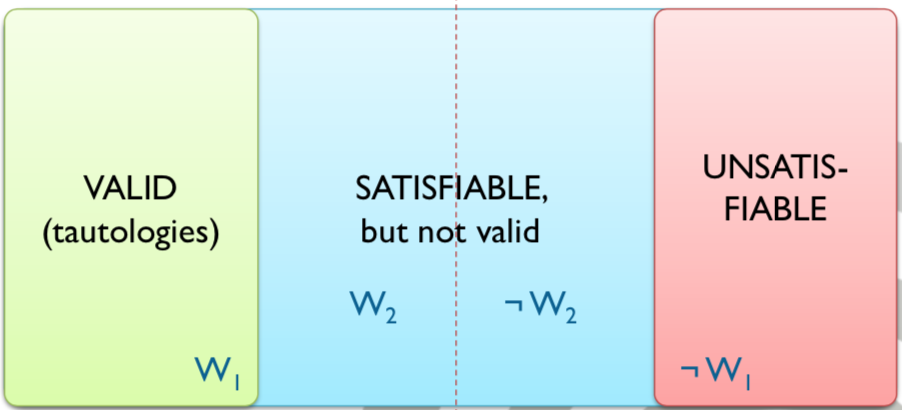
- Sets of expressions:
- VALID (tautology)
- \( \models W \)
- SATISFIABLE (but not valid)
- UNSATISFIABLE
- Negation as mirror operation
- VALID (tautology)
- Check for classes:
- Satisfiable: Generate substitution, evaluate
- \( W \) valid: Check if \( \neg W \) is unsatisfiable
- \( W \) unsatisfiable: Check if \( W \) is satisfiable
- Satisfiability:
- Propositional logic: Decidable
- First-order logic: Undecidable
Propositional Logic
- SAT problem:
- Satisfiability problem
- Is a given propositional formula satisfiable?
- Complexity class: NP-C
SAT Algorithms
- Deterministic decidable algorithm
- Generate all \( 2^n \) substitutions
- Evaluate all substitutions (\( O(n^2) \) per substitution)
- Overall \( O(n^2 2^n) \)
- Non-deterministic semi-decidable algorithm
- Guess any substitution
- Evaluate this substitution (\( O(n^2) \))
- Continue until the evaluation is \( true \)
- Construct a substitution
- Idea: Construct a substitution using the formula
- e.g., one variable must be true and one has to be false
- i.e., exclude certain substitutions
- Problem: Hard for general formulae
- Davis-Putnam Algorithm
- Default algorithm to solve SAT
- Formula must be in conjunctive normal form
- \( O(1.8^n) \)
- Idea: Build a pruned tree of possible substitutions
SAT Variants
- 3-SAT
- Formula must be conjunctive normal form where each clause contains at most 3 literals
- First problem shown to be NP-complete
- SAT reduces polynomially to 3-SAT
- Horn-SAT
- SAT with conjunctive normal form where each clause is a Horn clause
- Important: P-complete
- Idea:
- Write Horn clause in implication form
- Facts: \( true\rightarrow x_1 \)
- Definites: \( x_1\rightarrow x_2 \)
- Goals: \( x_1\land x_2\rightarrow false \)
- A set of Horn clauses is satisfiable iff all conjunctions of implications is true
- Find variables which have to be true
- Write Horn clause in implication form
- Algorithm:
- Set \( T=\emptyset \) contains all variables which must be true (all others are false)
- Pick any (currently) unsatisfied/false implication
- \( H_i\equiv\bigwedge x_j\Rightarrow y \)
- Must be a fact or a definite
- Add \( y \) to \( T \): \( T=T\cup \{y\} \)
- Repeat, until no unsatisfied/false implications exist
- Result: Iff \( T \) satisfies all clauses, \( \mathcal{W} \) is satisfiable
First-Order Logic
- Problem:
- Universe of potentially unlimited size (interpretations)
- Quantifiers (formula must be true for subset of universe)
Example (Number Theory)
- Language
- \( \mathcal{L}_{NT}=(\{0\}, \{\sigma, +,\times, \uparrow\}, \{=,<\},\{x,y,z\}) \)
- Interpretation
- Universe: All natural numbers
- Successor function \( \sigma \):
- \( \sigma(\sigma(\sigma(0)))=3 \)
- Shortcut: Decimal numbers
- Functions and functions are interpreted common sense
- Naive evaluation: Testing all values is very problematic
- e.g., \( \exists x(x>2000) \)
- Problem:
- Testing for all possible substitutions in an infinite universe does not work
Peano Arithmetic
- Guiseppe Peano, 1889
- Idea:
- Use deductive system to construct a proof (from a set of valid axioms)
- Do not test all possible values
- Axiomatization of Number Theory
- 15 axiom types inducing countable unlimited number of axioms
Fermats Last Theorem
- \( \neg\exists n,a,b,c((a^n+b^n=c^n\land n>2) \)
- Took very long (357 years) to show that this statement is provable for the natural numbers
- 1995: Proved by Andrew Wiles
Gödel’s Incompleteness Theorem
- […] generated theory can not be both consistent and complete. […]
- e.g., some statements are provable in the Peano arithmetic (Goodstein Theorem and Fermats Last Theorem)
- Result:
- For any non-trivial deductive system \( NT \), there exists a statement, which can not be proved within this system
- Unprovable is called undecidable
- \( NT\vdash W \): \( W \) can be proved in system \( NT \)
- Note:
- First-order logic can not be used to model infinite domains (e.g., the natural numbers)
- Hence, the incompleteness theorem does not apply to FOL
Goodstein Theorem
- Statement about the natural numbers (Hercules fighting the Hydra)
- Goodstein sequence eventually terminates at 0
- \( Goodstein(3)=3,3,3,2,1,0 \)
- \( Goodstein(4)=4,26,41,\ldots,299,\ldots,0 \)
- Theorem is expressible and true in the Peano arithmetic
Paris-Kirby Theorem
- Goodstein Theorem is not decidable
- Can not be proven in Peano Arithmetic (or First-Order Logic)
- Why?
- Consistency of Peano arithmetic would follow from the proof of the Goodstein Theorem
- This is not possible due to Gödel’s incompleteness Theorem (Peano arithmetic can not prove its consistency)
Herbrand Theorem
- Jacques Herbrand, 1928
- Informal:
- Closed formula \( A \) in universal prenex form is unsatisfiable iff there is a finite subset of the Herbrand expansion of \( A \) \( TA\subseteq E(A) \) which is Boolean unsatisfiable
- Result:
- Transform the First-Order Logic satisfiability problem to the Propositional Logic Satisfiability Problem (using this restriction)
- By assigning a truth value to each predicate in a ground instance the formula represents a propositional logic formula
Formalization
- Universal prenex form:
- Prefix: Universal Quantifier binding all variables
- Matrix: Formula without quantifiers
- \( \forall y_1,\ldots,y_n (F(y_1,\ldots,y_n)) \)
- \( F \) is quantifier-free
- Instance of \( A \):
- Formula where variables of \( A \) are substituted by entities
- Herbrand expansion \( E(A) \):
- Set of all possible ground instances of \( A \) with all substitutions from the Herbrand base
- Herbrand Theorem:
- \( A\equiv\forall y_1,\ldots,y_n(F(y_1,\ldots,y_n)) \)
- \( A \) is unsatisfiable if and only if there is a finite set \( TA\subseteq E(A) \) of ground instances such that \( TA \) is unsatisfiable
- Considerations:
- Check of \( TA \) can be performed in finite time
- e.g., Davis-Putnam algorithm
- Problem: Which \( TA\subseteq E(A) \) is unsatisfiable?
- Reducing to the Halting problem
Gilmore Algorithm
- 1960
- Meta-algorithm to check for unsatisfiability
- Algorithm:
- Input:
- FOL formula \( A \)
- Transform to universal prenex form (i.e., pull quantifiers and convert to universal quantifier)
- Criterion:
- Herbrand Expansion must be generateable (i.e., recursively enumerable)
- i.e., \( E(A)=\{A_1,A_2,\ldots\} \)
- \( k:=1 \)
WHILE\( \bigwedge_{i=1}^k A_i \)is satisfiable: k++(while not unsatisfiable)RETURN 'A unsatisfiable'
- Input:
- Semi-decidable algorithm (only terminates if \( A \) is unsatisfiable)
Schönfinkel-Bernays Class
- Restriction: Allow only a decidable subset of formulae
- Schönfinkel-Bernays class
- No functional symbols
- No equality predicate
- Formula \( W \) in prenex form
- SB-SAT:
- Satisfiability of formulae of SB-class is decidable
- Proof:
- No functional symbols
- –> Finite Herbrand Base
- –> Finite Herbrand Expansion
- –> Generation in finite time
- –> Finite time for the unsatisfiability check
- Problem:
- SB-SAT is in NEXP-C
- NEXP: Non-deterministic exponential time algorithm
- No functional symbols (restricts expressiveness)
Restriction
- Do we need full First-Order Logics?
- Requirements:
- Subset of FOL with guaranteed finite Herbrand expansions
- Better complexity than NEXP
- Subset should not limit expressiveness
- Restriction:
- Restrict to Horn clauses
- Finite Herbrand universe
- Check is in P
- Restrict to Non-recursive typed functions
- Restrict to Horn clauses
- Advantage:
- Check for unsatisfiability of finite subsets of Herbrand expansion is in \( PTIME \)
Deductive Systems (D)
- Question: How to find the set of all tautologies?
- Find the universal truth
- Automatically proof theorems
- Approaches:
- Model-theoretical (this course)
- Bottom-up approach (find a Herbrand model)
- Proof-theoretical
- Hilbert-Style deduction system
- Natural deduction
- Model-theoretical (this course)
- David Hilbert
- Mathematician in Göttingen (also university of Gauss and Riemann)
- Königsberg, 1862
- Pioneer in proof theory and logics
- The Hilbert Program
- Started in 1920
- Goal: Completely formalize math to finite, complete set and axioms
- Preciseness: Use precisely defined formalisms
- Completeness: All math can be proved by a system
- Consistency: No contradictions will show up
- Decidability: For each statement, an algorithm can decide if it is true
- Gödel incompleteness theorem:
- Prove that the Hilbert Program is impossible
Deduction Theorem
- \( \mathcal{W}\cup\{W_1\}\models W_2\iff \mathcal{W}\models W_1\implies W_2 \)
- Fundamental Meta-Rule: Deduction theorem is considered true in every system but not a theorem of that system
- Inference rules:
- Modus Ponens (Implication Elimination Rule)
- Abduction Inference Rule
Modus Ponens
- Implication Elimination Rule
- \( \{W_1, W_1\implies W_2\}\models W_2 \)
- Sound, i.e., never generates incorrect knowledge
- Example (for not-sound):
- Fact \( W_1 \): Today is Tuesday
- Rule \( W_1\implies W_2 \): If today is Tuesday, today is KBS lecture
- Derived \( W_2 \): Today is KBS lecture
- Usually sufficient for axiomatic systems
Abduction Inference Rule
- \( \{W_1\implies W_2, W_2\}\models W_1 \)
- Not sound
- Often helpful, used in medicine
- Example:
- Rule \( W_1\implies W_2 \): If it rains, it is wet
- Fact \( W_2 \): It is wet
- Derived \( W_1 \): It has rained
Hilbert-Style Deduction System
Deduction System: Logic
Also called Axiomatic systems
Hilbert-style deduction system for a language \( \mathcal{L} \)
Components:
- Logical axioms
- Set of formulae of \( \mathcal{L} \)
- Can not be proven that they are true/false
- Inference rules
- Set of rules to transform one statement to another
- Logical axioms
Deduction System generates proofs
Axiom must be an instance of the following schemes:
- A1: \( A\Rightarrow(B\Rightarrow A) \)
- A2: \( (A\Rightarrow (B\Rightarrow C))\Rightarrow((A\Rightarrow B)\Rightarrow(A\Rightarrow C)) \)
- A3: \( (\neg A\Rightarrow\neg B)\Rightarrow(B\Rightarrow A) \)
- All axioms are tautologies
- There is an unlimited number of axioms
Proof from \( \mathcal{W} \) to \( A \):
- Finite sequence \( W_1,\ldots,W_n \) of formulae of \( \mathcal{L} \) such that \( W_i \) is either an axiom or follows from one of the previous \( W_j \) by the inference rules
Example:
- Prove: \( \models \neg B\Rightarrow (B\Rightarrow A) \)
- \( \neg B\models B\Rightarrow A \) (Deduction theorem)
- \( \neg B \) (Hypothesis)
- \( \neg B\Rightarrow (\neg A\Rightarrow\neg B) \) (Axiom 1)
- \( \neg A\Rightarrow\neg B \) (Modus Ponens)
- \( (\neg A\Rightarrow\neg B)\rightarrow(B\Rightarrow A) \) (Axiom 3)
- \( B\rightarrow A \) (Modus Ponens)
Drawbacks:
- Few rules but many axioms (contradicts goals of deductive databases)
- Finding proofs is tricky (trial and error)
- Feels unnatural
Natural Deduction
- Gerhard Gentzen, 1938
- Use more rules but a limited set of axioms
- Later been adapted to deductive databases
- Concepts:
- Axioms (tautologies)
- Logical rules
- Structural rules (syntactical)