Document classification
- Task: Automatically assign documents to categories
- Applications
- Spam detection
- Email sorting
- Detect sexually explicit content
- Domain-specific search (e.g., Google Scholar)
- Language detection
- Information filtering / standing queries
- Formal
- Document space \( X \)
- Set of classes \( C=\{c_1,...,c_r\} \)
- Set of training pairs \( D\subseteq X\times C \)
- Task: Find function \( f:X\rightarrow C \)
- Evaluate using a test set
Naïve Bayes
- Idea: Estimate (train) probabilities from test set
- Bayesian network
- Directed acyclic graph
- Nodes: Observable variables/events
- Edges: Conditions between events
- Observation: Probabilities don’t sum up to one
- Reason: Statistical independence does not hold in data
- Therefore: Naïve Bayes is heuristic
- Optimization: Only use positive events (term-occurrence not lack of terms)
Classification
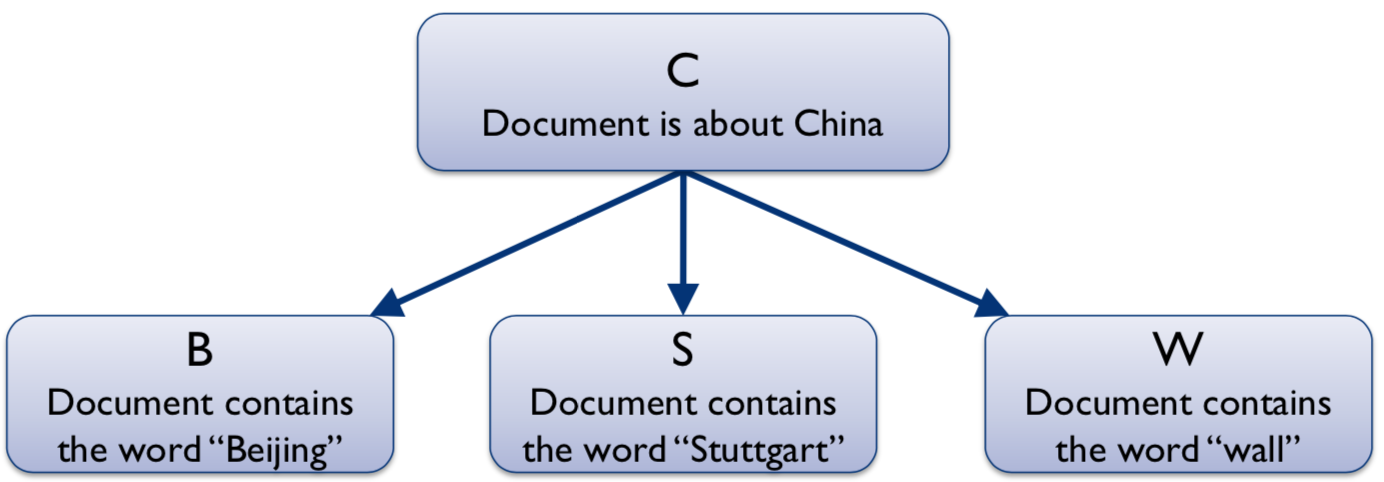
- Occurrence/lack of terms in documents are events
- Find probability of class membership
- \( P(C\mid t_1,...,t_n) = P(C\mid d) \)
- Use Bayes’ theorem
- \( P(C\mid t_1,...,t_n) = \frac{P(C)}{P(t_1,...,t_n)} P(t_1,...,t_n\mid C) \)
- Assume statistical independence
- \( P(C\mid t_1,...,t_n) = \frac{P(C)}{\Pi_{i=1}^n P(t_i)} \Pi_{i=1}^n P(t_i\mid C) \)
- Assign document to class with highest probability
Problem: Data sparseness
- Solution: Smoothing
- Laplace smoothing (add \( 1 \) to each term count)
- Weight \( P(t_i\mid C) \) and \( P(t_i) = \frac{df(t_i)}{N} \)
- e.g., \( P(t_i\mid C) = \lambda P(t_i\mid C) + (1-\lambda)P(t_i) \)
Extensions
- Use number of occurrences
- Better/advanced smoothing
- No independence assumption
- Use more than two classes
- Use discriminative terms
Rocchio
- Model: Vector space model
- Identify class by its centroid
- Assume classes are spheres
- Contiguity hypothesis
- Documents from same class form contiguous regions and different classes do not overlap
- Classification:
- Assign document to class with the nearest centroid
- i.e., 1-NN with centroids as data points
- Use Voronoi tessellation for visualization
k-Nearest neighbors
- Model: Vector space model
- Identify class by its documents
- Classification:
- Assign document to majority class of its k closest neighbors
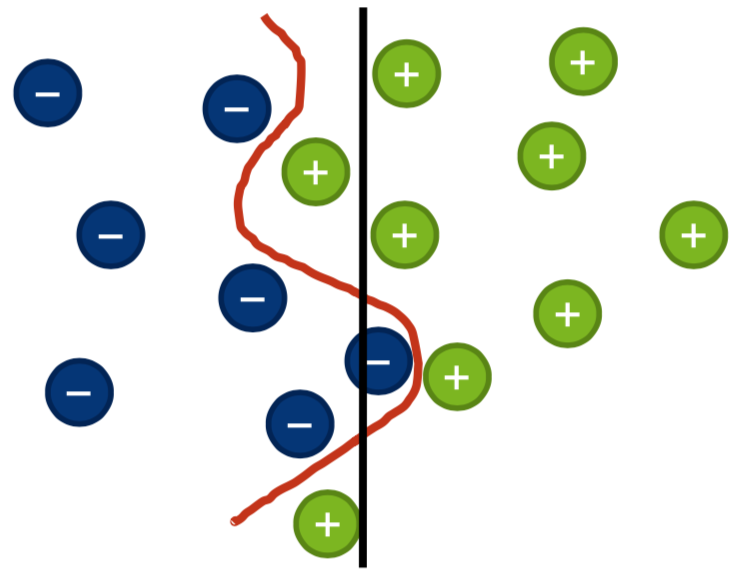
- Bias-variance tradeoff
- Underfitting: High k
- Overfitting: Low k
- Option: Weight votes
- Use cosine similarity
- \( score(C) = \sum_{x\in NN_k(d), class(x)=C} sim(d, x) \)
Support Vector Machine
- Assumptions
- Binary classification (-1, 1)
- Vector space model
- Task: Find linear classifier
- Idea: Maximize margin of classifier
Maximum margin classifier
- Motivation
- Intuitive design
- Robust against errors
- Theoretical arguments
- Empirical arguments
- Formalization
- \( n \) training examples
- Training set \( T=\{(x_i, y_i)\mid x_i\in \mathbb{R}^d, y_i\in\{-1,1\}\} \)
- Steps
- Formalization of the hyperplane
- Why does a perfect separating hyperplane exist?
- How to compute this perfect separating hyperplane?
Hyperplane
- Normal vector \( w\in \mathbb{R}^d \)
- Shift from origin \( b\in \mathbb{R} \)
- \( w*u+b=0, u\in \mathbb{R}^d \)
- \( w*x_i + b > 0 \Rightarrow y_i=1 \)
- \( w*x_i + b < 0 \Rightarrow y_i=-1 \)
- Data points: \( y_i(w*x_i + b) - 1 \geq 0 \)
Existence of a perfect hyperplane
- Idea: If there is a separating hyperplane, move the perfect one in the middle of the two boundary hyperplanes
- Corollary: If there is a separating hyperplane \( (w,b) \) there is always a hyperplane \( (w'',b'') \) such that
- \( (w'',b'') \) is valid
- \( (w,b) \) and \( (w'',b'') \) have equal margin widths
- Bounding hyperplanes of \( (w'',b'') \) are shifted away by one
- Proof
- Assumption: There is some separating hyperplane \( wx+b=0 \)
- Move plane into center
- \( b' = b+\frac{r_--r_+}{2} \)
- \( wx+b+\frac{r_--r_+}{2}=0 \)
- It has equal shift constants \( r_- = r_+ \)
- Normalize hyperplane
- \( w'' = \frac{w}{r_-} + \frac{b'}{r_-}) \)
- It has shift constants \( r_- = r_+ = 1 \)
Computation / Duality
- Goal: Maximize margin
- Distance of plane to center: \( d=\frac{|b|}{||w||} \)
- Margin width
- \( \frac{|b|+1-(|b|-1)}{||w||}=\frac{2}{||w||} \)
- \( (x_+-x_-)*\frac{w}{||w||}=\frac{2}{||w||} \)
- Minimize \( \frac{1}{2} ||w||^2 \)
- Standard form for quadratic programming
- Constraint: \( y_i(w*x_i+b)-1\geq 0 \) (every data point is classified correctly)
- Use Lagrange multipliers
- Maximize \( \max_{\alpha\in\mathbb{R}^n} \sum_{i} \alpha_i-\frac{1}{2}\sum_i \sum_j \alpha_i \alpha_j y_i y_j x_i x_j \)
- If \( \alpha_i > 0 \), \( x_i \) is support vector
- Classification function: \( f(x) = sgn(\sum_i \alpha_i y_i x_i*x + b) \)
- Observation: Computation depends on scalar product
Soft margin classifier
- Idea:
- Assumption that data would be linearly separable does not hold
- Allow errors/noise
- Each misclassification gets an error
- Minimize total classification error
- Optimization problem
- \( \frac{1}{2} ||w||^2 + C*(\beta_1+...+\beta_n) \)
- Constraints:
- \( \beta_i\geq 0 \)
- \( y_i(w*x_i+b)\geq -\beta_i \)
- \( C\geq \alpha_i \geq 0 \)
- \( \sum_i \alpha_i y_i = 0 \)
Multiple class classifier
- SVM handles two classes
- One-versus-all
- One-versus-one (one SVM per class pair)
- Multiclass SVM (complicated)
Non-linear SVM
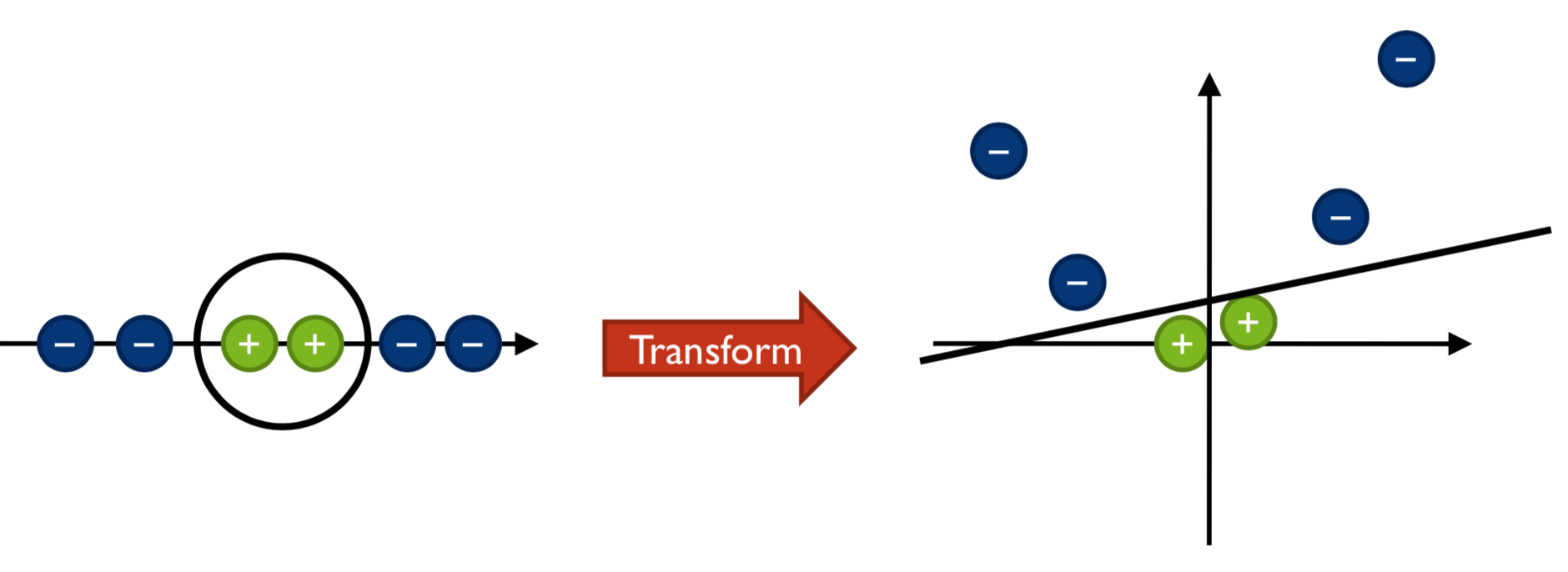
- Problem: Not all data is linearly separable (not noise)
- Idea: Transform data into higher-dimensional space
- Observation: Classification and training function use scalar product of vectors
- Kernel trick
- Transform function \( h: \mathbb{R}^d \rightarrow \mathbb{R}^{d'} \)
- Kernel is function that computes the scalar product of two vectors efficiently
- e.g. polynomial kernel \( k(x,y)=(1+x+y)^2 \)
- Applications
- Speech recognition
- Predict protein structures
- Beast cancer prognosis
- Stock forecast
SVM in information retrieval
Text classification
- Automatic assignment of topics
- Application to small and medium-sized document collections
Learning to rank
- Training set consists of pairs of documents \( (d_i, d_j) \) such that \( d_i \) is preferred to \( d_j \)
- Task:
- Find ranking function that assigns a numerical score \( s(d) \) to each document
- \( d_i \text{is preferred to} d_j \Rightarrow s(d_i) > s(d_j) \)
- Straightforward:
- \( s(d) = w*d \) (linear ranking)
- Use SVM to train
- Constraint: \( w * (d_i - d_j) -1 \geq 0 \)
- How to get training data?
- Joachims (2002)
- If user clicks on result \( k \) and not on result \( k-1 \), result \( k \) is preferred to result \( k-1 \)
- Workflow
- Compute initial results
- Collect user clicks
- Learn ranking function
- Use ranking function in retrieval process
Boosting
- Meta-algorithms: Blueprint for the combination of classification algorithms
- Idea: Combine weak learners to get a strong learner
- Weak learner: Slightly better than random guessing
- Approaches:
- Majority vote
- Adaptive boosting
Majority vote
- Approach
- Train each base classifier indepently
- Use majority vote of all classifiers for new document
- Problem: Individual strengths are ignored
- Solution: Allow expert votes (adaptive boosting)
Adaptive boosting
- Approach
- Train first base classifier
- Identify errors (misclassified documents)
- Assign high weight to errors/low weight to correct ones
- Train next base classifier on weighted training set
- Return to (2)
- Assign importance weight to each base classifier
- High importance if low-weight-objects are misclassified
- Low importance if high-weight-objects are misclassified
- Classification: Use weighted majority vote
- Tuning: Balance weights (importance + individual)
- Majority should be right very often
- Advantage
- Focus on hard training objects (expert vote)
Bias-Variance tradeoff
- Bias: Degree of not accounting specific characteristics of the training set
- Variance: Variance of the classifier over different training sets drawn from the true data points
- Learning error = Bias + Variance
- Overfitting: Low bias, high variance
- Underfitting: High bias, low variance
- Strategies to avoid overfitting
- Cross-validation (split data set, use classifier with best performance on test set)
- Regularization (add penalty for complex models, e.g., low polynomial degree; e.g., soft margin SVM)