General
- Definitions Information retrieval
- Find material of unstructured nature that satisfies as information need from large collections
- Retrieval of information from collection of written documents satisfying a user information need expressed in natural language
- Types
- Web search
- Enterprise, institutional, and domain-specific search
- Personal information retrieval
- Requirements
- Efficiency (process large collections fast)
- Scalability (system should work with large collections)
- Expressiveness (powerful querying model)
- Ranking (return the best match)
- Effectiveness (high result quality)
- Tasks
- Adhoc retrieval (standard IR task, answer arbitrary queries)
- Standing queries (monitor a set of document periodically)
- Effectiveness (quality of IR result)
- Precision (Fraction returned relevant of returned documents)
- Recall (Fraction returned relevant of real relevant documents)
Motivation
- Observation
- 80 % of business uses unstructured data
- 80 % of data is unstructured format
- 7 million web pages added per day
- Unstructured data doubles every three months
- Information flood needs to be managed
Libraries in the world
History
- Sumerian archives
- 3000 - 2000 BC
- 25000 clay tablets
- The Great Library of Alexandria
- 300 BC
- 750000 scrolls
- Gutenbergs Movable type
- 1450 AD
- Monastic libraries
- 1475 AD
- Hand-copying ancient texts
- German National Library
- 25 million items
- Library of Congress
- 164 million items
- British Library
- 170 million items
- World’s largest library
Catalogs and metadata
- Task: Describe data
- Classical catalog
- Author/editor
- Keywords/subject
MeSH
- Metadata for the MEDLINE database
- Life science and biomedical information database
- 26 million references
- Items are manually indexed
- Medical Subject Headings
- 27000 subject headings (called descriptors)
Dublin Core Metadata
- Small set of metadata to describe information resources
- Can be used with HTML (
metaorlinktag)
Full text search and indexing
- Use metadata to judge the relevance of a document
- Requires a powerful metadata set
- Needs to be simple
- Problem: Manual work is expensive
- Modern information retrieval: Automatically index documents
History of information retrieval
- 1957
- Hans-Peter Luhn
- Use words as indexing unit
- Document similarity by overlap
- 1960/1970
- Gerard Salton
- SMART system (vector space model)
- 1992
- Westlaw (legal research service, Boolean model)
Definitions
- Document
- Base unit of an IR System
- Coherent passage of free text
- Document collection/corpus
- \( N \) documents
- Set of documents
- Information need
- The topic the user wants to know sth. about
- Refers to individual cognitive state (background knowledge)
- Query
- What the user communicates to the computer
- Formal query language
- Relevance
- Document is relevant, if the user finds it matching his information need
- Binary concept
- Dictionary
- Index data structure
- Vocabulary
- Index terms
- Term-document incidence matrix
- Matrix indicating that a term \( t_i \) occurs in a document \( d_j \)
- Problem: Too huge to store in memory
- Solution: Inverted index
- Inverted index
- Observation: term-document matrix sparse
- Mapping from term to postings list
- Posting: Document ID
- Postings list: List of document IDs
- Index consists of dictionary and postings list
- Term frequency \( tf(d, t) \)
- Number of occurrences of term \( t \) in document \( d \)
- Document frequency \( df(t) \)
- Number of documents containing that term
- Length of postings list
- Collection frequency \( cf(t) \)
- Number of occurrences of \( t \) in the complete collection
- IR Model
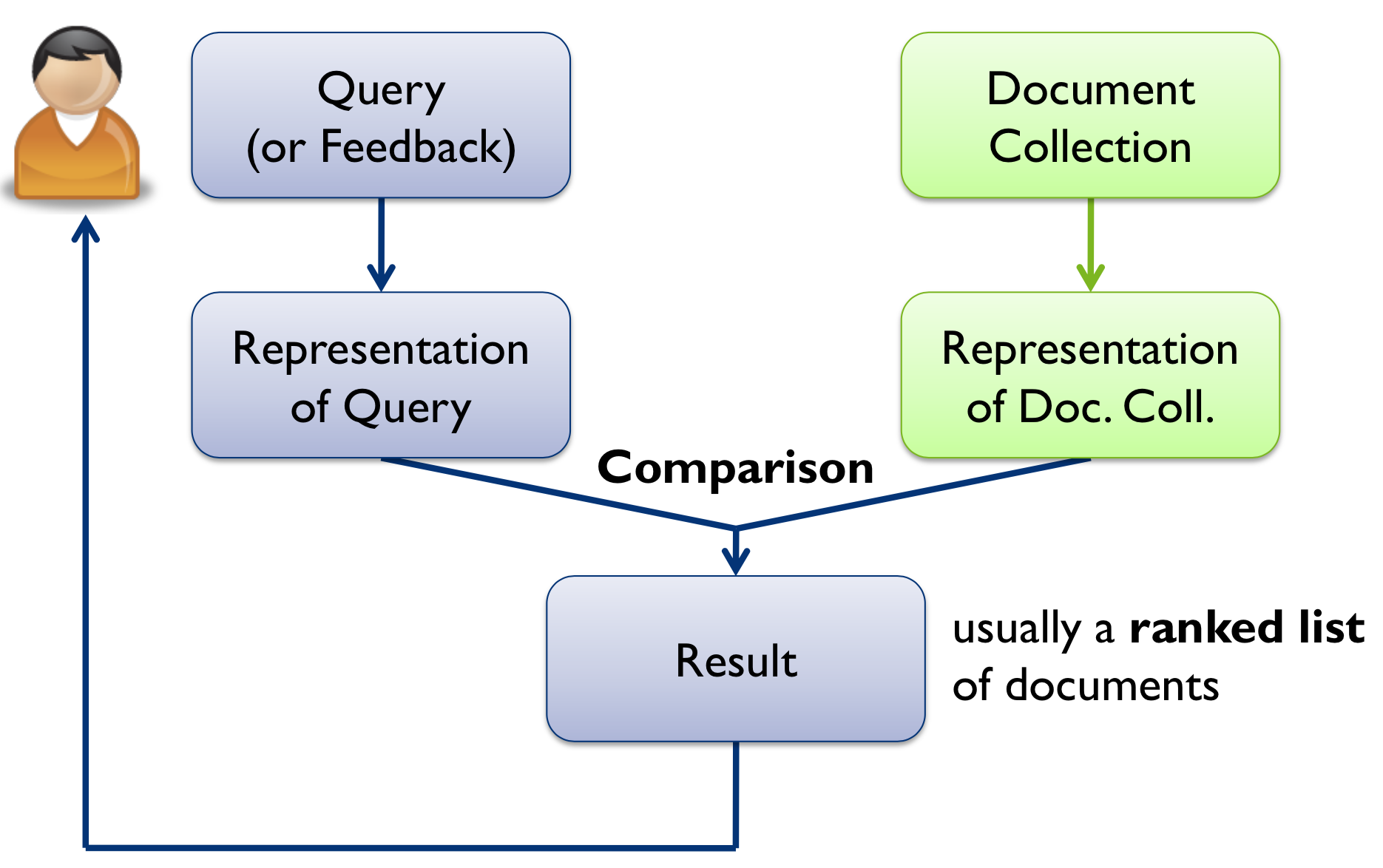
- Components
- Query language
- Internal representation of documents
- Internal representation of queries
- Ranking function (\( r:Q\times D\rightarrow \mathbb{N} \))
- Optional: Mechanism for relevance feedback
- Components
- IR System
- Application which implements an IR model, a query interface, relevance feedback, an index structure
- Application to support an user
Difference to data retrieval
- Data retrieval
- Clearly defined conditions
- Query stated in query language
- Well-defined result set
- Information retrieval
- Ill-defined information need
- Query stated in natural language
- Result list