Web Search
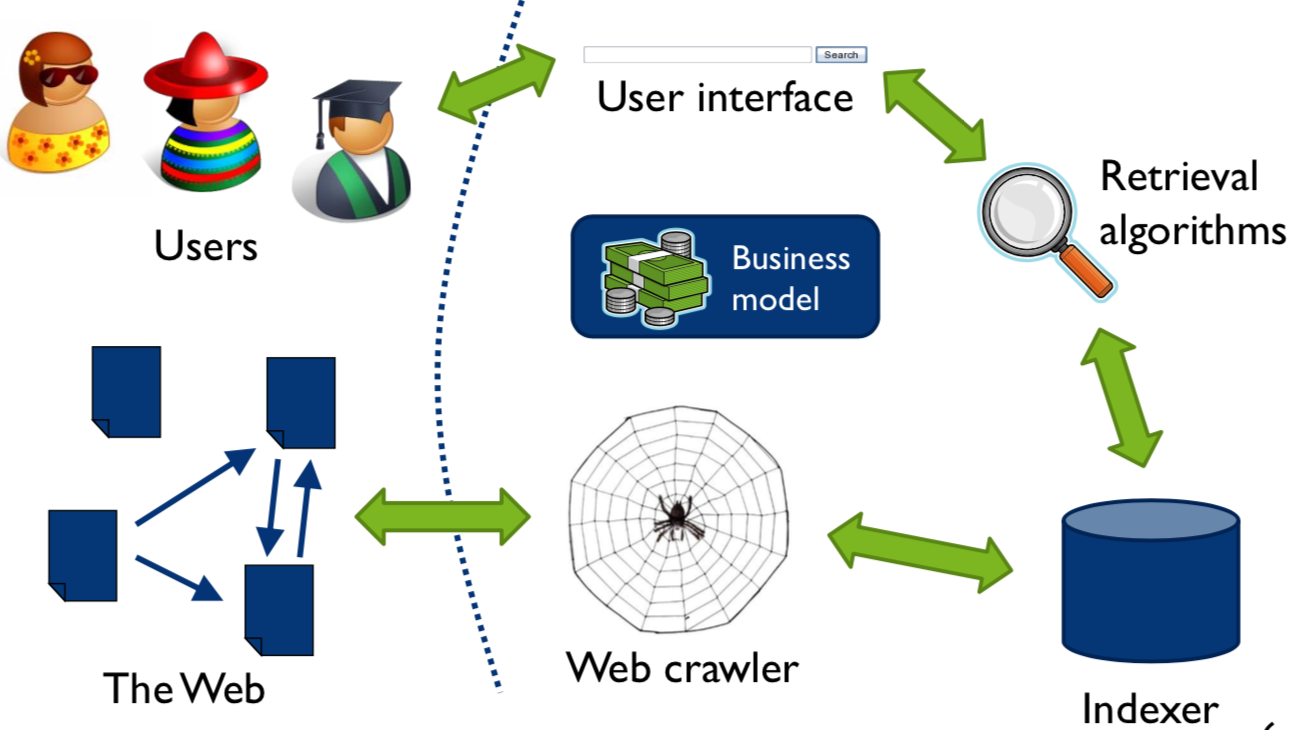
Difference to classical information retrieval
Heterogeneity
- Dynamic content/collection
- Different users (status 2014)
- 87 % of adults
- 97 % of 18-29 year old
- 57 % of 65+ year old
- Languages (status 2013)
- 55 % English
- 5 % German
- Various writing styles
- Document types
- HTML / XML / CSS / Flash
- MS Office types
- PDF / RTF
- TAR / ZIP
- Query types
- Informational (find information about topic)
- Navigational (find specific website)
- Transactional (find website providing a service)
- Connectivity (Find connected pages)
- Statistics (status 2008)
- Question: Actions of internet users on a typical day
- 60 % of adults search for information
- 60 % of adults check their emails
- 80 % of teens do social networking
- 62 % of teens get news
Link structure
- Interconnectedness of documents
- Links are not randomly
Size
- Queries per second
- High number of users
- Statistics (status 2005)
- Google: 700 qps
- MSN: 300 qps
- Index size
- Statistics(status 2014)
- Google: 15 trillion
- Bing: 9 trillion
- Estimation: ???
- Statistics(status 2014)
- Data size
- Challenge for crawler
- Handle new/deleted/updates pages
- Scalability
- Number of host names (seems to) grow exponentially
Spam
- Spamdexing: Fake relevance of pages
- e.g., Google bombing
- Increase term frequencies
Business model
- Web Search is expensive (storage, hardware, development)
- Business models
- Advertising model
- Subscription model
- Community model
- Infomediary model
Advertising model
- Show other ads of other companies
- Alternative: Pay people money if they use ad link
- e.g., Google AdSense/AdWords, Microsoft CashBack
- Requirement: Attractive search engine
- Example: Google AdRank
Subscription model
- Customer pays to use search engine
- Requires high quality search engine
- e.g., rent search engine for company’s site
Community model
- Users participate in development of the search engine
- Advantage: Reduced costs
- Handle costs with donations/ads
Infomediary model
- User participates in market studies
- Search engine analyzes users’ behavior
- Analyzed information is sold
- Problem: Privacy
Properties of the Web
Web page size
- Status 2011
- Average of 16 KB
- Average of 512 words
- 68 % of web pages does not change within a week
Index size
- Problems in estimation
- Duplicates (ignore)
- Spam (ignore)
- Dynamic web pages (focus on content)
- Pages/content that is considered
- Private sites (e.g., Facebook)
- Challenges
- Find duplicates
- Detect spam
- Handle dynamic sites
- Handle private sites
- Estimation using samples
- Two crawls \( C_1, C_2 \)
- \( P(p\in C_1 \mid p\in C_2) = \frac{|C_1\cap C_2|}{|C_2|} \)
- \( P(p\in C_1 \mid \text{Web}) = \frac{|C_1|}{|\text{Web}|} \)
- Assume: Probabilities are equal (sample is representative)
- \( |\text{Web}| = \frac{|C_1| * |C_2|}{|C_1\cap C_2|} \)
- Practice:
- Take samples from the index of search engines
- Samples are not independent
- Layers of the web
- Sufrace Web
- Deep web/invisible web
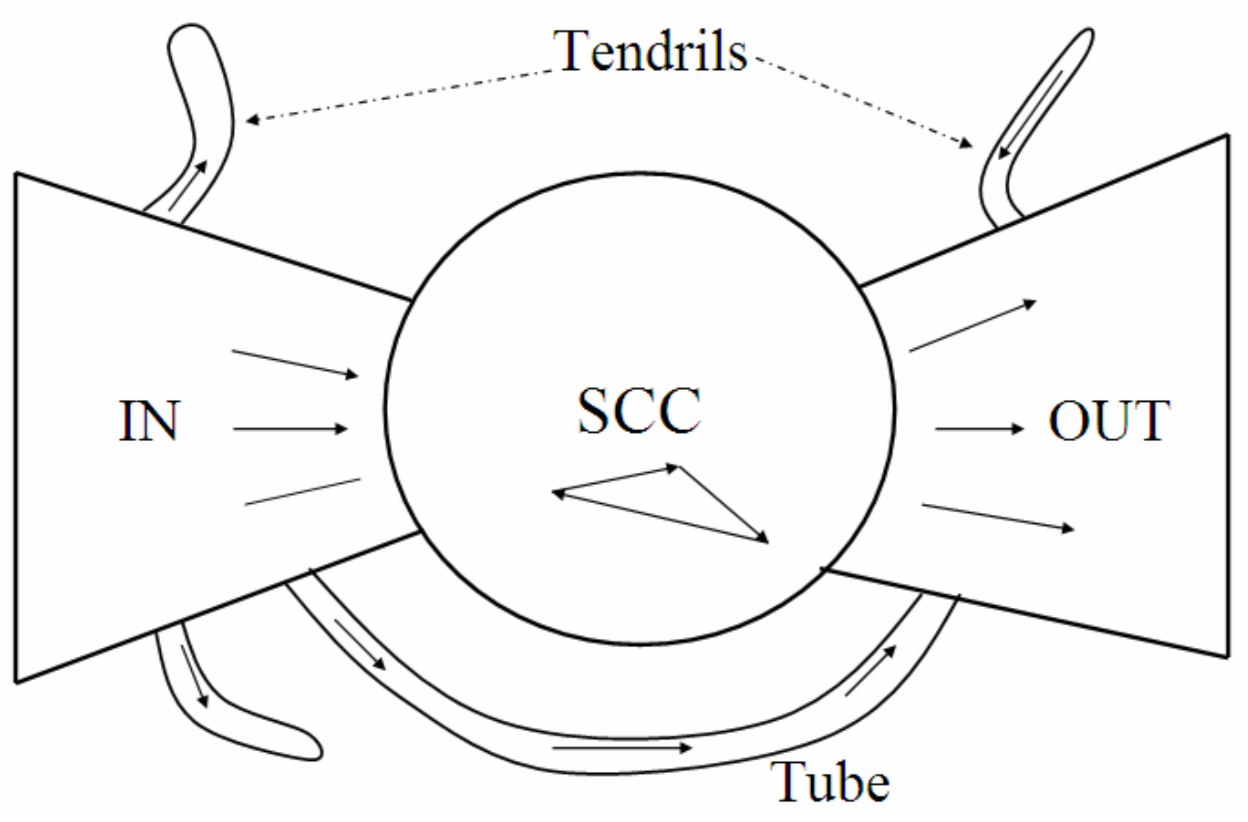
Shape (Web graph)
- Directed graph (in- and out-links)
- Distribution
- \( X_p \): Number of in-links of a page
- \( P(X_p=k) \propto k^{-2.1} \)
- Shape: Bowtie shape
- IN: Link into SCC
- SCC: Central core
- OUT: Links from SCC
- Tentrils: Links from IN to nowhere/nowhere to OUT
- Tube: Directly from IN to OUT
- Disconnected components
User behavior
- Page Popularity is Zipf distributed
- Incoming traffic is Zipf distributed
- Average query length: 2.4 terms
- Single-term queries: 50 %
- 50 % of users looks on first 20 results
- Term frequency distributed follows power law
Web crawling
Web resources
Identification using URIs
<scheme>://<authority><path>?<query>#<fragment>- Normalization
- Quote characters
- Case normalization
- Remove default ports
- Remove path segments
Retrieval using HTTP
- Protocol for client/server
- Base: TCP/IP
- Map hostnames to Domain Name System (DNS)
- Methods:
- GET (request resource)
- HEAD (request meta data)
- POST (submit data)
- Status codes:
- 2xx Success (e.g., 200 OK)
- 3xx Redirect (e.g., 301 Moved Permanently, 304 Not Modified)
- 4xx Client Error (e.g., 404 Not Found, 410 Gone)
- 5xx Server Error (e.g., 500 Internal Error)
Representation using HTML
- Hypertext Markup Language
- Describe structure of text-based information
Challenges
- Spam detection
- Duplicate detection
- Spider trap avoidance
- Spider trap: Link (invisible for user, excluded for serious crawler) to block IP address of undesired crawler
- Distribute process
- Handle latency problems (slow responses)
- Crawling depth
- Respect site owner’s policies
Crawler
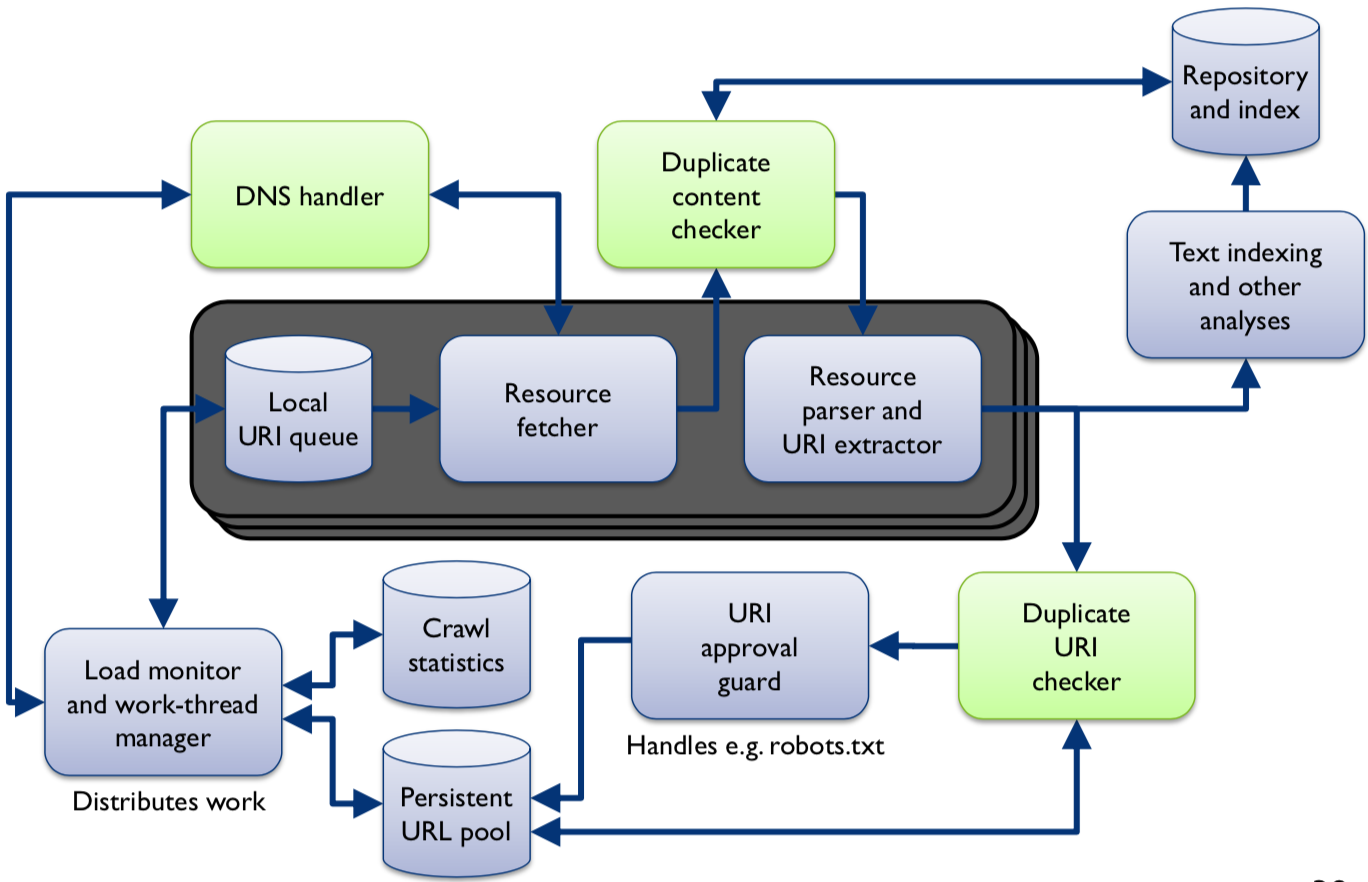
- Architecture
- Queue of URIs
- Method for data retrieval/processing
- Page parser (extract links)
- Connection to indexer of the search engine
- Algorithm
- Initialize queue with seed pages
- Retrieve page from the next URI
- Extract URIs
- Add URIs to queue
- Repeat
Features
- MUST-have
- Robustness
- Golden rule: For every possible problem, there is a website exhibiting this problem
- Handle failures (e.g., spider traps)
- Politeness
- Do not generate high traffic (traffic is money for the customer)
- Respect crawling policies (e.g.,
robots.txt)
- Robustness
- SHOULD-have
- Distributed
- Scalable
- Performance/efficiency (efficient resource usage)
- Quality (update relevant pages more often than non-relevant)
- Freshness
- Continuous mode
- Crawl proportional to rate of change
- Ability to update set of pages on demand (e.g., World Cup)
- Extensible (new data formats, new protocols, modular architecture)
DNS Handler
- Customized local DNS component
- Problem: DNS request is slow (parallel requests, latency)
- Solution:
- Prefetch DNS information
- Relaxed policy for DNS updates (i.e., ignore the standard for practical reasons)
Duplicate URI Checker
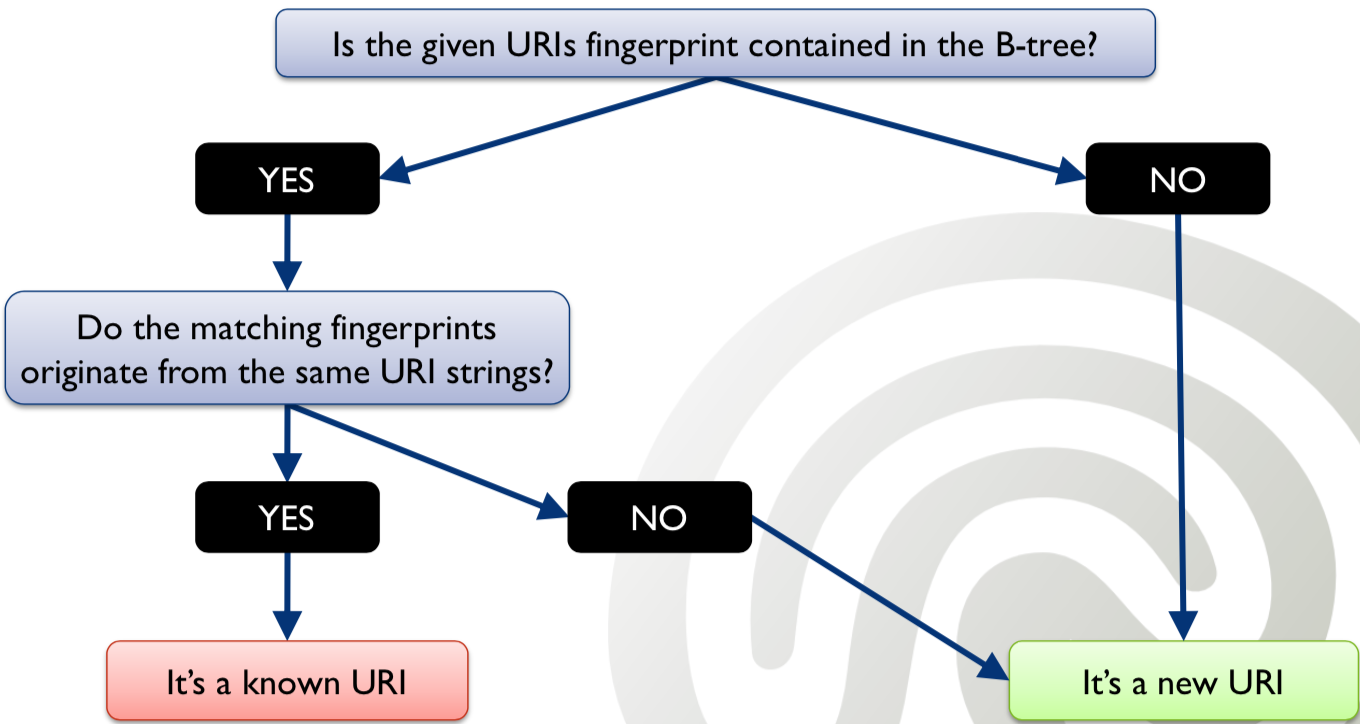
- Task: Check if URI has been checked (avoid unnecessary fetching)
- Problem: String comparisons are expensive
- Solution: Fingerprints
- Fingerprinting
- Normalize URIs
- Compute URI hash
- Insert URI hash into B-tree (efficient search)
- Problem: Amount of storage
- Solution: Locality
- Idea: Enforce URI locality to speed up access (URIs with the same hostname are accessed together)
- Use concatenation of two fingerprints (hostname, rest)
- Use hash function with continuity
Duplicate Content Checker
- Problem: Near-duplicate detection (e.g., timestamps)
- Normalization:
- Remove styling information
- Convert to text-only
- Drop navigational structures
- Drop images/dynamic content
- Solution: Shingling
- Create k-shingles/k-grams (on words) for each document
- Definition: Documents \( d_1,d_2 \) are near-duplicate iff \( J(d_1,d_2)>0.9 \)
- \( J(d_1,d_2)=\frac{|S(d_1)\cap S(d_2)|}{|S(d_1)\cup S(d_2)|} \)
- Problem: Expensive computation \( O(n\log n) \) (sorting, merging)
- Randomized approximation algorithm
- Hash sets and perform random permutation (uniform distribution)
- \( J=P(\min(\Pi(d_1)) = \min(\Pi(d_2))) \)
- Proof: Vector reordering, using relative frequency of (1,1)-columns over not-(0,0)-colums
- Hashing and permutation forms a new hash function
- Compare: Drawing with placing back
- Estimation
- Create sketch of document
- \( \Psi(d) = (\min(\Pi_1(d)), ..., \min(\Pi_{200}(d))) \)
- \( J(d_1,d_2)\approx \frac{\text{Overlap}(\Psi(d_1), \Psi(d_2))}{200} \)
- Using 200 permutations estimates the probability (Law of large numbers)
- Problem: Expensive comparison of sketch of every document to new one
- Solution: Pruning/Indexing
- Order pairs \( (\Psi_i(d), id(d)) \) by \( \Psi_i(d) \) in B-Tree
- For each new document, union documents for each \( \Psi_i(d_{new}) \) in B-Tree
- Compute Jaccard-index with pruned documents
Focused crawling
- Search engine focuses on specific topic
- Start with manual set of pages
- Use classifier for new pages
Link Analysis
Basis
- Assumptions
- Hyperlink is signal of quality/popular interest
- Anchor text of a link describes target
- Algorithms
- PageRank (Page, 1998)
- HITS (Kleinberg, 1999)
PageRank
- Page et al., 1998
- Idea: Assign query-independent measure of prestige/popularity to Web resources
- Solution: Use Seeley’s model of prestige (prefer in-links from high quality resources)
- Components
- Random surfer model yields stochastic matrix
- Perron-Frobenius theorem yields unique stationary probability vector \( p \)
- Formula fits Seeley’s mode of prestige
- Importance
- PageRank is only one component in ranking (e.g., anchor texts, phrases, proximity)
- Addressing link spam is important
- Improvement
- Remove navigational links (quality assumption does not editorial judgement, i.e., link means a recommendation)
- Remove nepotistic links (e.g., sites by same author, hard to detect)
Random Surfer model
- 90 % of time, surfer clicks random hyperlink
- 10 % of time, surfer types in a random URI
- PageRank is long-term visit rate of nodes
- Use transition matrix
- Probabilities to move from page \( i \) to page \( j \)
- Sum of rows equals 1
- Problems:
- No equal probability for link-choosing (usually topic-driven)
- Back button/bookmarks are not considered
- Algorithm
- Choose a random page \( d \) (uniform distribution)
- Choose random number \( p \)
- If \( p > \lambda \land deg^+(d)>0 \), randomly choose an out-link, continue at (2)
- If \( p < \lambda \lor deg^+(d)=d \), choose a random page, continue at (2)
Convergence
- Transition matrix \( T \) (Markov chain)
- Probability: \( p_{t+1} = T^T * p_t \)
- Probability vector converges iff t limits infinity
- \( p=T^T * p \)
- \( p = \lim\limits_{t\rightarrow \infty} p_t \)
- \( p \) is eigenvector \( T_T \) with eigenvalue \( 1 \)
- Perron-Frobenius theorem because \( \lambda > 0 \) and therefore \( T \) has only positive entries
- \( p \) is stationary probability vector
Computation
- Compute eigenvalues
- Power iteration
- Iteratively compute \( p_{i+1}=A^T * p_i \)
- Normalize \( p_{i+1} \)
- Converges against eigenvector with largest eigenvalue (in this case, the stationary vector)
- Use Map and Reduce
Topic-sensitive PageRank
- Problem: Resource can be important in a local view/specific topic
- Uses set of topics/classification to assign topics
- Topic-sensitive PageRank is compute on set of each topic
HITS
- Kleinberg el al., 1999
- Hyperlink Induced Topic Search
- Patent assigned to IBM
- Idea: Assign query-dependent hub score and authority score to Web resource
- Hub: List of links to authorities
- Authority: Definitive high-quality information
- Page can be hub and authority
- Advantage
- Query-dependent
- Uses subset of Web graph
- Disadvantage
- Expensive (computation at query time)
Formalization
- Important: Connection to SVD
- Root set: Compute using standard IR system
- Base set \( V_q \): Root set and neighbors of root nodes
- Authority score:
- \( a = \alpha A^T h \)
- Proportional to sum of hub scores linking to it
- Eigenvector of \( a=\alpha\beta A^TA a \)
- Hub score:
- \( h=\beta A a \)
- Proportional to sum of authority scores to which it links
- Eigenvector of \( h=\alpha\beta AA^T h \)
- \( \alpha,\beta \): Proportionality constants
- Use principal eigenvectors (hubs/authorities in largest linked community)
- Computation
- Power iteration
- SVD (\( U \) contains eigenvectors of \( AA^T \), \( V \) contains eigenvectors of \( A^TA \)
- Problem: Ambiguous/polarized query
- Base set contains disconnected components
- Principal eigenvector are hubs/authorities in largest linked community
- Solution: Don’t use strictly the principal eigenvectors
Spamdexing
- Goal: Rank Web resource unjustifiably high (e.g., SEO)
- Idea: Find weaknesses in ranking algorithms + exploit weaknesses
- Techniques:
- Content spam (change page content)
- Link spam (change link structure)
- Important:
- Create good content
- Costs in cheating search engine is higher than benefit
- Rule: Link is recommendation
Content Spam
- TF-IDF / Google Bombing
- Add keywords to content/title/URI/anchor text
- Add related high quality content (e.g., Wikipedia) to your site
- Countermeasure:
- Classification (Problem: Feature selection)
- Detection of hiding the text
- Cloaking
- Distinguish between IP addresses (deliver different page to crawler then to user)
- Types: IP-cloaking, User-Agent-cloaking
- Doorway pages
- Automatic redirect from different pages to cheating page
- Different pages are optimized for specific queries
Link spam
- Idea: Improve rank by getting in-link from other pages
- Problem: Hard to detect
- Countermeasures:
- Remove pages with similar in-links (comment spamming/Google bombing)
- Remove copies of high quality content (honeypot)
- White-list of good pages (use distance to white-list pages as indicator of trustworthiness)
Comment spam
- Spam comment section of indexed high quality forums (e.g., blogs, Wikis)
- Countermeasure: CAPTCHA
- Countermeasure against CAPTCHA:
- Character recognition algorithms
- Crowd-solving CAPTCHAs
Link farms
- Large set of pages with links to each other
- Set out-links to high quality pages (e.g., high hub score)
- Result: High authority scores
Honeypots
- Copy high quality content pages (e.g., copy Unix documentation, Wikipedia)
- Add hidden links to your target
Buy expired domains
- Monitor DNS records & buy expired domain
- Replace page with redirect to your page
Google’s hardware
- Data from 2007
- Custom-built servers
- 7 % of all internet traffic generated by GOogle
- Server rack:
- 40-80 commodity class PC servers
- 12 V battery
- Unstable but cheap
- Challenges
- Deal with failures
- Avoid data loss
- Guarantee 100 % uptime
- Sources:
- https://www.youtube.com/watch?v=Ho1GEyftpmQ
- https://www.youtube.com/watch?v=XZmGGAbHqa0
Metasearch
- Similar to Boosting: Combine strengths/weaknesses of multiple search engines
- Metasearch engine uses result lists
- Problem:
- \( k \) ordered result lists of size \( n \)
- Task: Aggregate results into single ranking with some constraints (similar to social choice theory)
- Assumptions
- Search engines are independent
- Search engines have similar quality
- Aggregation methods
- Majority rule
- Borda count
- Application
- Search engine with maximum recall
- Other queries don’t work well
Aggregate quality
- Pareto efficiency:
- If every search engine ranks \( p_a \) over \( p_b \), \( p_a \) is ranked higher than \( p_b \) in aggregate ranking
- Non-dictatorship:
- Aggregate ranking should be unequal to the ranking of any search engines
- Independence of irrelevant alternatives
- If A is ranked higher than B, adding C to the individual search engines does not change the ranking of A and B
- Kenneth Arrow’s impossibility theorem
- 1951
- If there are more than two different pages to be ranked, there is no deterministic aggregation algorithm that satisfies Pareto efficiency, Non-dictatorship and independence of irrelevant alternatives
Aggregation method
Majority rule
- Assumption: All search engines ranked the same pages
- For each pair \( (a,b) \) count the number of search engines ranking \( a \) higher than \( b \)
- \( (c_{ij})=|\{s\mid\text{rank}_s(i)>\text{rank}_s(j), \text{s is search engine}\}| \)
- Rank is given by product of rows
- Problem: Cycles
Borda Count
- Assign to each result in each ranking a score
- \( \text{score}_\text{ranking i}(a) = \text{rank}(a) \)
- \( \text{score}(a) = \sum_i \text{score}_\text{ranking i}(a) \)
- Advantages
- Easy
- Can handle unranked results
- Can weight search engines result
- Disadvantages
- Tie
- Assumes uniform degradation of relevance
Kendall’s Tau
- Measure for the agreement of two result sets
- \( \tau \in [-1,1] \)
- Both results contain the same \( m \) elements
- For each pair of results count if the ordering is the same in both result sets
- \( p_+ \): Number of agreeing pairs
- \( p_- \): Number of disagreeing pairs
- \( \tau = \frac{p_+-p_-}{\binom{m}{2}} = \frac{2(p_+-p_-)}{m(m-1)} \)
Privacy
- Problem: AOL Dataset (users were de-anonymized)
- Netflix: Matching with IMDB dataset
Social networks and prestige
Seeley’s model of Prestige
Centrality
Co-citation