Evaluation in information retrieval
- Efficiency
- Aspects
- Storage space
- CPU time
- I/O operations (number, load)
- Response time
- Scalability
- Goal: Efficient enough
- Easy to evaluate
- Aspects
- Effectiveness
- Measure result quality
- Key concept: Relevance
- No precise definition
Relevance
- Manifestations of relevance
- System/algorithmic relevance
- Topical/subject relevance
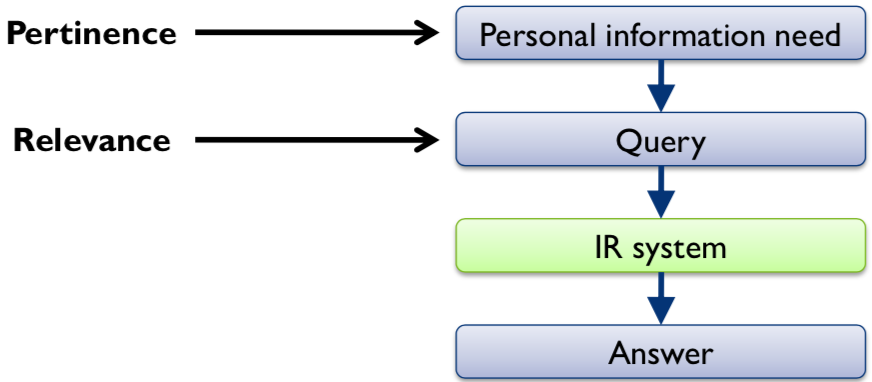
- Cognitive relevance/pertinence
- Situational relevance/utility
- Affective relevance
- Notion of relevance in the lecture: Topical/subject relevance
- Current IR goal: Topical/subject relevance
- Future IR goal: Other manifestations of relevance
- Relevant to query means relevant to typical information need for that query
System/algorithmic relevance
- Static and objective concept
- Fit between retrieved documents and user’s query
- Measurement: Effectiveness/rules for comparison
Topical/subject relevance
- Static and subjective concept
- Semantic fit between query and topics of retrieved documents
- Based on judgements
- Measurement: Aboutness
Cognitive relevance/pertinence
- Dynamic and subjective concept
- Relation between content of documents and cognitive state of knowledge/information need
- Judgement about the applicability of the documents
- Dynamic: May change over time
- Measurement: Information quality/informativeness
Situational relevance/utility
- Dynamic and subjective concept
- Relation between documents and situation/task/problem
- Can the user complete his task with the retrieved documents?
- Serendipity: Information can be useful without expecting it
- Measurement: Reduction of uncertainty/Usefulness in decision making
Affective relevance
- Dynamic and subjective concept
- Relation between documents and user’s intents/goals/emotions/motivations
- Represents the human drive for information
- Measurement: Success/satisfaction
Evaluate relevance
- Benchmark approach
- Document collection
- Set of queries (information needs)
- Gold standard: Assessment of relevance for each query-document pair
- Problem: Assessment for large document collections is very expensive
- Solution: Pooling method
- Assumption: Un-assessed/un-marked documents are irrelevant (default)
- Run query on set of IR systems
- Union top-k results
- Present union of documents to human assessors
- Test collections
- Assumptions
- Binary relevance
- Independence of assessing documents
- Collection resembles real retrieval (query logs?)
- Intersubject reliability: Consistency between multiple users’ opinion
- Cranfield collection
- 1960, Cranfield university
- 1400 abstracts of aerodynaics
- 225 queries
- Judgement: Five steps
- TREC
- 1992, Text retrieval conference
- 1.9 million documents (newswire)
- 450 queries
- Judgement: Binary
- Reuters-RCV1 (800000 stories)
- Assumptions
Metrics
- Evaluate sets
- Precision
- Recall
- Fallout
- F-measure
- Evaluate lists
- Precision at k
- Recall at k
- Interpolated precision (for precision-recall curve)
- Mean average precision
- Errors
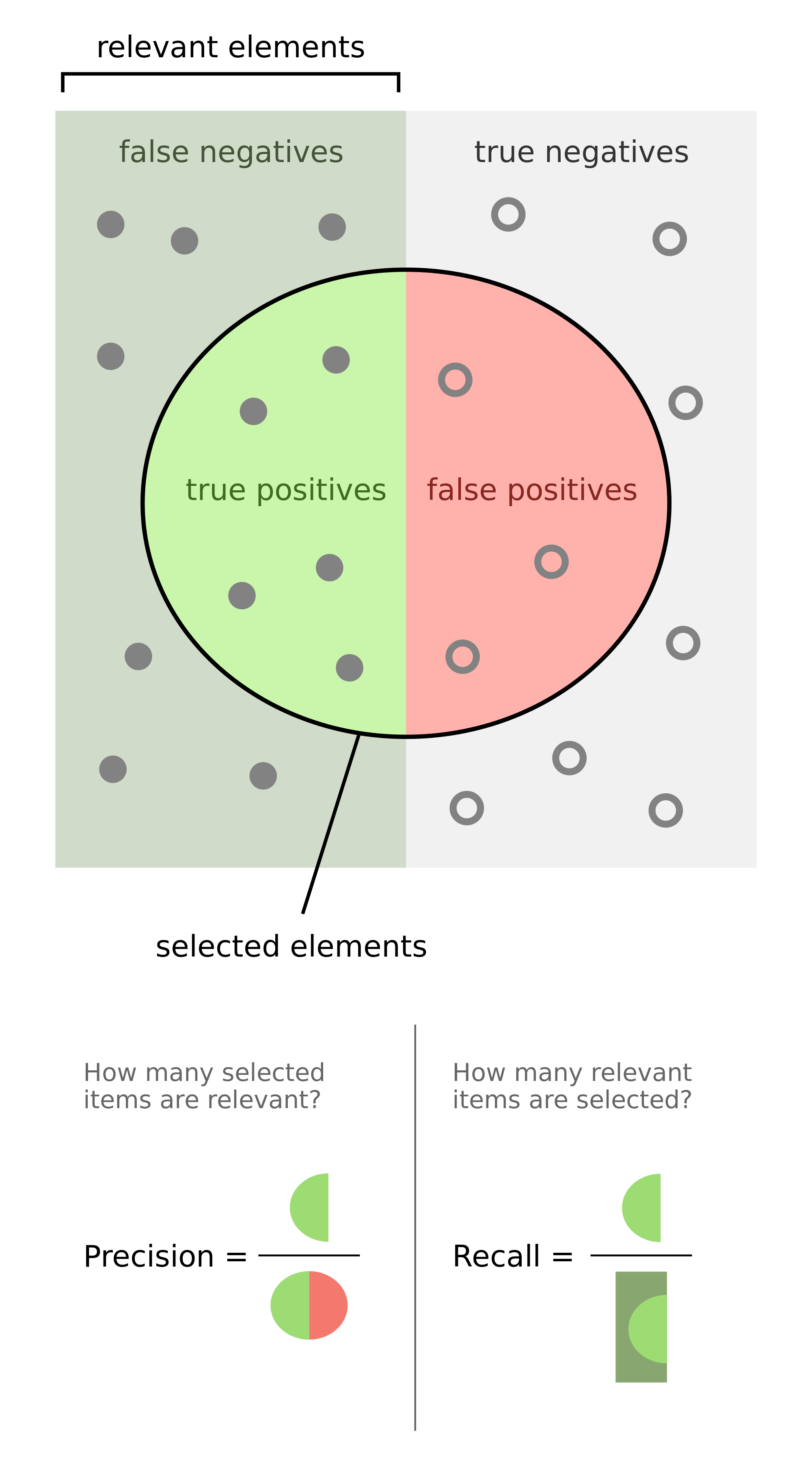
- False positives
- Irrelevant documents returned by the system
- Unnecessary extension of result set
- False negatives
- Relevant documents not returned by the system
- User is not aware of missing documents
- Often worse than false positives
- False positives
Precision
- Use for result sets
- Called Positive predictive value PPV
- Ratio of returned relevant documents to all returned documents
- \( Precision = \frac{TP}{TP+FP} \)
- Important for Web search
Recall
- Use for result sets
- Called True positive rate TPR, Sensitivity, Hit rate
- Ratio of returned relevant documents to all relevant documents
- \( Recall = \frac{TP}{TP+FN} \)
- Important for professional searchers
- Important for desktop search
- Hard to measure (relevant documents often unknown)
Precision-recall curve
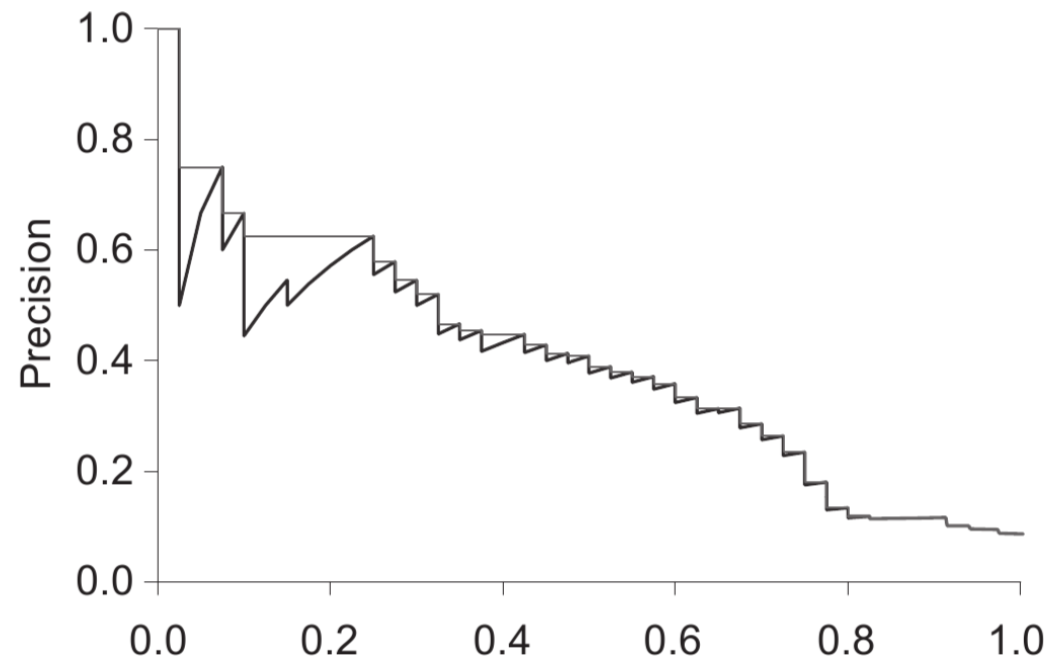
- Precision and recall tradeoff against each other
- Leads to system tuning
- Decide whether to optimize precision/recall
- Result lists
- Sawtooth shape ((k+1)-th document is non-relevant, recall stays the same but precision drops)
- Interpolated precision: Precision at recall \( r \) is highest precision of any recall level \( r'>r \)
Fallout
- Use for result sets
- Called False positive rate FPR
- Ratio of returned non-relevant documents to all non-relevant documents
- \( Fallout = \frac{FP}{FP+TN} \)
- Important for large result sets
F-measure
- Use for result sets
- Combine precision and recall
- Weighted harmonic mean (reciproke of the weighted average of the reciprokes)
- \( F=\frac{1}{\alpha \frac{1}{precision}+(1-\alpha)\frac{1}{recall}} \)
- Parameter \( \alpha\in [0,1] \)
- Motivation harmonic mean: \( F=0.5 \) with arithmetic mean by returning all documents
Precision/recall at k
- Use for result lists
- Compute precision/recall for the first \( k \) returned documents
Mean average precision
- Use for result lists
- Single aggregated value for a IR system
- Advantage:
- Good discrimination
- Stability
- Computation
- Compute precision at k for any k that there is a relevant document on position k
- Compute arithmetic mean of these precision at k values
- Repeat this computation for every query and compute the average precision