Implementation
Document preparation
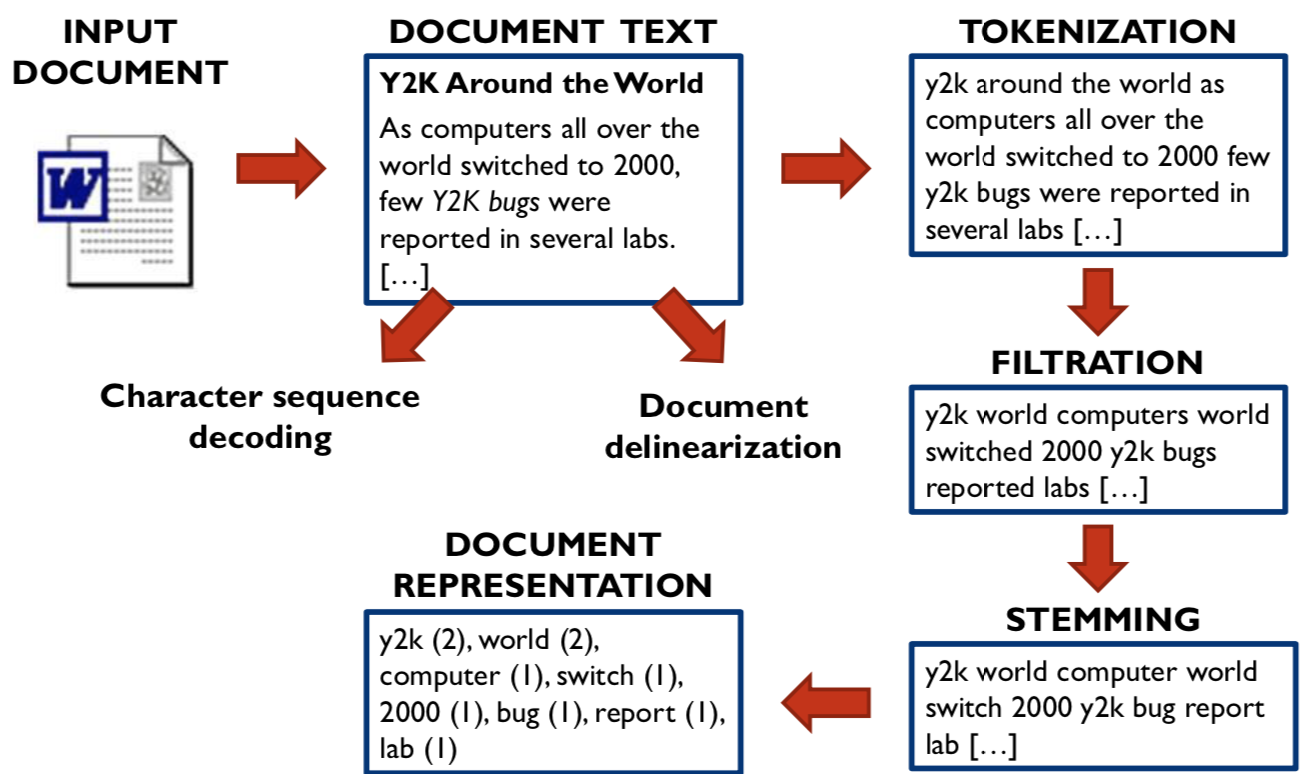
- Workflow
- Character sequence decoding
- Document delinearization
- Tokenization
- Filtration
- Stemming and lemmatization
- Representation
- Problems
- Heterogeneous data (date formats, coding)
- Multiple forms of the same word (apple, Apple, apples, Apple’s)
- Important: Query must be processed the same way
Character sequence decoding
- Goal: Get textual representation
- Problems: Different formats
- e.g., DOC, PDF, HTML, RTF
- Solution: Converters
- Problem: Different character encodings
- e.g., UTF-8, ASCII, ISO-8859-1
- Character encoding unspecified/wrongly specified
- Solution: Heuristics for auto-detection
- Problem: Double-column PDF with images
Heuristics for encoding detection
- Coding scheme method
- Exclude encodings by checking for illegal byte sequences
- Character distribution method
- Use language statistics of character frequencies
- Compare byte frequency with character frequency
- Collect co-occurring bytes (?)
- Two-char sequence distribution method
- Use statistics about 2-grams
- Pairs of adjacent characters
Document delinearization
- Goal:
- Split documents into smaller parts
- Select document unit (e.g., file, email, web page, slides)
- Motivation:
- Unix Email
mbox-Format contains multiple emails, which could be considered as single document - Split large documents to parallelize processing
- Unix Email
- Split by heuristics
Tokenization
- Goal: Convert text into sequence of tokens
- Definition token: Useful semantic unit for processing
- Aspects:
- Tokenization is language-specific
- Tokenization rules affect the expressiveness
- Every transformation has problems
- Tasks:
- Token normalization
- Equivalence classing for tokens
Transformation/normalization rules
- Split whitespaces (several problems, see below)
- Remove formatting information (e.g., HTML-tags)
- Replace/remove diacritics (e.g., accents, umlauts)
- Remove punctuation (e.g., U.S.A. becomes USA)
- Case folding
- e.g., convert to lower case
- Exception for names
- Truecasing: Heuristics for case folding
Problems
- Multiple related words form one token
- e.g., San Francisco, New York
- No whitespaces in text
- e.g., Chinese characters (one word or multiple)
- Solution: Word segmentation
- Formatting
- e.g., dates, telephone numbers
- Different format, could be the same token
- Compounds
- e.g., white space vs. whitespace
- Solution: compound splitter (check if subwords are contained in vocabulary)
- Hyphens
- e.g., Hewlett-Packard, co-education
- Case folding
- e.g., windows vs. Windows
- Punctuation
- e.g., C.A.T. vs. cat
Filtration
- Goal: Remove stop words
- Stop word: Common word without representational value
- Problem: Phrase queries
- e.g., King of Finland
- Stop word is necessary
- Strategies:
- General
- Sort tokens by collection frequency
- Identify top-k as stop list
- Domain-specific
- Use predefined stop list
- General
- Trend: Small stop lists
- e.g., 7-12 terms
- Storage no problem due to good compression
- Web search engine: No stop words
Stemming and lemmatization
- Definition Lemmatization: Group together different inflected forms of a word (professional)
- Definition Stemming: Lemmatization using crude heuristics (no context, no rules)
- Problem with lemmatization
- Computationally expensive (for large collections)
- Gains (mean average precision) over stemmers are modest for English (0-5%)
- Stemmers:
- Porter stemmer (1980)
- Lovins stemmer (1968)
- Paice/Husk stemmer (1990)
Porter stemmer
- Porter, 1980
- Stemmer tool for english language
- Idea: Suffixes are mostly made from combination of smaller, simpler suffixes
- Algorithm uses five steps
- Each step applies rules to change the suffix of a word
- e.g., ing->EMPTY, ies->i
Representation
- Input: List of tokens (stemmed)
- Output: Final document representation (e.g., bag-of-words, vector)
- Next step: Build index
Indexing
- Important aspects
- Indexing granularity (e.g., book, chapter, paragraph, sentence)
- Handling large collections
- Reduce disk accesses
- Goal: Inverted index
- Index is term-postings-mapping
- Optional: Add idf to term
- Optional: Sort
- Postings list: Tuples with docID and term frequency
- Index is term-postings-mapping
- Requirements
- Keep index small
- Minimize disk accesses
- Solution: Use compression
- Indexing types
- Static/dynamic
Static/dynamic indexing
- Static indexing
- Build index at design time
- Dynamic indexing
- Situation: Changes in collection
- Problem: Complete rebuild too expensive
- Solution:
- Auxiliary index in-memory
- Merge with disk-index if too large
Algorithm
- Run document preparation (assign docID)
- Compile list of terms
- Assign termID to each term
- Create matrix/list (termID, docID, tf)
- Sort list by termID and docID
- Alternative: Sort by termID and tf
Handle large collections
- Small collection: Fit in main memory (no problem)
- Large collection: Disk access necessary
- Sort-based inversion
- External sorting algorithm
- Merge-based inversion
- Read/index in-memory until buffer filled
- Flush to disk and merge
- Advantage: Practical, scalable
- Sort-based inversion
Compression
- Types of codes
- Fixed-length codes
- Variable-length codes
- Advantages
- Less disk space utilization
- Better caching (more data per block)
- Better data transfer
Enhancements of the postings list
- Storing gaps
- Store gaps between two document IDs
- Use gaps instead of document IDs
- Skip lists
- Goal: Reduce number of disk accesses
- Add evenly spaced skip pointers to list
- Skip pointer consists of pointer to posting and its value
- Intersecting (AND-query) two postings lists one can follow the skip pointer
Fixed-length codes
- Fixed-length for document ID and term frequency
- e.g., 32 bit and 16 bit
- Size: \( df(t) * 48 \) bit
- Problem: Not space-efficient
- Few documents occur very frequently
- Most documents occur very rarely
- Solution: Variable-length integers
Variable-length codes
- Advantage:
- Store arbitrary large numbers
- Store small values with little cost
- Types
- Unary code
- Elias’ gamma code
- Elias delta code
Unary code
- Use for integers \( x>0 \)
- Representation: \( x-1 \) ones and trailing zero
- Example: \( 6=111110 \)
- Optimal for \( P(x) \approx 2^{-x} \)
- Alternative: Store \( x \) ones and trailing zero (not necessary in IR)
Elias gamma code
- Use for integers \( x>0 \)
- Representation
- \( x = 2^a+b \)
- \( a=\lfloor \log_2 x \rfloor \)
- \( 0\leq b < 2^a \)
- Concatenate \( a+1 \) in unary code and \( b \) in binary with width \( a \)
- Example: \( 12=2^3+4=1110100 \)
- Optimal for \( P(x) \approx \frac{1}{2x^2} \)
Elias delta code
- Use Elias gamma code
- Motivation: Elias gamma code becomes long for large numbers
- Encode the \( a \) part with Elias gamma code
- Example:
- \( 1025 = 2^{10} + 1 \)
- \( 10=2^3+2 \)
- \( \gamma = 1111111110,0000000001 \)
- \( \delta = 110,010,0000000001 \)
Handle phrase queries
- Phrase query: Query with word order
- Strategies
- Post-processing
- Prune using normal retrieval
- Search documents for phrase
- Positional postings
- Add word positions into each posting
- Check positions during evaluation
- Partial phrase index
- Create multi-term-index for certain phrases
- Post-processing
- Hybrid processing
- Use phrase index for frequent terms
- Use positional postings (efficient due to compression)
- If not positional postings found, use post-processing technique