Access Control
- Fundamental concept:
- Protection System (specification)
- Reference monitor (enforcement mechanism)
- Models:
- Discretionary Access Control
- Mandatory Access Control
Definitions
- Access Control: Control the permissions of subjects on objects
- Access Control Policy: Set of rules after which access should be granted
- Subject: Entity performing an action (e.g., users, processes)
- Object: Entity on which an action is performed (e.g., resource, file)
- Operation: Action to be taken
- Access control mechanism
- Enforces Access Control Policy
- Authorize requests from subject to object
- Enforcement levels
- Operating System: TCB (determine security by allowed control flows)
- Applications: Database, JVM, Browser, Python
- Multi-layered: Virtual Machine + OS + Application
- Important: All layers should be consistent with system security goals
- Safety problem:
- Ensure that current and future protection states ensure security goals
- Given:
- Set of rules (policy)
- Initial access matrix
- Generic access right a
- Task: Manipulate matrix using policy so that any subject gets a
- Problem: Undecidible
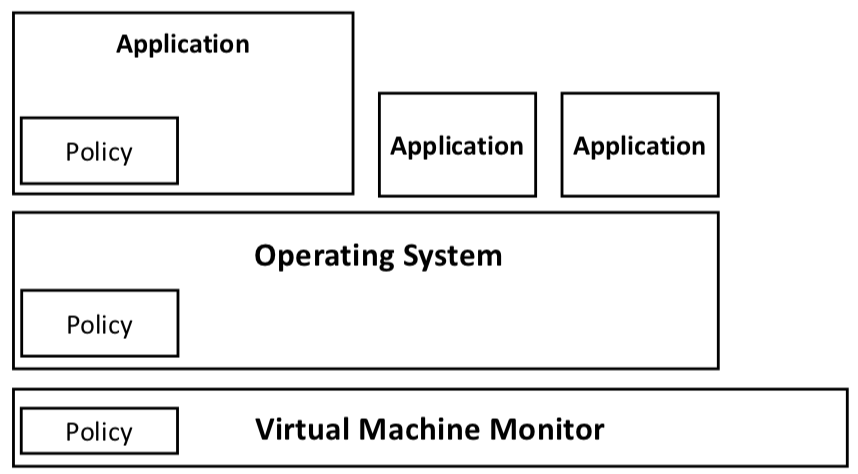
Protection System
- Definition Protection System
- Define access control specification
- Protection state
- Operations that subjects can perform on objects
- e.g., State of access Matrix
- Set of protection state operations
- Modify protection state
- Important for adding new subjects/objects
- Defintion Protection Domain
- Set of objects and actions a process can perform
- Goals
- Determine whether the enforcement mechanism enforces policy correctly
- Determine whether the policy expresses effective goals
Reference monitor
- Purpose: Access control enforcement mechanism
- Components
- Reference monitor interface (e.g., LSM)
- Reference validation mechanism (e.g., SELinux)
- Policy store (e.g., policy database) Is this the implementation???
- Reference monitor concept (guarantees)
- This is a major focus of the course
- Complete Mediation
- Tamperproof
- Verifiable
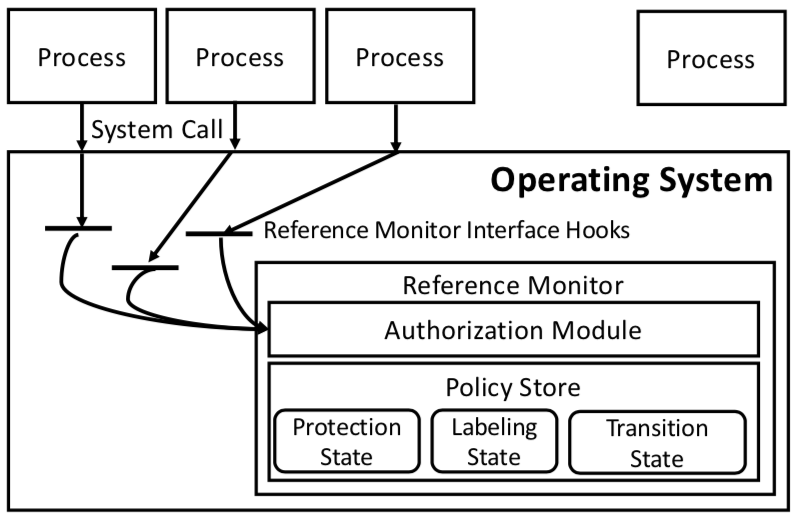
Complete mediation
- Always be invoked for security-sensitive calls
- Security-sensitive call: Operation that may not be authorized for every subject
- Evaluation criteria:
- Interface mediates all requests?
- All resources mediated?
- Verifiability to enforce security goals?
Tamperproof
- Not modifiable by untrusted entities (e.g., subjects)
- Not modifiable code/data affecting reference monitor
- Detection of tamperproofing: Integrity guarantees (e.g., Biba)
- Evaluation criteria:
- Is reference monitor protected?
- Is system TCB protected?
Verifiable
- Subject to analysis/tests
- Determine correctness of code/policy
- Test/analyse reference validation mechanism
- Evaluation criteria:
- Is TCB code correct?
- Enforcement of security goals of system by protection system?
Discretionary Access Control
- Definition
- Access is based on user’s identity/groups
- User can pass access rights to other users
- Prominent example: Lampson’s Access Matrix
- Two classes:
- Capabilities: Subject has list of objects with actions
- Access Control List: Object has list of allowed subjects
Lampson’s Access Matrix
- Lampson (1970)
- Matrix indicating access rights for certain operation
- Rows: Subjects (e.g, users, processes)
- Columns: Objects (e.g., resources, files)
- Cell contains information if action is allowed (authorized operations)
- Problem: Doesn’t protect security goals
- Malicious code executed by user can change permissions (i.e., change protection state)
- e.g., change permissions
UNIX Access Control
- Objects: Files, sockets, etc.
- Model: Access Control List (columns of ACM)
- Additional roles
- Discretionary protection state:
- Subjects may change protection state
- e.g., add access for
others
Mandatory Access Control
- Definition
- Access is based on rules
- Rules can’t be changed by user
Mandatory Protection System (MPS)
- Task: Define security goals/access control specification
- Modified only by trusted administrators
- Immutable to user-space processes
- Components
- Mandatory protection state
- Labeling state
- Transition state
- Challenges:
- How to set up a MPS?
- How to manage a MPS?
- Status quO: Dynamic analysis to setup Mandatory Access Control policy (e.g., kRazor)
- Problem:
- This results in a functional policy
- => Can’t solve safety problem
- Stakeholders:
- Programmers (what do they need to know?)
- OS Distributor
- Administrators
- Users
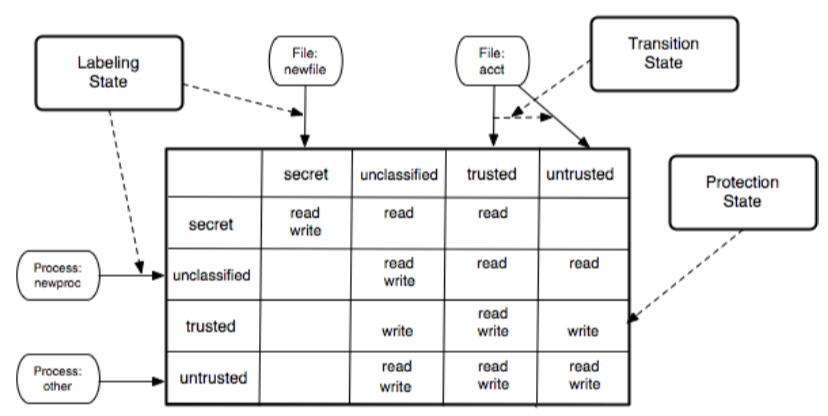
Mandatory protection state
- Definition of protection state
- Immutable set of labels
- Operations that subject labels can perform on object labels
- Matrix (subject labels/object labels/operations)
- Enforce security against bad code using labels
Labeling state
- Immutable mapping subjects/objects to labels
- e.g., for new subjects/objects
- Example:
- New (malicious) process wants to modify kernel memory => Deny access/map to labels which does not have this privilege
Transition state
- Immutable relabeling strategies/rules for subjects/object
- Examples
- Process reads adversary-controlled object label => Remove privileges
- Process reads adversary-controlled object label => remove write-permission for objects which can be read by higher-level privileges