Multics
- Multiplexed Information and Computing Service
- MIT, 1969 (in cooperation with Bell Labs and GE)
- Basis for UNIX
- Features
- Virtual memory with segmentation and paging
- Hierarchical file system (with symbolic names and automated backup)
- Concepts for security
- Problem:
- Slow + complex
- Lead to development of security kernels
Fundamentals
- Core concept:
- Processes (executable contexts)
- Segments (storage of code/data/devices)
Process
- Executable context (i.e., runs program code)
- Process is assigned to the user/subject
- Protection domain of process:
- Segments it has access to
- Complete Descriptor segment
- Descriptor segment:
- Each process has a descriptor segment
- Contains the segment a process can access (without segfaults)
- Composed of segment descriptor words (SDWs)
- Segment descriptor word: Address of the segment
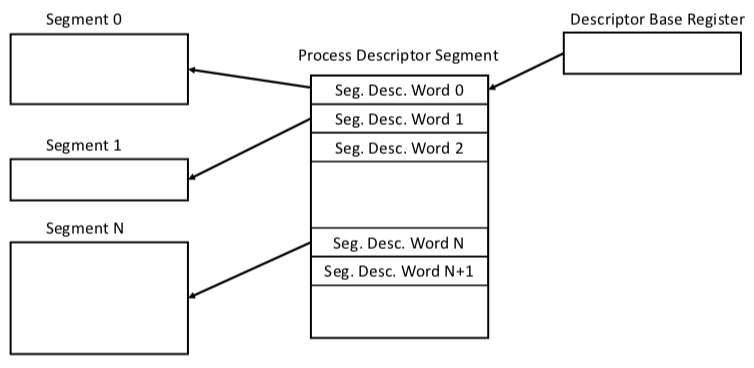
Segments
- Storage of code/data/devices
- Have symbolic names in hierarchical name space (directories and segments)
- Are granularity/unit of sharing
- Protection ring
- Segment protection level (all processes having access)
- Segments are made known
- Process is interrupted
- Translate segment name to address
- Construct SDW
- Perform access control
- Segmentation to extend address space: Divide process memory into segments
- References across segments using dynamic linking (not used anymore)
- Addressing:
- Inside a process
- By name from secondary storage (e.g., disk)
- Multics Kernel is responsible for segment swapping
Security fundamentals
- Security goals of system
- Secrecy (prevent leakage)
- Integrity (Prevent unauthorized modification)
- Comprehensive control
- Architecture:
- Secrecy: Multilevel security
- Reference Monitor:
- Mediate segment access
- Mediate ring crossing
- Security evaluation
- Mandatory protection state guarantees failed
- Reference monitor guarantees failed
- But: Integrity can be achieved
- Concepts
- Supervisor
- Protections rings
- Segment description word
Example
- Answering service: Process responsible for login/logout
- Supervisor authorizes access to password segment
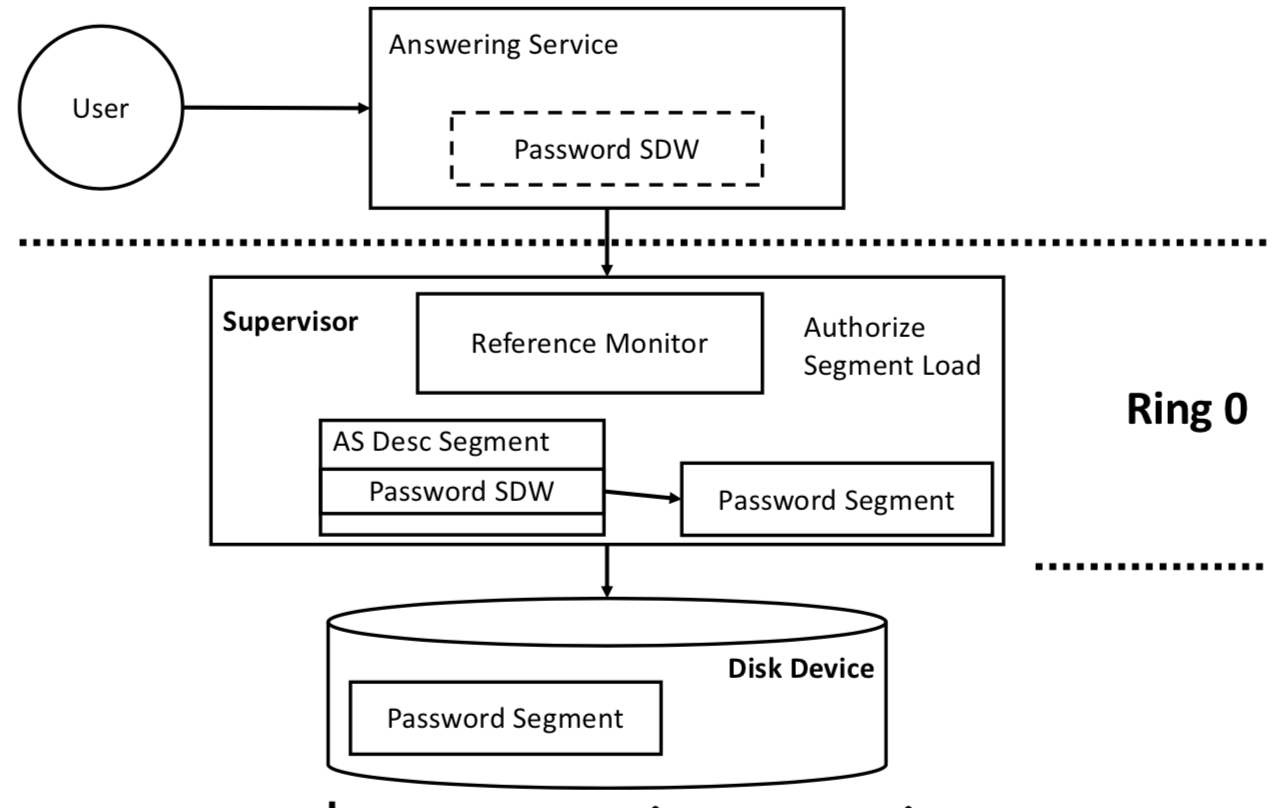
Supervisor
- Core component
- Implements the reference monitor
- Has highest privilege level
- Ring 0: Access control, I/O, memory management
- Ring 1: Accounting, file system search
- Isolated from other processes (supervisor ring 0/1 only)
- Tasks
- Authorization (enforced at each instruction)
- Segmentation
- File systems
- I/O
- Scheduling
- Most SDW authorization is enforced in hardware (formerly by supervisor)
- Responsible:
- Set descriptor segments
- Protect descriptor segments (no modification by untrusted processes)
- Protection domain transitions: Requires gatekeeper
- Execution of segments:
- Segments provide call gates for lower-privileged rings
- Gatekeeper:
- Is a special segment (program/code)
- Performs Argument validation
- Checking the number of expected arguments
- Data type of each argument
- Accessibility of each argument (e.g., copy arguments to lower-privileged segment)
- Compare to Assured Guards
- Runs in ring 0
- Supervisor manages return gates (shared memory for return values)
- Important: Domain transitions carry security risk!
- High to low: Process data could be leaked
- Low to high: Process could retrieve malicious data
Protection rings
- Mechanism to isolate processes with different privilege levels
- see Multics Protection System Fundamentals > Ring mechanism
- Hierarchical layering
- Most privileged level 0
- Less privileged level 64
- e.g., GE 645 Multics hardware implemented 8
Segment description word
- Define access restrictions and permissions (using the fields)
- SDW points to segment
- Contains access information for a specific process
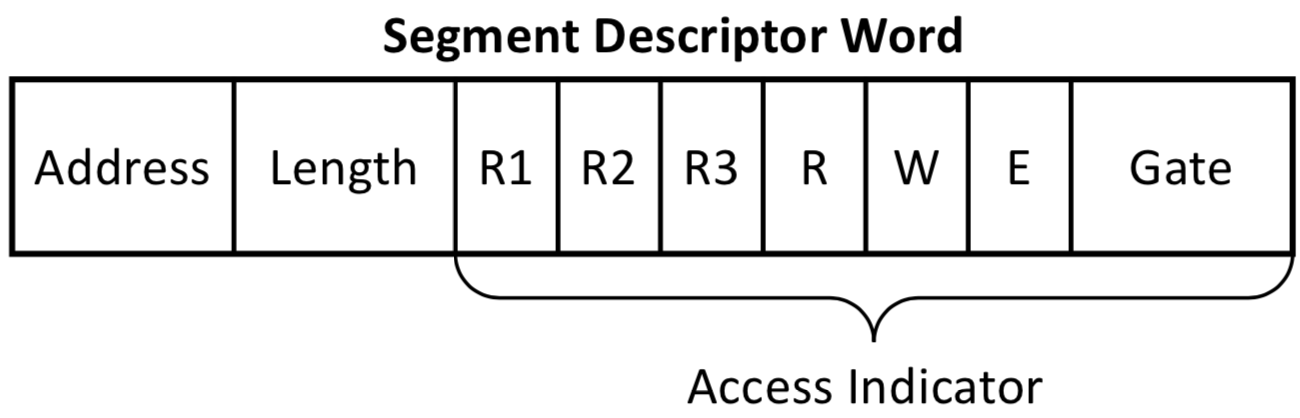
- Structure
- Address of segment
- Length of segment
- Ring brackets (\( r_1,r_2,r_3 \))
- Limit access based on process
- Access control list
rwebits- Purpose: Limit operations on that segment by user
- Number of gates/Gate address
- Enable access from lower-privileged ring
- Define rings that may execute segment
- Gatekeeper is code (running in ring 0) performing argument validation
- Called gatekeeper (compare to Assured Guards)
- Access Indicator: Ring brackets, ACL, Gates
Multics Protection System Fundamentals
- Consists of three different models
- Access Control Lists (limit access on user-basis)
- Rings and brackets (limit access on process-basis)
- Multilevel security (limit access on clearance-level)
- Each model defines aspects of the Multics Protection System
- Together, they perform the overall authorization
Access Control List
- Each objects (segment or directory) gets an ACL
- ACL composed of user identity and allowed operations (wildcards are allowed)
- Purpose: Limit access based on user identity
- Operations:
- Segment:
read,write,execute - Directory:
status,modify,append
- Segment:
- Segment ACL:
- Stored in parent directory
- A change requires a modification permission on the parent directory
- Segment access:
- Process requests access to segment
- Check if user associated with the process has in the ACL of the segment
- If the entry exists, the reference monitor authorizes the construction of an SDW with the requested operations and assigns it to the process
Ring mechanism
- Ring bracket specification
- Assigned to each segment (in parent directory)
- \( r_1\leq r_2\leq r_3 \)
- Can be changed by segment owner
- Purpose:
- Limit access based on the calling process (with its ring)
- Define whether a process from ring \( r \) can read/write/execute the segment
- Define protection domain transition rules (i.e., range of possible target rings)
- Basically, access rights of ring \( i \) are superset of access rights of ring \( i+1 \)
- Are Ring brackets a Mandatory protection system?
- No
- Mandatory protection state
- Realization: 64 Rings and actions
- Not immutable: Modifiable by owner
- Labeling state
- Realization: Ring determined at login
- Not immutable: Ring of objects can be changed by owner
- Transition state
- Realization: Brackets define privileges and transition rules
- Immutable by ring brackets
Access bracket
- Access bracket \( r_1\leq r_2 \)
- Define read/write access
- \( 0 \leq r < r_1 \): Process can read and write (Write bracket)
- \( 0 \leq r_1\leq r\leq r_2 \): Process can read only (Read bracket)
- \( r_2 < r \): Process has no access
- Ensure, that higher-privileged rings have more access than lower-privileged rings
Call/execute bracket
- Call bracket \( r_2\leq r_3 \)
- Define execute access (invoke code segment)
- Define transition state
- \( r < r_1 \): Process invokes code segment but process \( r \) makes a ring transition to new ring \( r' \) with \( r_1\leq r' \leq r_2 \)
- \( r_1\leq r\leq r_2 \): Process invokes code segment in its ring
- \( r_2\leq r\leq r_3 \): Process invokes code segment but ring transition to higher-privileged ring \( r' \) if authorized by the gates in SDW
- \( r_3<r \): No access
Multilevel Security (MLS)
- Goal:
- Enforce secrecy
- Prevent information leakage
- see Access Control Policies > MLS
- Mappings
- Directory contains mapping from segment to secrecy level
- Mapping from process to secrecy level
- Secrecy levels are independent from rings
- Multics-Docs: 4 levels
- Request authorization conditions (one must be met)
- Write request: Grant if target (segment/directory) secrecy level if greater or equal than the process level (write up)
- Read request: Grant if target secrecy level if less or equal than the process level (read down)
- Read/write access: Target secrecy level is equal to the process level
- Is MLS a Mandatory protection system?
- Yes
- Mandatory protection state:
- Realization: Set of levels
- Immutable
- Labeling state:
- Realization: Set level at login / at creation
- Immutable
- Transition state:
- Realization: Only from low to high secrecy
- Immutable
Multics Protection System
- Protection state:
- Access Control Lists
- Ring brackets
- Multilevel Security
- Request:
- Check ACL if user has access
- Check MLS policy for secrecy levels
- Check ring bracket for access
- Execution request:
- MLS must permit reading
- Protection domain transition possible
- Process has higher privilege: Transition to lower-privileged ring
- Process has lower privilege: Transition to higher-privileged ring if specified by call gate
- Mandatory protection system:
- Labeling state:
- Not specified
- New objects could get ACL/MLS by creator
- Transition state:
- Ring brackets (only for subjects)
- Not specified for objects
- Labeling state:
- Policies:
- ACL: DAC
- Ring brackets: DAC
- MLS: MAC (loaded at boot time, immutable)
Vulnerability Analysis
- Schell/Karger, 1974
- Criteria:
- Practicability of the reference monitor
- Identify security enhancements
- Determine scope of certification effort
- Hardware
- 1 Vulnerability/1 undocumented instruction
- Address checking can be bypassed (fails complete mediation)
- Software
- Multics Master Mode: Permits running instructions in higher-privileged ring without a ring transition
- Vulnerability in this Master Mode: Run privileged code with ring 0 permissions
- Report
- 54 kLOC with hundreds of programmers
- Security mechanisms are ad-hoc (overlapping semantics)
Evaluation
Complete Mediation
- Correct mediation:
- Mediate on object references (segment level)
- Weakness: Indirect addressing
- Weakness: MLS labels are stored in parent directory (prevent TOCTTOU attack, directory contains segments from single directory class)
- All resources:
- Segment/object access is mediated at instruction level
- Ring transitions in both directions
- Weakness: Master mode executes code in higher ring without transitions
- Argument validation via gatekeepers is not part of reference monitor
- Verifiability of mediation:
- Ring transitions and segment access are well-defined
- Implementation is too complex for verification
Tamper-proofing
- Protection of reference monitor and protection system
- Supervisor implements reference monitor
- Runs in ring 0
- Ring bracket policy prevents writing to ring 0
- Gatekeeper must ensure that inputs to ring 0 by untrusted parties are non-malicious
- Protection of system TCB
- Managed by brackets
- TCB in rings 0-3
- User programs in ring 4 or higher
- Weakness: Ring bracket policy is discretionary
- Can be changed with subject having modify access to a directory containing system segment
Verifiability
Correctness of the TCB
- Too large for formal verification
- Further research: Motivated development of security kernels
Protection system enforces system security goals
- Ensure that secrecy/integrity are enforced by the protection state
- Secrecy by MLS
- Integrity is hardened by the ring mechanism (read-down)
- Ensure that labeling state works correctly
- Not specified
- Ensure that protection domain transitions protect secrecy/integrity
- Secrecy given
- Integrity problematic (transfer from low- to high-privileged ring)
- Not an MPS
- Ensure that secrecy/integrity are enforced by the protection state