Trusted Execution
Intel SGX
- Intel Software Guard Extensions
- Extension of x86 instruction set (Skylake architecture)
- Allows isolation of code (enclave)
- Used to isolate sensitive code
- Requires trust Intel and the CPU
- Use Cases
- Developer does not trust system provider
- e.g., server host
- Store keys/personal data inside enclave
- Remote party does not trust me
- Software hiding secrets
- Rights management
- e.g., use feature X k times
- Developer does not trust system provider
- Features
- Trusted execution
- Memory encryption
- Integrity checks
- Change attacker model (towards physical attacker)
Architecture
- Enclave
- Part of normal application (less privileged)
- All memory is encrypted
- Integrity is verified
- Run in user-space (create in kernel-space)
- No system calls allowed
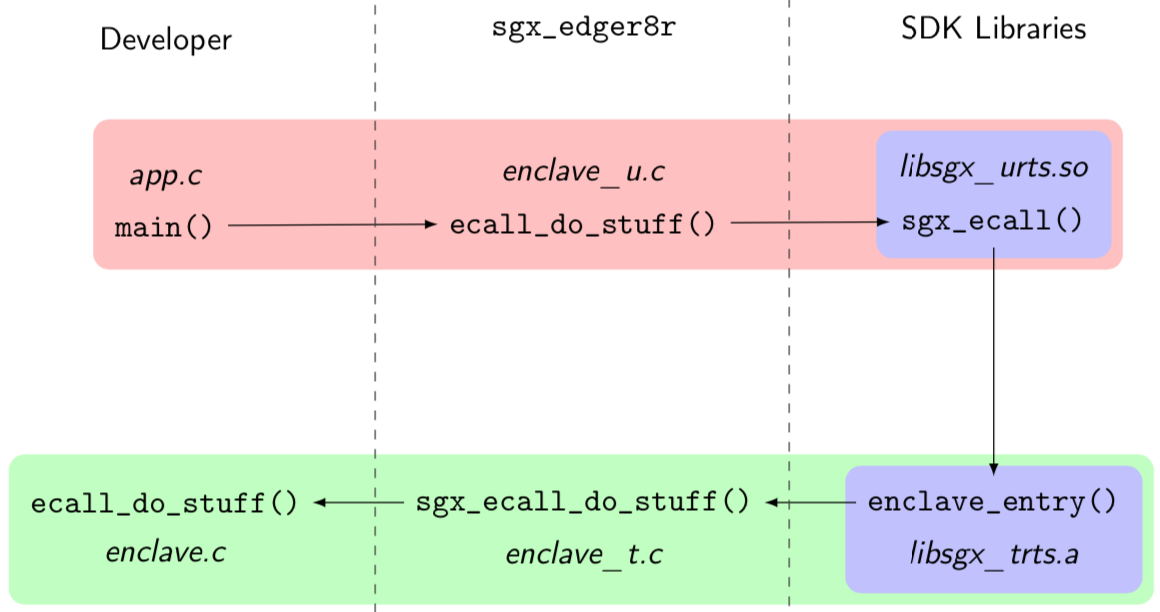
- No direct communication with enclave (use well-defined end-points, i.e., ecalls/ocalls)
- Enclave Page Cache (EPC)
- Integrity protected using hash tree
- Root hash inside CPU package
- Every access checks tree
- Swapping possible
- Requires EPC table for information of swapped tables
- Can be recursive
- High cost
- Integrity protected using hash tree
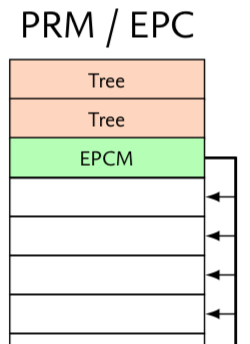
- Enclave Page Cache Map (EPCM)
- Keeps track of all pages in EPC
- Only one
- EPCM size determines EPC (EPCM has all pages)
- 188 MiB
- Information:
- Permissions of page
- Page type
- Is page mapped?
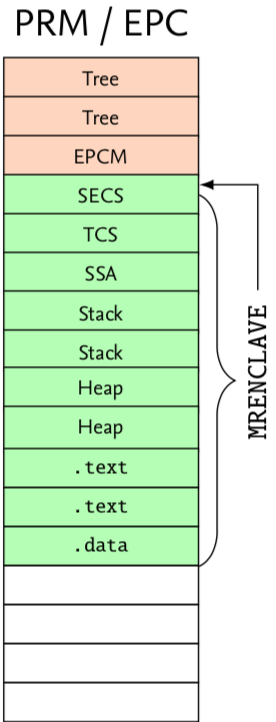
- SGX Enclave Control Structure (SECS)
- One per enclave
- Hold enclave metadata (e.g., size, hash)
- Only accessible from CPU itself
- Immutable
- Thread Control Structure (TCS)
- Describe entry point into enclave
- One TCS per enclave thread
- Inaccessible from outside
- Immutable
- References at least one State Save Area
- State Save Area (SSA)
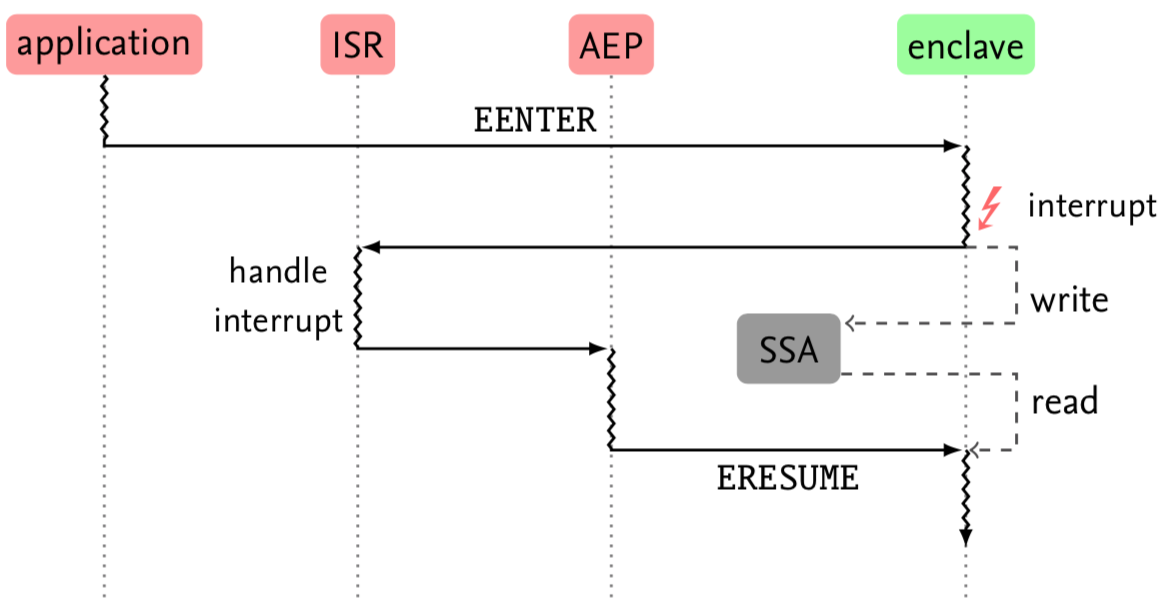
- Save processor state (during interrupts)
- At least one per TCS required (multiple interrupts mean multiple SSAs)
- Write on interrupt
- Read on resume
- Stack/Heap
- SGX does not enforce enclave stack/head (but recommended)
- Code/data
- Encrypted after enclave creation (but integrity checked)
- Inject secrets later (enclave has not secrets at startup)
Attestation & Sealing
Enclave Measurement
- Use for integrity protection
- Enclave has unique hash (comprised of pages and their layout)
- Identical measurements iff enclaves identical
MRENCLAVEcall
Attestation
- Purpose: Prove that they are the enclaves
- Allowing for secure communication
- Types
- Local: Between two enclaves
- Remove: Between enclave and remote party
- Local attestation
- Scenario: Enclave A and B want to identify identity to each other
- Report
- Enclave can generate report with HMAC from processor (
EREPORT) - Generated for specific target enclave
- May have payload (e.g., nonce, public key)
- Enclave can generate report with HMAC from processor (
- Result: Secure channel between enclaves Is this a result???
- Example
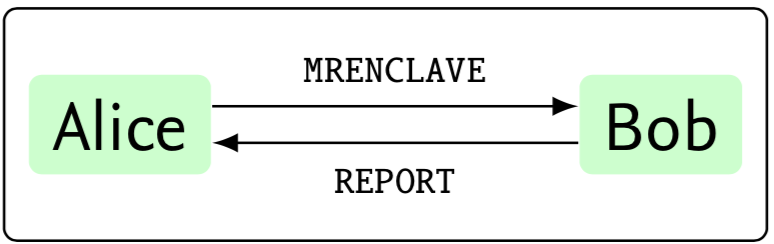
- Alice sends MRENCLAVE to Bob
- Bob creates report with Alice’s MRENCLAVE
- Bob sends report to Alice
- Alice verifies receive report (with EGETKEY)
- Repeat
- Remote attestation
- Quoting enclave:
- Special enclave
- Signed by Intel
- Generates a quote from a report
- Workflow
- Alice does local attestation with QE
- Send MRENCLAVE
- QE generates report
- QE sends quote to Alice
- Alice sends quote to Bob
- Bob asks Intel Attestation Service (IAS) for verirication
- Alice does local attestation with QE
- Result: Secure channel between enclave and remote party Is this a result???
- Quoting enclave:

Sealing
- Store data securely and persistently
- Workflow
- Enclave generates key
- Depends on platform
EGETKEY:MRENCLAVE: Key tied to enclave memory structureMRSIGNET: Key tied to enclave signing key (allows for enclave updates)
- Encrypt data
- Give data to untrusted system to store (contradictory)
- Enclave generates key
Development
- Instruction set overview:
- Kernel-mode:
ECREATE: Start creationEADD: Add page during creationEEXTEND: Calculate hash sum of added pageEINIT: Finalize creation
- User-mode:
EENTEREEXITERESUME
- Kernel-mode:
- Compilation
- Enclave must be self-contained
- Statically linked
- Non system calls (use compiler flags)
- Requires
SIGSTRUCTandEINITTOKEN(signed by processor) - Use SGX
- Enclave must be self-contained
- Interrupts
- Transparent to enclave
- Generate Asynchronous Enclave Exits (AEX)
- Register an asynchronous exit handler (AEP) (on enter)
- Call AEP every AEX (same on exceptions/faults)
- AEP decides whether to resume or not
- SDK
- Library for enclaves
- SDK has simulation mode
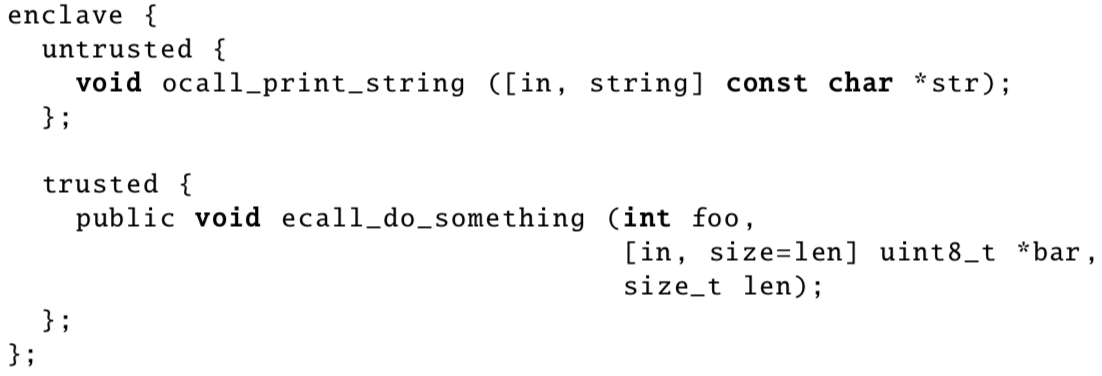
- Defne ECALLs and OCALLs
Attacks
- Against SGX
- Rollback attack against swapped pages: NO (EPC version is tracked)
- Rowhammer on EPC:
- Rowhammer: Periodically swap memory to change nearby bits due to electrical fields
- NO: Pages are hashed
- YES: SGX-Bomb: Lock processor down
- Bugs in SGX specification: MAYBE
- Bugs in SGX implementation: MAYBE/YES
- Break Management Engine: MAYBE (not proven)
- Against Enclave
- Rollback attack against sealed data: YES/MAYBE (enclave provides backwards compatibility, use legacy data)
- Iago attack: MAYBE/YES (depends on app)
- TOCTTOU attack: MAYBE/YES (depends on app)
- Against SDK
- TOCTTOU attack: NO/MAYBE
- SGX copies arguments
- Does not deep-copy structures
- TOCTTOU attack: NO/MAYBE
- Side channel against SGX/SDK
- Side-channel attack: Exploit physical implementation of crypto system
- Spectre: Read virtual memory by exploiting execution order
- Foreshadow: Extract keys
- ZombieLoad: Read virtual memory from other processes running on the same core
- Plundervolt: Control voltage and frequency to corrupt SGX integrity
- Side channel against Enclave
- Depends on implementation
- AsyncShock: Exploit synchronization bugs
- Controlled-Channel attack
- Steal page tables
- Infer control flow
AMD SME/SEV
- Problem Cloud computing:
- Applications are usually VMs
- Hypervisor as access to all sensitive data
- Hypervisor isolation can have faults
- User must trust cloud provider
- Attacks
- Admin reads memory of VM data
- Admin injects code into VM
- User steals data using hypervisor bug
- Install malicious hardware
- Freeze and steal RAM
- Steal non-volatile RAM
- Components
- Hardware encryption module
- Secure processor
- Summary
- Easy full-memory encryption
- Guard against physical attacks
- SEV does not protect against malicious hypervisor
Hardware encryption module
- AES engine
- Part of memory controller
- Key located inside CPU (isolated)
- Encrypt DRAM
- Minimal performance overhead
Secure processor
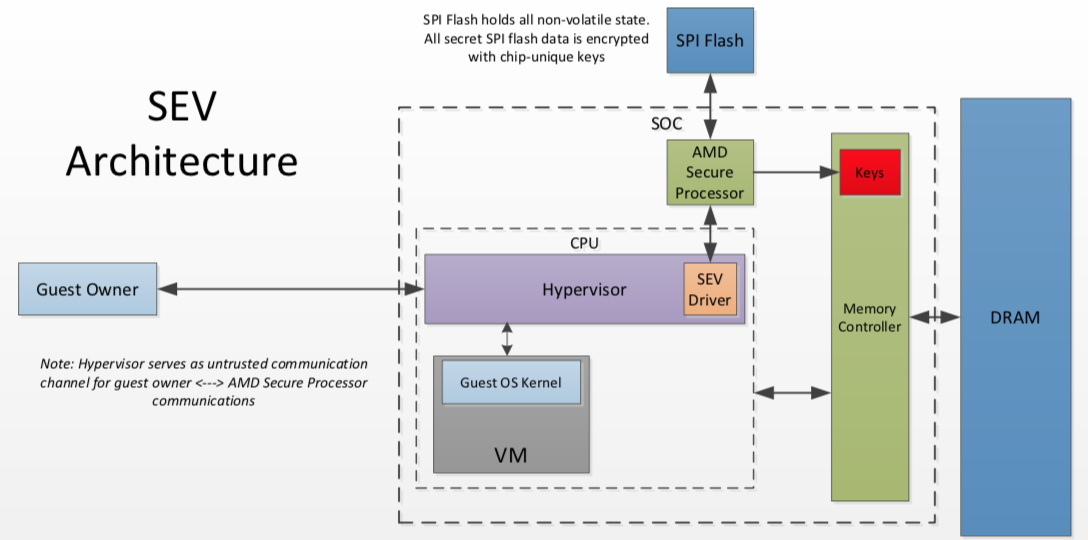
- Dedicated security subsystem (SoC)
- Non-volatile storage
- Off-chip
- Secure
- Stores firmware + data
- Provide key generation
- Enables secure boot (chain/root of trust)
Secure Memory Encryption (SME)
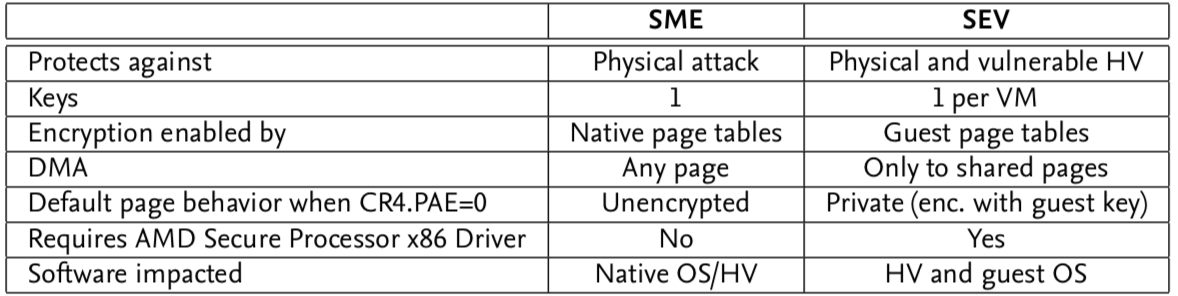
- Simple and efficient encryption
- Defend against physical memory attacks
- Use single key for encryption
- OS/Hypervisor choose pages to encrypt
Secure Encrypted Virtualization (SEV)
- Provide secure, encrypted virtual machines
- Combine SME and AMD-V virtualization
- Protect VMs/Containers from each other and untrusted hypervisors
- Keys
- One for Hypervisor
- One per VM
- Cryptographically isolates hypervisor from guest VM
- Requires AMV-V technology
- Key management (launch guest VM)
- Hypervisor load BIOS/OS into DRAM (not encrypted)
- Hypervisor and user exchange keys (DH, AMD Secure processor)
- Hypervisor prepares BIOS/OS image
- Allocate address space identified (ASID)
- Generate encryption key
- Firmware encrypts image
- Hypervisor creates Control Block for VM
- Hypervisor sends authentication information to user
- User supplies disk decryption key to guest VM via secure channel
- Details
- ASID determines encryption key
- DMA must occur to shared pages
SME/SEV Interaction
- Host mode (ASID=0): Host C-bit determine encryption status of page
- Guest mode, non-SEV guest: NPT determines encryption status
- Guest mode, SEV guest: Consult guest and NPT
Software
- AMD
- Currently developing
- Secure Processor code not public
- Linux driver for Hypervisor and AMD Secure processor communication is open source
- Linux kernel supports SME/SEV
- AMD Secure Processor driver:
- Marshal between Hypervisor and processor interface
- Linux changes for SME
- Setup: Boot unencrypted, encrypt kernel, enable encryption
- Runtime: Set C-bit on all new pages
- Exceptions: ???
- Linux changes for SEV
- Pages are encrypted by default
- ???