Exercises
Programming exercise
01 Namespaces
- Process
- Concept for an executable
- Gets virtual memory (mapped to physical)
- Share resources
- Isolation
- Virtual machines
- Isolate complete OS
- Own kernel and applications
- Isolation enforced by Hypervisor
- Disadvantage: Heavy weight (kernel)
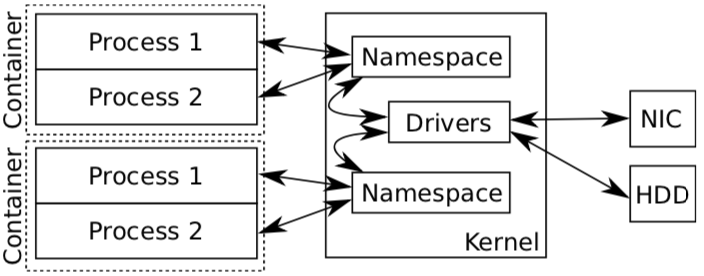
- Container
- Isolate processes
- Use namespaces for access
- Re-use host kernel
- Virtual machines
- Linux Namespaces
- Abstraction of resources (box holding resources)
- Process belongs to one namespace per type
- Create new namespace:
unshare - Namespaces
- Unix Timesharing System (hostname, domain)
- IPC
- PID (process number, PID 1 in container)
- User (isolate user/group IDs, use mapping to host)
- Mount (isolate mount points, change root)
- Change root
chroot: Not for security reasons, only pathname resolutionpivot_root: Securely change root (then unmount old root)
- Workflow:
- Create namespaces
- Mount new file system
- Change user/group IDs
- Mount special files (
dev/tmp/proc) - Change root
- Fork container process
- Set hostname
- Execute entrypoint
02 Securing container
- More isolation:
- Environment variables (e.g.,
USER, Tokens, Paths) - Scheduling information (
/proc/sched_debug)
- Environment variables (e.g.,
initprocess- PID 1
- Collects zombies (child whose parent died)
- Container root process is
bash(doesn’t collect children) - Use container-aware init process (e.g.,
tini,dumb-init)
Resource restriction
- Isolate resources
nice: process prioritysetrlimit:- Restrict resources for process and children
- But consumption is not accumulated
- Child may use as much as parent
cgroups:- Fine-grained, complex limitation
- Requires root
- Uses controllers (manage groups using directories)
Syscall restriction
- Filter syscalls
seccomp- Based on Berkeley Packet Filters
- Library
libseccomp(easier to use) - Features
- Masking of arguments
- Creating black- and whitelists
Capability restriction
- Linux 2.2 introduced
capabilities - Each thread has sets of capabilities (basically bitmasks)
- Sets:
- Bounding set \( B \)
- Superset for capabilities a thread can add to inheritable and permitted sets
- Permitted \( Prm \)
- Capabilities a thread can have
- Superset for the effective capabilties
- Effective \( Eff \)
- Capabilities a thread has (used for permission checks)
- File capability is single bit
- Inheritable \( Inh \)
- Not preserved across
execve(non-root)
- Not preserved across
- Ambient \( Amb \)
- Preserved across
execve(non-root)
- Preserved across
- Bounding set \( B \)
- Roles:
- Child process \( C \)
- Parent process \( P \)
- File \( F \)
- Rules
- \( B\supseteq C_{Inh} \)
- \( B\supseteq C_{Prm} \)
- \( C_{Prm}\supseteq C_{Eff} \)
- \( C_{Prm} = (P_{Inh} \& F_{Inh}) | (F_{Prm} \& B) \) (6.)
- \( C_{Eff} = F_{Eff} ? C_{Prm} : C_{Amb} \)
- \( C_{Amb} = (\text{file is privileged}) ? 0 : P_{Amb} \)
- \( C_{Prm} = (P_{Inh} \& F_{Inh}) | (F_{Prm} \& B) | C_{Amb} \)
- \( C_{Eff} = F_{Eff} ? C_{Prm} : C_{Amb} \)
- \( C_{Inh} = P_{Inh} \)
- Drop capabilities
libcap- Drop specific capabilities
- Problem: Inside container we are root
03 SGX SDX
- Use wrapper code
edger8r - Enclave metadata file
- Enclave description file
enclave_u- Untrusted side (call Untrusted Runtime System)
- Marshal arguments
enclave_t- Trusted side (called from TRTS)
- Unmarshal arguments
- Untrusted Runtime System
- Transition into enclave
- Provides ECALLs
- Trusted Runtime system
- Provides OCALLs
- Libraries
- No unsafe calls
- No system calls
- Use SGX libraries
Paper analysis
Evaluating Software (In)Security
- Jain et al. (2017)
- Topic
- Measure software security/TCB complexity
- Changing code base increases risk for new bugs
- Which metrics are useful?
- Goal:
- Prevent security issues
- Prove absence of bugs
- Current standard
- Formal verification: Too complex
- Lines of code: Unreliable
- Lines of code weakly correlates with vulnerabilities
- Bug does not imply vulnerability
- Testing
- Auditing prevents bugs
- Unit tests find obvious bug (not necessarily vulnerabilities)
- Bug finding tools
- Contribution: Features of code to train a classifier (static analysis)
- Propose metrics/features:
- Lines of code
- Common Vulnerability Scoring System (CVSS)
- Radial Attack Surface Quotient (RASQ)
- Number of functions/variables
- Classes to predict:
- Network attacks
- Buffer overflows
- Dynamic analysis more effective
- Detect vulnerabilities in runtime
- Monitor program behavior
- Advantage if code base is inaccessible
- Discussion:
- Feature set provided but no classifier
Kernel Attack Surface Reduction (kRazor)
- Kurmus et al. (2014)
- Problem:
- 90 % of kernel functions are not used by average network daemon
- Unused kernel functions mean unnecessary large attack surface
- Contribution: Limit attack surface by reducing number of kernel functions at run-time (kRazor)
- Definition attack surface:
- Subgraph of kernel call graph
- Entrypoints are accessible to adversary
- Approaches:
- Static:
- Micro-kernel (lack of compatibility, e.g., MINIX 3)
- Kernel specialization (remove sys-calls from kernel, re-compile kernel for application)
- Dynamic:
- System call monitoring
- System-call-based process sandboxing (whitelist system calls, kRazor is generalalization of this)
- Static:
- kRazor:
- Run-time
- Complete mediation (syscalls are objects)
- Add hooks to each syscall
- quantifiable + non-bypassable
- Learn set of system calls used by application
- Create set of allowed kernel functions (expand by using related functions, e.g.,
readandwrite) - Option for violations:
- Kernel Oops
- Logging
- Metrics for attack surface:
- LOC
- Cyclomatic complexity
- CVE-based (1 if function has security vulnerability, 0 otherwise)
- Discussion:
- Least Privilege Policy
- Problem: No guarantee that all system calls are traced (edge case)
- No statistics in prevented attacks
TrustVisor
- McCune et al. (2010)
- Related lectures: SGX
- Provide isolation for security-sensitive code parts (PALs)
- TrustVisor is a hypervisor
- Features:
- Code integrity (memory region is checked)
- Data secrecy (memory is encrypted)
- Data integrity
- Execution integrity
- Marshal parameters when call enters a PAL
- Split code into sensitive and non-sensitive parts
- Use Dynamic Trust for Measurement (hardware component)
- Chain of Trust
- Emulate TPM for each PAL
- Memory encryption is not possible, use memory isolation
- Trap into hypervisor if PAL is accessed
From L3 To seL4
- Elphinstone et al. (2013)
- Related lectures: Security Kernels, VMM
- seL4 is security-microkernel
- Microkernel principles:
- Minimality (and no policy in kernel)
- IPC performance
- Real-time computing (?)
- Development since L4:
- Synchronous messaging replaced (support multi-threaded application)
- Physical registers to virtual registers (improve portability)
- Long IPC removed (could trigger page faults)
- Thread IDs replaced by port-like endpoints (improve confidentiality)
- IPC timeouts restricted to 0 (poll) or infinity (block) (adapt to practice)
- Communication control (chief-and-clans) remove (contradicting goal of policy-freedom)
- Problem of scheduling:
- Scheduling often implemented in kernel
- Contradicts goal of policy-freedom
- Often used: Hard-priority round-robin (fixed time-slices)
- Scheduling in user-space too slow (bottleneck is IPC)
- Minimality
- Important
- Formal verification is easier with minimality
- But it influences design decisions (multi-threading, complex scheduling, standard calling convention)
- Authors do not think performance suffers from the new design decisions
Graphene-SGX
- Tsai et al. (2017)
- Related lectures: SGX
Hardware Is The New Software
- Baumann et al. (2017)
- Related lectures: SGX
Lecture Questions
01 Introduction
- What are the problems with adversary code on your machine?
- What can an adversary do?
- What can you do to avoid executing adversary-controlled code?
- What is the problem with running code from benign sources?
- How would “good” code look like?
- Who may be responsible for software and systems security in computing environments?
02 Threats & Security Principles
- Why is Protection State insufficient to enforce security?
- What do we need to achieve necessary controls?
- How do we know the policy expresses effective goals?
- How do we know the enforcement mechanism will enforce policy as expected?
- How can you use an MPS to control use of bad code?
- How can you use labeling state to control bad code?
- What defines correct code?
- What defines correct policy?
- What about objects created by these processes?
- How can you use labeling state to prevent good code from going bad?
- What if good code needs to access some adversary-controlled resources?
- How do we achieve this change with the MPS?
- Is it possible to launch processes with more permissions than the invoker with MPS?
03 Multics
- „If people just used Multics, we would be secure. UNIX and Windows are insecure.“ What is the basis for these statements?
- Does Multics implement a Mandatory Protection System enforced by a Reference Monitor?
- Does Multics satisfy the evaluation criteria?
- What were the security goals for Multics?
- Are brackets a Mandatory Protection System?
- Multilevel Security a MPS?
04 LSM
- How do we add MAC enforcement effectively to a commercial OS?
- What is required to be a secure OS?
- Which Linux data types are sensitive?
- What to do about object creation before the security module is loaded?
- How do we know LSM implements complete mediation?
- How is LSM code protected?
- How is LSM data protected?
- Where to exactly place the hooks?
05 Integrity
- What is data integrity?
- What do we need to do to ensure data integrity?
- What do you expect for integrity of software?
- How does software integrity impact data integrity?
- How to compute least privilege?
- Can we use it to verify a policy is secure?
- What do we do if a system needs an information flow from low integrity to high?
- Assured Guards: What does “fully assured” mean?
- What could you do to avoid self-revocation?
- But shouldn’t programs at least know where they expect to receive UDIs?
07 Security Kernels
- What are the advantages of such an approach?
- What are the limits of verification?
- Why is Scomp appropriate to support such an application?
- [Drivers in user space] how is this possible in Scomp?
- [Complete Mediation] For files? For mail data? What about DMA operations?
- Why are systems like Scomp not the norm?
- Why are drivers a problem?
- How do we reduce such problems?
- Can we somehow fix drivers?
- What exactly does an MMU do?
- Who does Mediation? - Are they all reference monitors?
- Does this approach satisfy reference monitor concept?
- Does it implement a MPS?
- So why don’t build systems with such a design?
- What could be transferred to current systems?
08 VMM
- Do these work for modern OSes? Are there alternatives?
- How does VM isolation differ from OS isolation?
- What are the trust model issues when comparing Type I and Type II?
- How does a VM System improve the ability to achieve reference monitor guarantees?
- What components constitute the VAX VMM reference monitor?
- How is the protection state modified?
- How do we implement a reference monitor and a validation mechanism for theses systems?
- At what granularity control should be enforced?
- How do we configure access control for containers?
- Can we use VM isolation to prevent compromise of applications by malicious OS?