Security Kernels
- Problem with Multics:
- Slow, large and complex
- Hard to achieve performance, generality and security
- Two trends:
- UNIX (focus on generality and performance)
- Security kernels (security, performance and verifiability)
- Definition:
- A security kernel is defined as the hardware and software necessary to realize the reference monitor abstraction
- Systems:
- Secure Communications Processor (SCOMP)
- KSOS/PSOS
- SLAN
- Secure Ada Target
- Core principles:
- Implement security policy (define in MPS)
- Define a verifiable protection behavior of the system (reference monitor)
- Implementation must be faithful to the security goals
- Formal Verification
- Became the main focus
- Limits:
- Can’t detect errors in specification
- Can’t detect incomplete coverage of the functionality in the specification
MITRE
- MITRE Project, 1974
- First security kernel
- Manage system resources directly
- Less than 20 subroutines
- Less than 1 kLOC
Secure Communications Processor (SCOMP)
- Honeywell, 1983
- Security kernel-based system
- Policy: Multics Multilevel Security
Architecture
- Scomp hardware mechanisms (by Honeywell)
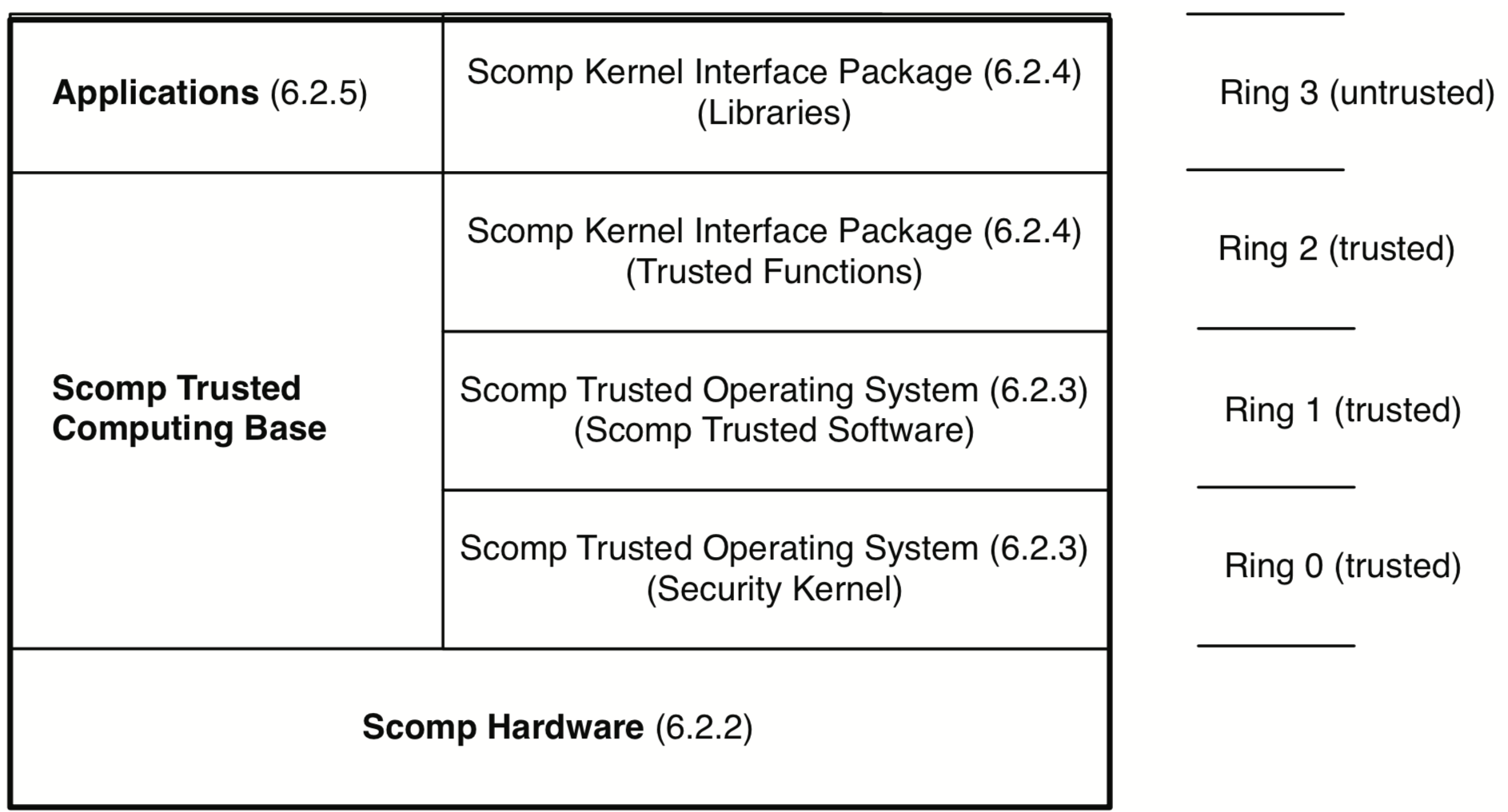
- Trusted Computing Base:
- Runs in rings 0,1,2
- Scomp Trusted OS
- Kernel (ring 0)
- Trusted Software (ring 1)
- Scomp Kernel Interface Package
- Trusted functions (ring 2)
- Untrusted
- Scomp Kernel Libraries (ring 3)
- Applications
Fundamentals
- Similarities to Multics
- Access control via segments (memory + I/O)
- Secrecy using Multilevel Security
- Ring Brackets
- Differences to Multics
- Access control/ring implemented in hardware
- Formal verification
- Enforcing the policy (formal top-level specification)
- Trusted software outside the kernel is verified using a procedural specification
- Separate kernel from system API (e.g., file access)
- Security kernel
- Manages hardware descriptors (containing address and access rights)
Hardware
- Complete mediation is implemented in hardware
- Inspired by Multics
- Fundamental changes to Multics:
- Only four protection rings
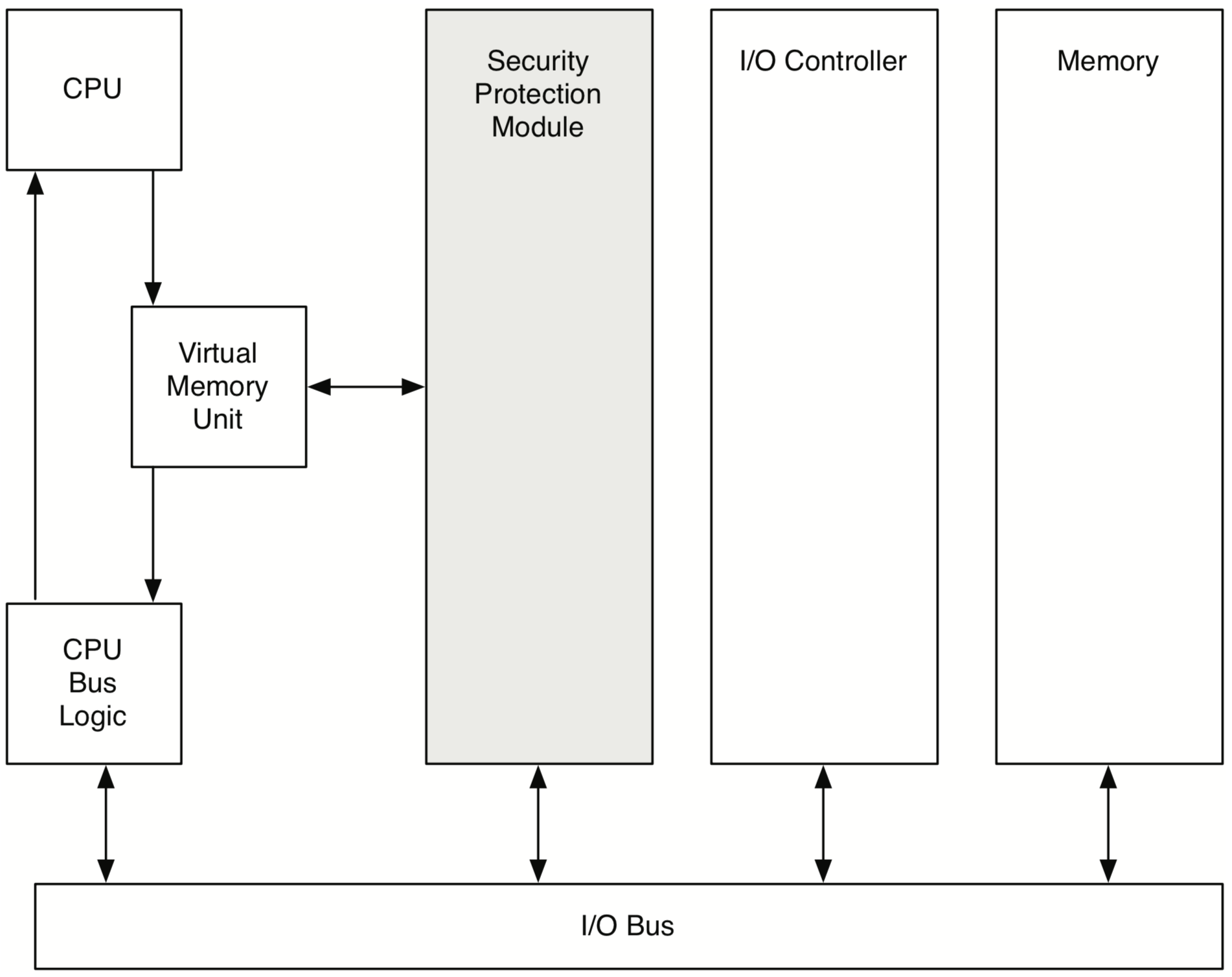
- Security protection module (complete mediation)
- Argument addressing mode
- Scenario: Lower-privileged process calls higher-privileged routine
- Goal: Prevent confused deputy
- Comparable to Multics’ gatekeepers
- Caller provides memory page with arguments
Security protection module (SPM)
- Mediate all memory and I/O accesses in the Scomp system
- Mediate on main system bus
- Provides access to I/O and memory
- SPM maps virtual device name to I/O descriptor
- Memory mediation
- SPM has hardware cache
- I/O mediation
- I/O operation requests a physical address from virtual name
- SPM and Direct Memory Access
- DMA: Access memory without CPU (required for performance reasons)
- Pre-mapped DMA:
- Driver accesses device/memory
- SPM authenticates a DMA request once
- SPM caches request
- Mapped I/O:
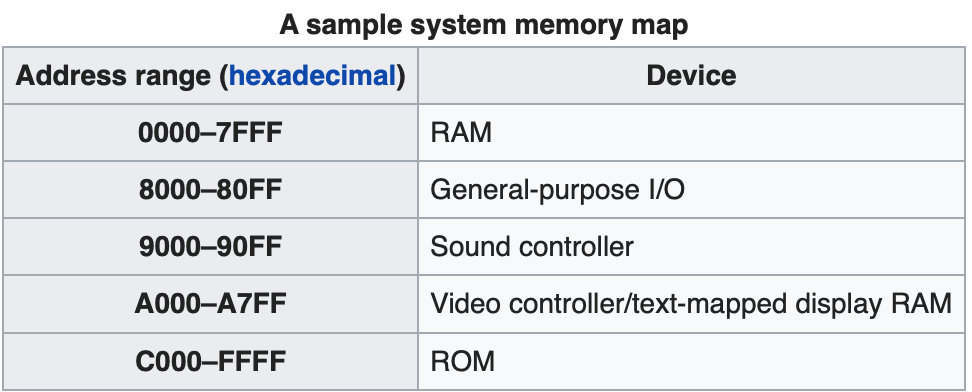
- Map devices (I/O descriptors) to addresses/registers
- Device listens on system bus for address
- Send address to device
- Device can perform DMA directly
- Result:
- Kernel only constructs the I/O descriptor
- Mediation performed by SPM
- Drivers can be run outside the kernel
- AMD/Intel:
- Adopted four rings but ignored hardware mediation
- Problem: DMA bypasses CPU (security problem)
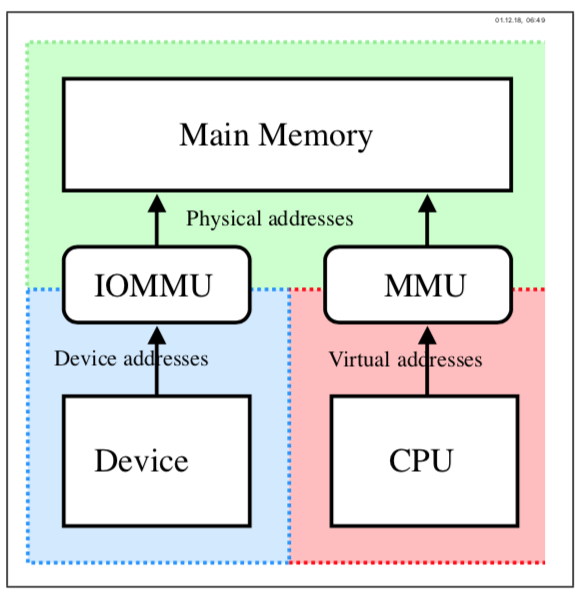
- Added I/O MMUs (inspired by SPM)
- I/O MMUs mediates I/O access
Drivers
- Scomp runs driver in user-space
- Workflow
- Driver performs I/O operations
- Kernel maps I/O to address
- SPM uses pre-mapped DMA (SPM only authorizes first request)
- User process (i.e., driver) can directly address device
- Advantage:
- Performance (user process/driver directly communicates with device without the CPU)
- Stability (drivers often cause kernel fault)
Operating System
- Security Kernel
- Ring 0
- Minimized (10 kLOC, Pascal)
- Tasks:
- Memory management
- Process scheduling
- Interrupt management
- Auditing
- Reference monitoring functions
- Access Control:
- Multilevel security (i.e., Bell-LaPadula)
- Ring bracket policy
- Discretionary policies
- Ring transitions
- 38 gates
- Similar to modern syscalls (e.g., map segments)
- Provide argument validation (compare to Multics gatekeepers)
- Trusted Software
- Rings 1 + 2
- Software trusted to not violate security goals (e.g., process loading)
- Software trusted to maintain security policy correctly (e.g., authentication services)
- 23 trusted functions (11 kLOC)
- Kernel Interface
- Ring 2
- Comparable to syscall interface
- Trusted operations on user-level objects
- Trusted not to violate MLS requirements
User Software
- Scomp Kernel Interface Package Library
- Ring 3 (untrusted)
- Compare to
libc/POSIX API - Mail Guard
- Mail client ensuring MLS policy
- Information not leaked to less secret subjects
Evaluation
- Complete Mediation
- Mediate all security-sensitive operations: Hardware enforcement
- Mediate on all objects: Hardware enforcement
- Verification: Hardware verification
- Problem: What about data inside the system?
- Tamperproof
- Protect reference monitor: Protection rings
- Protect TCB:
- Protection rings and bracket model
- Leads to integrity (No untrusted code runs in rings 0-2)
- More complex system than Multics (no more specification in book)
- Verification
- Correctness of TCB: Formal verification (using semi-automated methods)
- Enforcement of security goals: mandatory MLS policy + discretionary bracket policy
- Result:
- Verification by DoD’s Trusted Computer System Evaluation Criteria (TCSEC)
- A1 evaluation level (most secure evaluation level)
Driver Isolation
- Problem:
- Scomp in 1983 had complete mediation
- Later technologies had incomplete mediation (did not use SPM)
- Faulty drivers are major cause of OS crash
- 2/3 of code base are extensions
- 65 - 83 % of crashes in Windows XP are caused by drivers
- Fixing drivers is infeasible (too rapid growth)
- Idea:
- Isolate drivers
- Use I/O MMUs for mediation
- Can be more effective
- Attacks malicious driver:
- Wipe out kernel memory
- Overwrite drivers (memory corruption)
- Design principle: Least Authority
Historical driver isolation
- Source: Herder et al., 2007, Chapter 4
- Use trusted kernel + MMU
- Driver gets own virtual address space
- MMU denies DMA
- Kernel copies data between memory segments
- Process must authorize DMA
- Explicitly define address space and access rights
- Pass to other party
- Approaches:
- Use better programming language
- Place driver in virtual machine
Memory Management Unit (MMU)
- Task: Map virtual to physical addresses (use page tables of process)
- Driver in virtual address space limits contexts it can access
- Problem:
- Driver must access device
- Device performs DMA
- Device performs operations important for the OS
- –> Using CPU is too slow
- IOMMU:
- Used for DMA
- Requires DMA-capable bus
- Map device address/IO address to physical address
Fault Isolation for Device Drivers
- Source: Herder et al. 2009. Fault Isolation for Device Drivers
- Focus: Isolating untrusted drivers that threaten OS dependability
- Assumptions
- Requires IOMMU
- Blocking of interrupt requests (IRQ): Multiple devices receive an IRQ, one blocks the IRQ due to the PCI standard
- PCI sharing: Communication over PCI can’t be isolated (only using PCI-E)
- Limitations
- MINIX 3: 10-20 % overhead in macro benchmark
- Overview
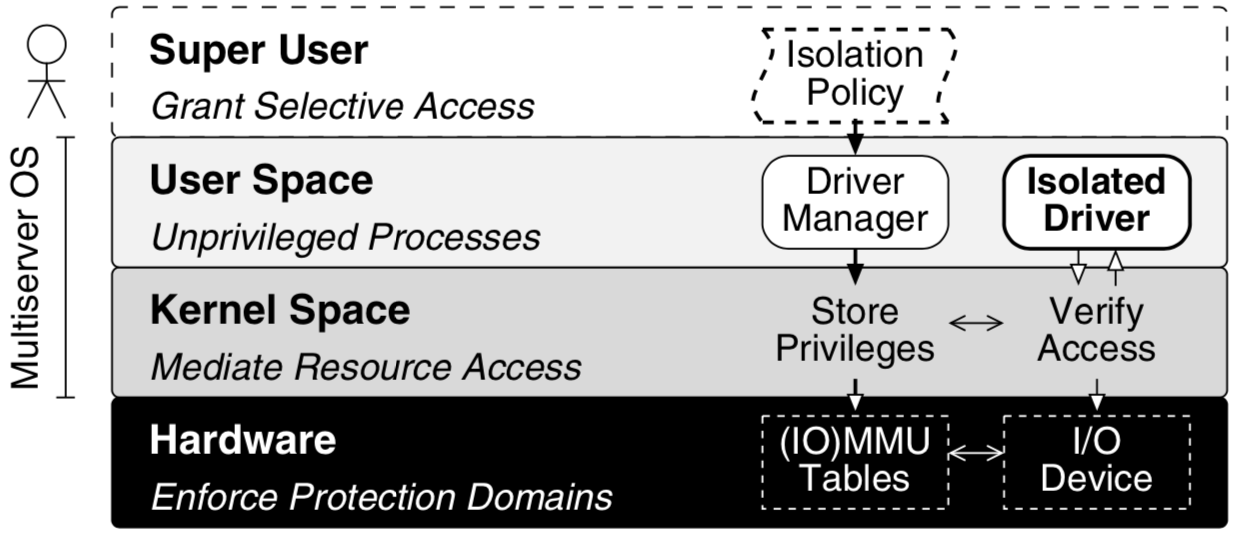
- Based on MINIX 3 (adheres to principle of least privilege/authority)
- Driver runs as user-mode process
- Each process has private (IO)MMU-protected address space
- Policies on driver-basis
- Reference monitor: Kernel + trusted OS
- Does this implement a Reference Monitor???
Enforce Least Authority
- Classify potentially dangerous driver operations:
- CPU usage
- Memory access
- Device I/O
- System services
- Restrict each class
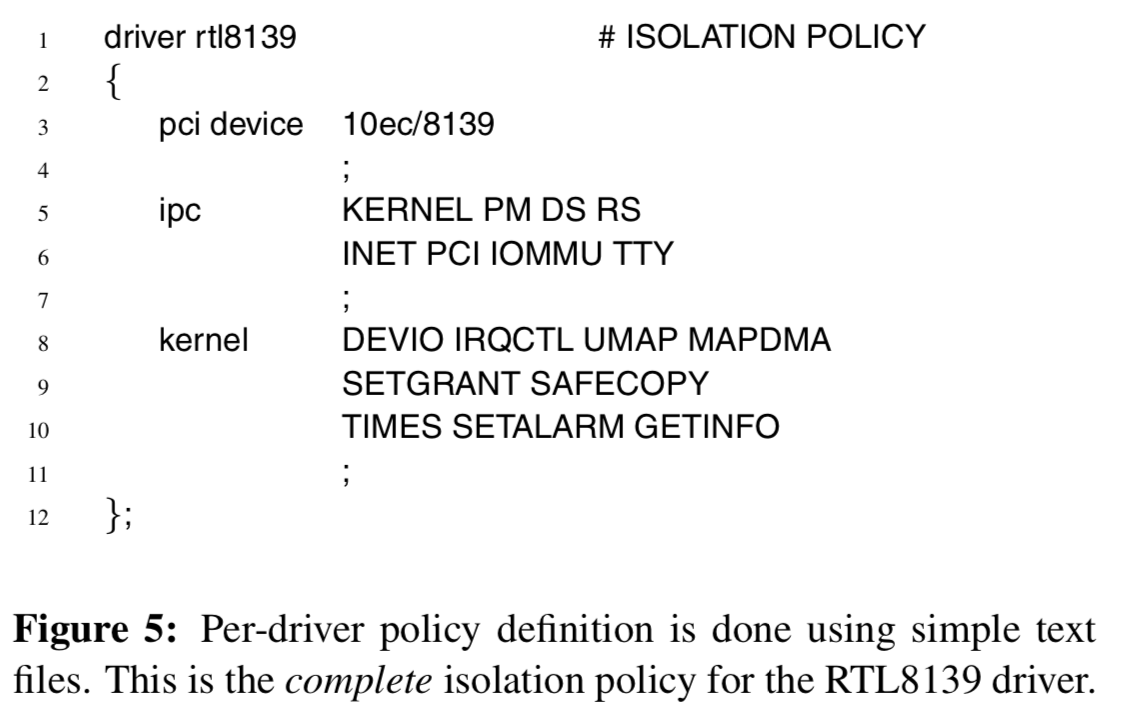
- Isolation policy:
CPU usage
- Privileged instructions
- e.g., resetting page tables
- Restriction: Put driver in user-space (no privileged operations)
- CPU time
- e.g., infinite loop
- Restriction:
- Use scheduling
- Send heart-beats and restart driver if not response
- Use resource-reservation framework to protect real-time processes
Memory access
- Memory references
- e.g., memory corruption
- Restriction: Address space separation
- Use hardware MMU
- Driver gets personal address space
- Driver accessing outside its space is killed
- Problem: Page sharing is too coarse for exchanging small data structures
- Copying/sharing
- Feature to enable fine-grained sharing
- Restriction: Run-time memory granting
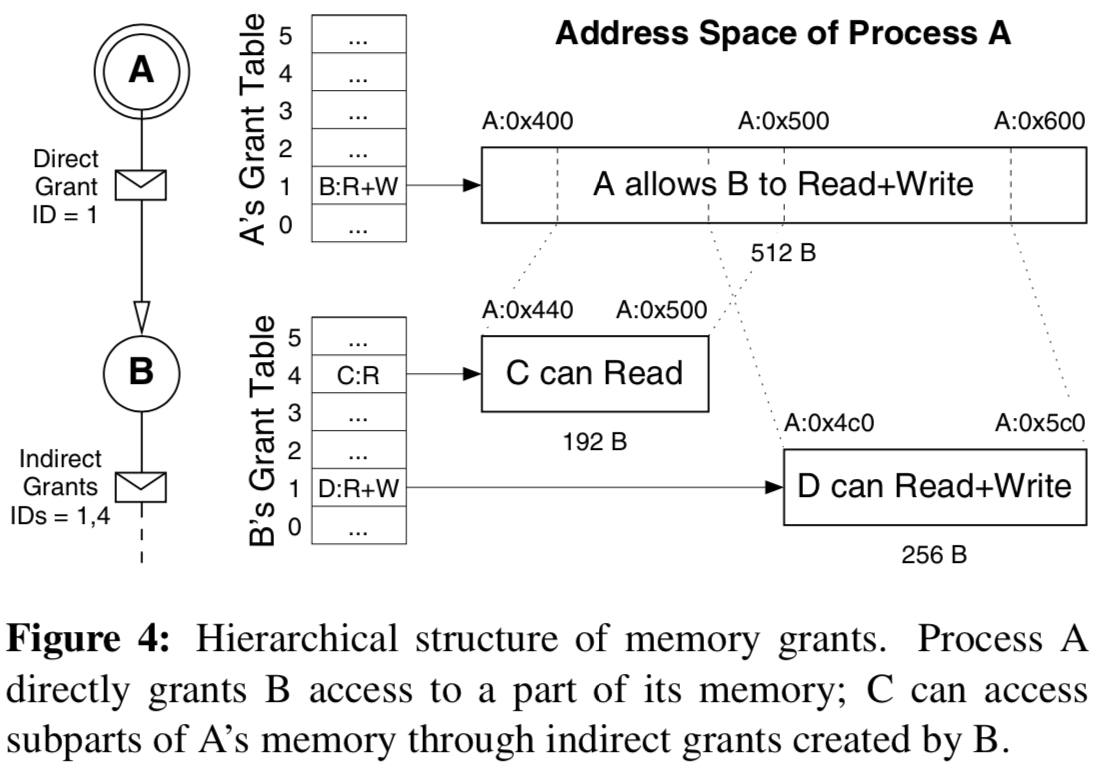
- Process can grant address spaces to other processes
- Store these addresses in grant table (inside kernel (?))
- Byte-level-granularity
- Process specifies whether read/write is possible
- Direct grant and indirect grants possible
- Results in hierarchical structure
- DMA
- Restriction:
- Driver requests DMA from trusted IOMMU driver
- DMA into driver’s own address space is allowed
- Restriction:
Device I/O
- Device access
- e.g., wrong/unauthorized I/O access
- Restriction: Per-driver I/O policy
- Drivers have different requirements
- Each driver gets policy with fine-grained access to the required resources
- Driver manager reads policy from disk
- Driver manager informs kernel and trusted OS servers
- Interrupt handling
- e.g., hard to implement correctly
- Restriction: User-level IRQ handling
- Driver registers for interrupt notifications for a specific interrupt (IRQ) via
IRQCTL - Kernel verifies the access rights with policy
- Generic kernel-level handler disables interrupts, masks the IRQ, notifies the driver (
HWINTmessage), re-enable interrupt controller - Driver can acknowledge the interrupt using
IRQCTLto unmask IRQ line
- Driver registers for interrupt notifications for a specific interrupt (IRQ) via
System services
- Low-level IPC
- e.g., unreliable/hostile sender
- Restriction: Per-driver IPC policy
- Generally, drivers are not allowed to use IPC
- IPC can be specified in isolation policy
- OS services
- e.g., request routing is privileged operation
- Restriction: Per-driver call-policy
- Isolation policy restrict access to kernel calls
- Protect using POSIX
Evaluation
- Not really possible to evaluate
- MPS
- Each driver has own policy
- Protection state: Devices + Interfaces
- Labeling state: Driver-policy
- Transition state: Not given
- Reference monitor
- Complete mediation: Who does mediation?
- IOMMU/MMU/Kernel (?)
- Tamperproof: ?
- Verification: Code+policy not provided
- Complete mediation: Who does mediation?