Linux Security Modules
- Goal: Enforce mandatory access control
- LSM Framework: Interface for a reference monitor
- LSM:
- Security module
- Implementing a reference monitor
- Here: SELinux
- Motivation
- Lots of attacks against Windows in 2000
- MPS is required for a secure OS
- How to enforce MPS in commercial OS?
- Idea: Approximate a secure OS
- Requirements for a secure OS
- Security policy (e.g. information flow, least privilege)
- Reference monitor (complete mediation, tamperproof, validation)
- Formal assurance (OS with reference monitor must enforce policy)
LSM Framework
- 2001: Secure Linux Project
- Goal: Refactor security features into Linux
- e.g., Argus Pitbull, Security-Enhanced Linux (SELinux), AppArmor
- Problem: All different ideas, which to include?
- Solution: Linux Security Modules (add another level of indirection)
- LSM Project:
- Linux Security Modules
- Idea:
- Authorization interface for a security model to act as access control mechanism
- Interface for any authorization module
- Module implements policy and the reference monitor
- Focus: Mediation
- Current LSMs:
- Argus Pitbull
- Security-Enhanced Linux (SELinux)
- AppArmor
- LSM as general interface for authorization queries
- Complete mediation? Not known
Requirements
- Balance: Kernel developer vs. security developer (speed vs. security/tracing)
- Challenge: Unify requirements of security projects and minimal impact on Linux kernel
- Generic
- Applicable for the normal user
- Loading a different module is possible
- Conceptual simple
- Minimally invasive
- Efficient
- POSIX support
- Support Loadable Kernel Modules (LKMs)
LSM Reference Monitor
- Goal:
- Enforce mandatory access control
- Ensure reference monitor concept
- Policy defined by module
Complete mediation
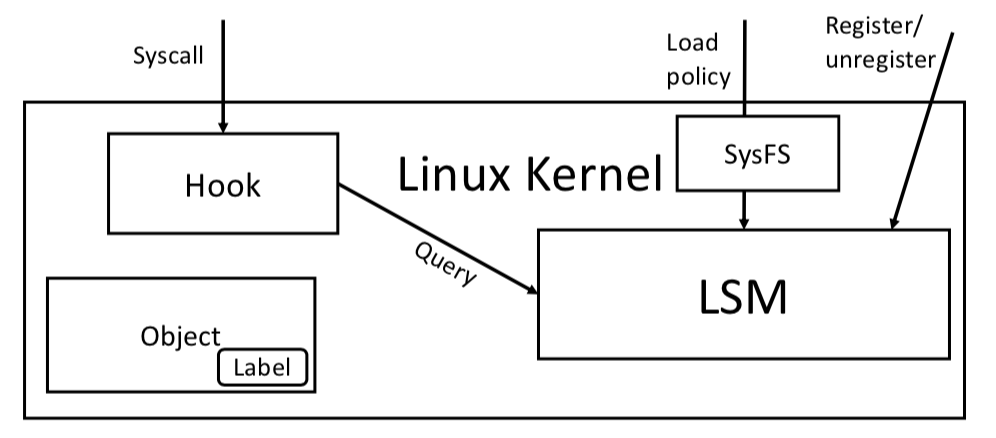
- Add security hook into syscalls
- Security hook (security check function)
- Inside syscall (wrap security-sensitive operation)
- Execute hook before accessing sensible kernel module or similar
- Hook creates authorization queries to module (invoke function defined in module)
- Authorization query components:
- Subject
- Object (sensitive data type ???)
- Operation
- Security module overwrites function
- Hook default is restrictive
- Function is pointer (to LSM module function)
- Function pointer is stored in
security->obstable
- Examples
- Object types: packet, superblock, process, shared memory, etc.
- Finer-grained Operations: ioctl, create, getattr, setattr, lock, append, unlink
- Sensitive data types
- Used for security labels (see labeling state)
- Opaque Security Fields
- Purpose: LSM associates security information with kernel objects (i.e., labels of objects)
- Implemented as
void*pointer (anything can be the value, void pointer has no type, Module should define target)
- Problem: How to handle object creations before security module was loaded?
- Problem: LSM unknown whether it implements complete mediation
Tamperproof
- Goal: Prevent attackers from modifying code/data of LSM/reference monitor (i.e., protection system)
- Linux: Add function to register/unregister LSMs
- LSM defines code
- LSM function pointer points to hooks
- Problem: Could be changed
- Idea: Require compiled-in LSM (pointers can’t be changed)
Verification
- Static analysis
- Tool: CQUAL
- Object states: checked/unchecked
- Time-of-compute-to-time-of-use vulnerability
- Dynamic analysis
Impact on Linux
- Changes in kernel
- Opaque security fields added
- Security hook function calls inserted
- Generic security system call added
- Register/unregister functions for LSMs
- Capabilities logic moved into security modules
- Difference from previous DAC
- Add object types
- Added authorization for finer-grained operations
- System labeling: Independent from user
- Authorization defined by module
- Policy defined by module
API
Analysis
- Zhang et al.
- Static analysis using CQUAL
- Two states for objects: Checked / unchecked
- Idea: All objects in security-sensitive operations must be checked
- Result: TOCTTOU vulnerability
- Time-of-Check-to-Time-of-Use-Problem
- Attack: Exploit time between check and use
- Example: Check file for permissions/change file/use file
- Overhead (worst case): 5 %
SELinux
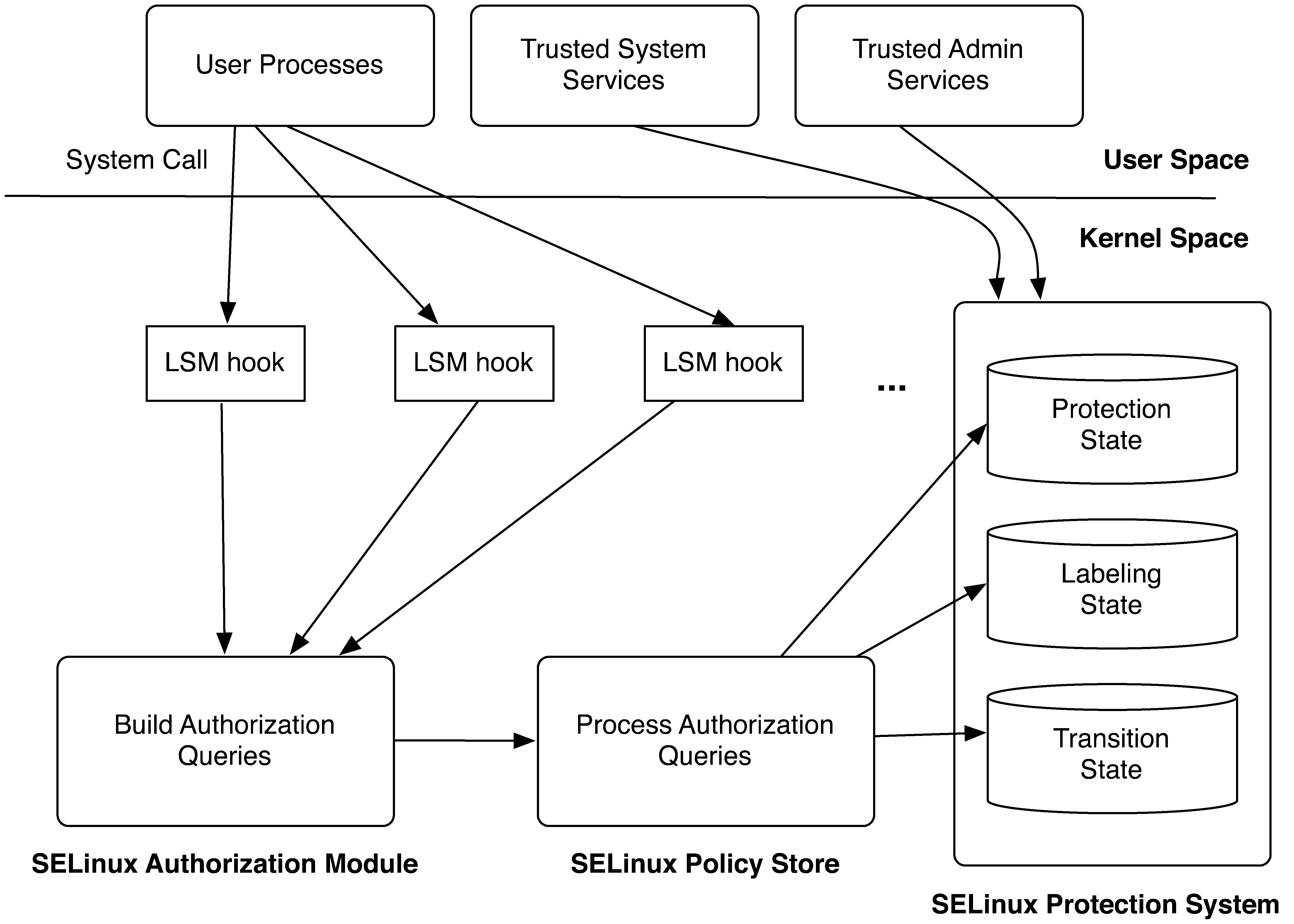
- Reference monitor to enforce mandatory access control
- Components
- Authorization module (build authorization queries)
- Policy store
- Fine-grained control of system resources
- Philosophy: Inevitability of Failure
- Security management in application-space is insufficient
- History:
- 1980s: Mach microkernel retrofitting
- 2000: Start of SELinux
- Motivated by the security kernel design philosophy
- Design of the MPS
- Problem: Classical integrity un-achievable (due to too many exceptions)
- Confine root processes (tamperproof)
- Least privilege (verifiability)
- Problem: Tens of thousands rules necessary for standard Linux (significant effor)
- Problem: Get SELinux policy working/usable
Essentials
- Type
- Group of objects (files/directories)
- Based on security sameness
- e.g.,
passwd_exec_t,etc_t
- Domain
- Process runs in a domain
- Domain is assigned types it can access
- e.g.,
initrc_t
- Role
- Define domains and types a user/process can access
- e.g.,
user_r,admin_r - User/process can transition between roles
- Transition rules defined in SELinux policy
- Identity
- Identity is applied to user account
- Usually, does not change
- e.g.,
alice - Identities are assigned roles
- Security Context
- Comparable to label (assigned to each object/process)
identity:role:domainidentity:role:type
- Type Enforcement (TE)
- Principle of Least Privilege
- Control access to system calls/domains/types
- Role-based Access Control (RBAC)
- Users are assigned to roles
- Roles are assigned to domains/types
- SELinux Policy
- TE + RBAC = SELinux Security Model
- Define rules
- Policy expresses an MPS
Protection State
- Syntax:
<access_vector> <subject_t> <object_t>:<object_class> <permission_set> - Default: Access denied
- Access Vector (
access_vector):allow(explicitly grant access)neverallow- Explicitly disallow access
- Invariants
- If violated, policy does not compule
auditallow(log when granted)dontaudit(do not log deny (eliminate expected denies))
- Types (
subject_t,object_t):*: All typesself: Same source~: Complement set{}: Multiple (set)
- Class (
object_class):{}, *, ~allowed- e.g.,
file
- Permissions (
permission_set):- Operations/permissions on that type
{}, *, ~allowedexecute_trans: Execution allowed with transition
- Examples
allow user_t passwd_t:file execute: Allow roleuser_rtoexecuteallfiles from thepasswd_ttypeneverallow ~{user_t} passwd_t:* *: Prohibit every access topasswd_ttype exceptuser_t
Labeling State
- Syntax:
type_transition source_type target_type : class default_type; - Must be allowed by TE policy
- Default: Same state as creator
- Class:
file-related- New object type
- Process from
sourcecreates new file-related object in directory oftarget - Object has
defaultlabel
- Example:
type_transition passwd_t tmp_t:{file lnk_file} passwd_tmp_t: File/link created bypasswd_tintmp-dir gets typepasswd_tmp_t
Transition State
- Syntax:
type_transition source_type target_type : class default_type; - Must be allowed by TE policy
- Class:
process- Domain transition
- Process from
sourceexecutingtargettransitions todefault
- Must be allowed by TE policy
- Examples:
type_transition user_t passwd_exec_t:process passwd_t: User executing password program transitions topasswd_t
Example: setuid
- Normal user should run privileged process (e.g.,
passwd) - Protection state:
allow user_t passwd_exec_t:file executeallow user_t passwd_t:process transitionallow passwd_t shadow_t:file {read write}
- Transition state:
type_transition user_t passwd_exec_t:process passwd_t
Deployment
- Install policy in kernel
- Make services aware
- Maintain policy
- System is dynamic
- Adapt to changes
- Reconfigure policy
- User-space services
- Authentication
- Access control
- Configuration
Authentication
- Example:
sshd(network) - Services must create a SELinux subject context for a user login
- Problem: Services must work with SELinux
- Solution: Pluggable Authentication Module (PAM)
- API for central authentication
- Comparable to GITZ (?)
Access control
- Example: Databases, Browsers
- Problem:
- PostgreSQL accesses server
- Server may leak user information
- Client-side software implements SELinux user-space library
- Use Access Vector Cache for faster access control
Configuration
- Example: Policy change/recompile
- Goal: Prevent attacker from controlling system policy at load
- Use Policy Management System
- How does this work???