HTTPS
Transport Layer Security (TLS)
- Focus: Network attacker
- Problem: HTTP has no security/encryption
- Idea: Encapsulate HTTP in secure channel (i.e., HTTP via SSL/TLS)
Basics
- Features:
- Symmetric end-to-end encryption
- Server authentication (Server certificates)
- Client authentication (Client certificates, rarely used, e.g., pybits Redmine)
- 1999: TLS replaces Secure Sockets Layer (SSL)
- Provide security for connection:
- Integrity using HMAC
- Confidentiality using symmetric encryption
- Authentication using public-key cryptography
- Supports cipher suites
Cipher Suite
- Cipher suite:
- Set of algorithms for security purposes (e.g., key exchange, encryption, integrity checks)
- Components:
- Protocol: Usually TLS
- Key exchange algorithm:
- Authentication and key exchange
- e.g., RSA with Diffie-Hellman
- Encryption:
- e.g., AES with 256-bit CBC
- Message authentication code:
- e.g., SHA-256
- Cipher suite is represented by two bytes
- e.g.,
TLS_DHE_RSA_WITH_AES_256_CBC_SHA256
Handshake
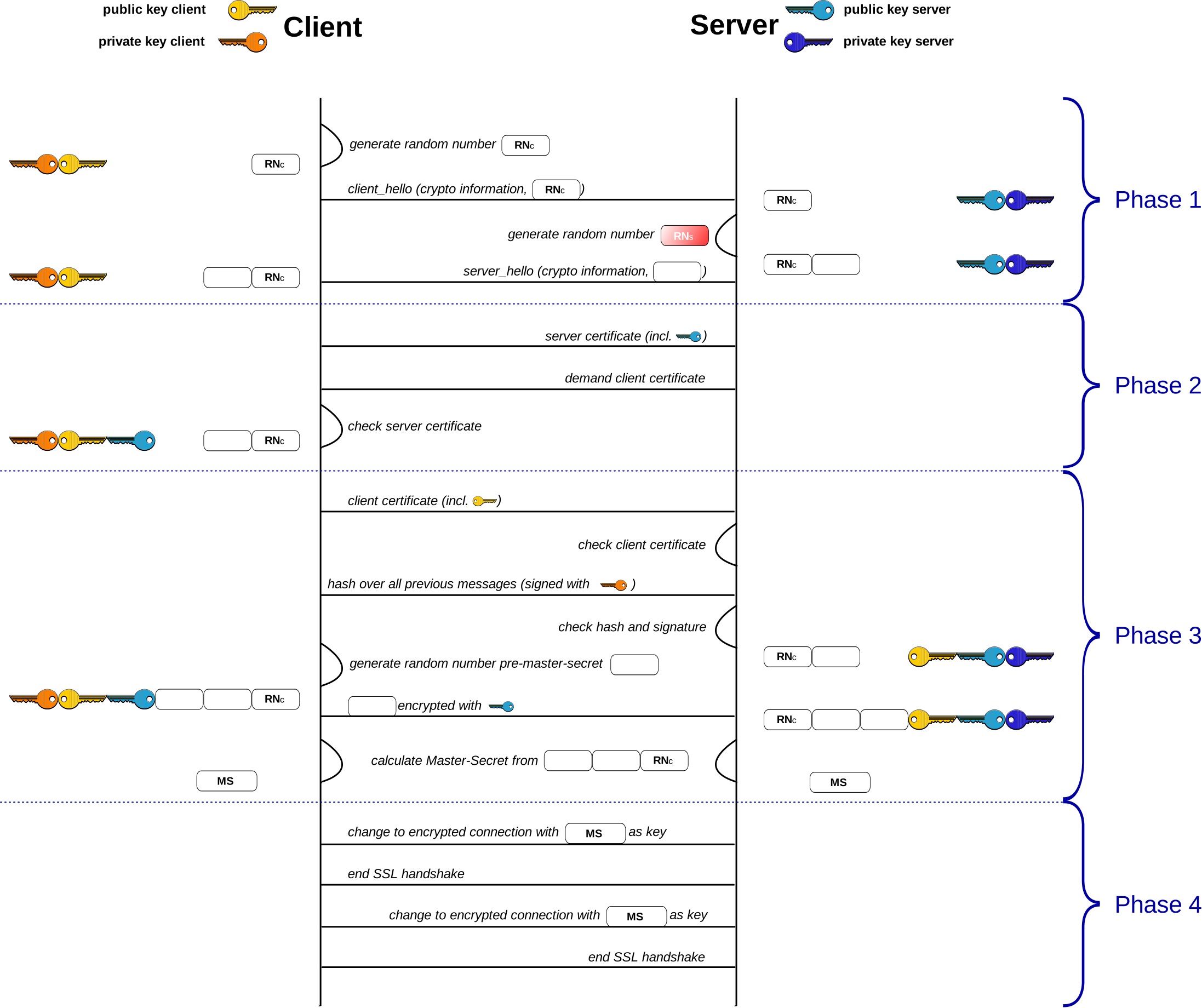
- Phase 1: Hello
- Client sends cipher list and a nonce
- Server selects common suite (e.g., clients priority)
- Server sends chosen suite, cipher list and a nonce
- Phase 2: Public key of server
- Server sends RSA certificate + public key
- Client checks certificate
- Phase 3: MS generation
- Client sends certificate + public key
- (Client sends singed hash over all messages)
- Client generates PreMasterSecret (PMS)
- Client encrypts PMS and sends it to the server
- Server decrypts PMS
- Both derive the MasterSecret using a key-derivation function (using PMS, Client Nonce and Server nonce)
- Phase 4: Change to Symmetric Encryption
- Client changes to symmetric mode
- Server changes to symmetric mode
- End the handshake
Long-Term Connection Privacy
- Decrypt the TLS traffic:
- Requirement:
- Computation of MasterSecret (based on Nonces and PMS)
- Nonces are transmitted in clear text
- Client-generated PMS is encrypted using public key of server
- Problem: Compromised private key of server (trivial)
- Problem: RSA key of server doesn’t change (can be compromised, decrypted, leaked, etc.)
- Solution: Use ephemeral keys for key exchange (achieve forward secrecy)
- Requirement:
- (Perfect) Forward Secrecy
- Inability to decrypt past messages after compromised key
- Perfect: If keys are never used again
- Forward secrecy protects past sessions against future compromises of secret keys or passwords (Wikipedia)
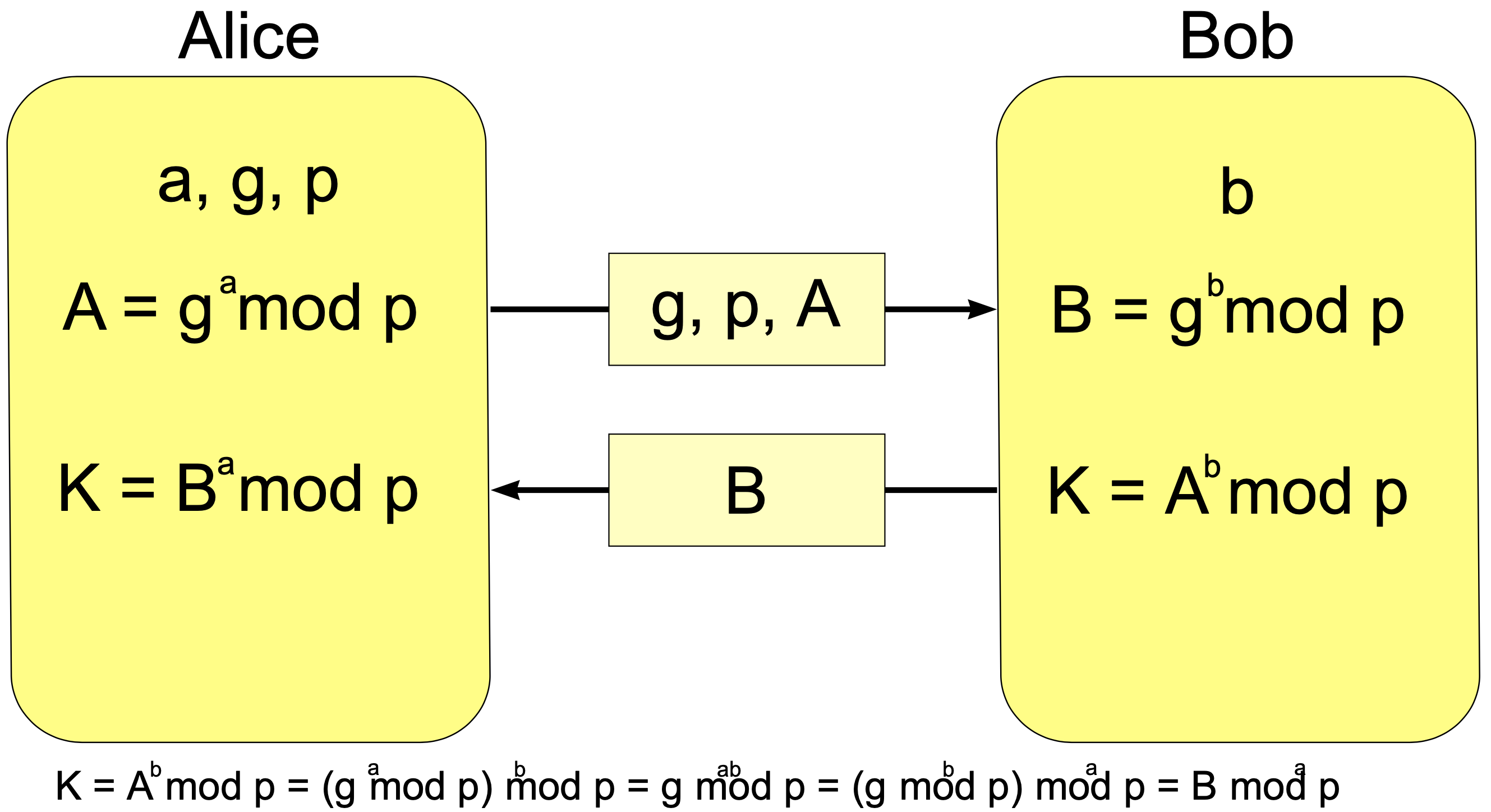
- Diffie-Hellman
- Goal: Two parties establish shared key
- Agree common prime \( p \) and generator \( g \)
- Parties generate private keys \( a \) and \( b \)
- Public key \( K=(g^b mod p)^a mod p \)
Certificates
Server Name Indication (SNI)
- Problem:
- Server can host several domains
- TLS connection established using IP
- Past: One certificate per IP containing all domains
- Problem: Horrible to maintain (add domain, revoke, …)
- Solution: Server Name Indication
- Client sends desired domain unencrypted to server
- Server uses correct certificate for that domain
Public Key Infrastructure
- Motivation:
- MitM attack possible using RSA (replace server key)
- Requires trust in certificate
- Idea:
- Chain of trust: Need to trust the certificate authority (root of trust)
- Definition Certificate:
- Signed document binding a subject to some information OR identity to cryptographic key
- Technically: Combination
- Server’s public key
- Domain name (identity)
- Validity timestamps
- Certificate signed with Certificate Authority’s (CA) private key
- Root CAs are stored in browser
Validation
- Goal: Prove ownership of domain
- Domain validation
- Owner should host certain file under certain path (e.g., Let’s Encrypt)
- Extended Validation (EV)
- Proof legal identity + physical location
- Green lock icon
Revocation
- Important if ownership changes
- Certificate Revocation Lists (CRLs)
- Updated by CA
- List of revoked certificates
- Downloaded regularly by browsers
- Issues:
- Interval of update by CA
- Interval of update by browsers
- Blacklist may miss revoked certificates/does not ensure validity
- Online Certificate Status Protocol (OCSP)
- Client checks validity on request
- Problem: High load on OCSP servers
- Problem: Privacy (OCSP knows the contacted HTTPS servers)
- Problem: Not enabled by default
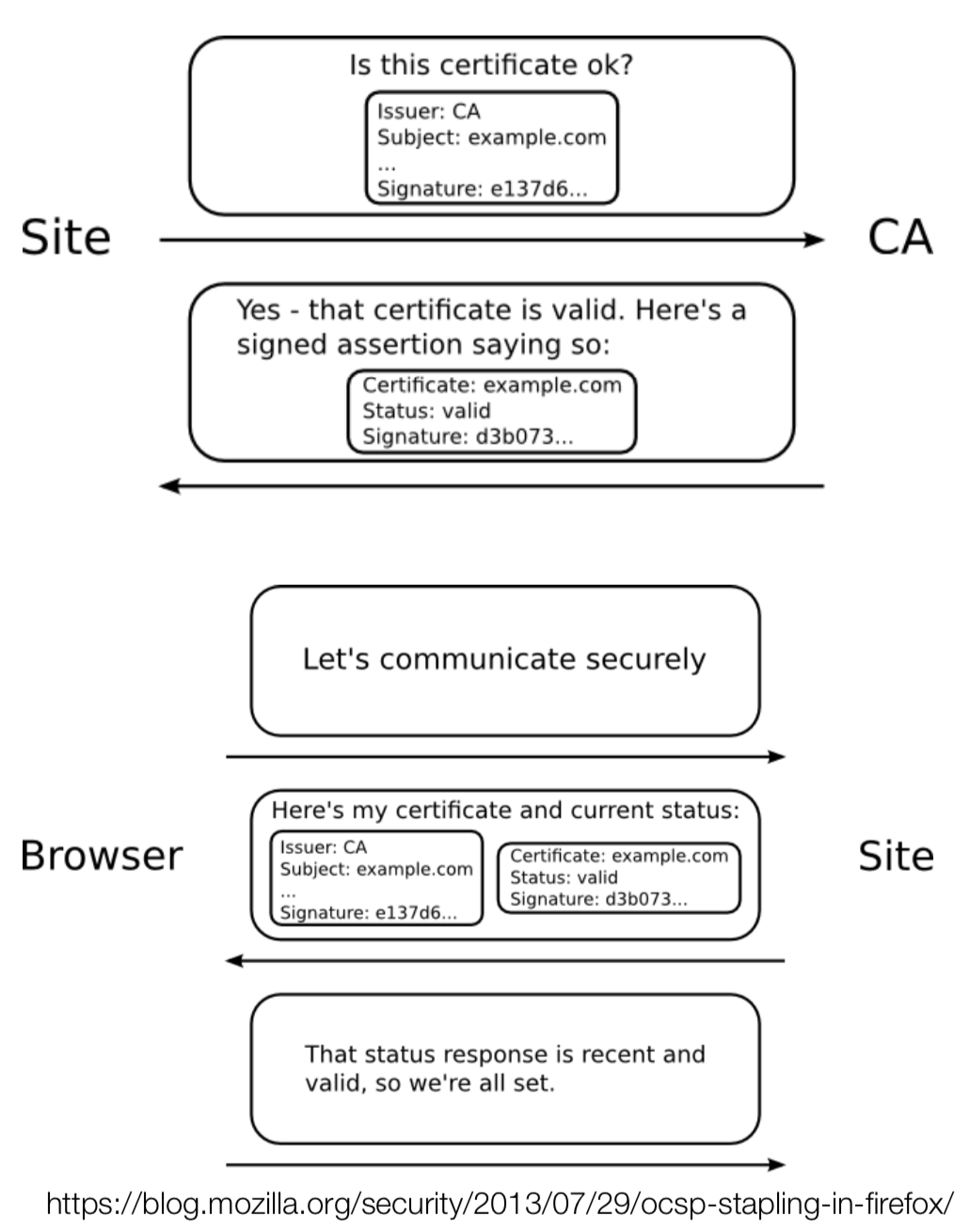
- OCSP Stapling:
- Website issues ticket with limited validity from OCSP server
- Website sends ticket to client in handshake
- Advantages:
- Less load on OCSP servers
- No privacy issues
- Disadvantage: Delay in revoked certificates
Attacks on TLS
- Problem of MitM: Hard to prevent
- Attacks:
- SSL Stripping
- HSTS Tracking
- PKI Compromise
- HTTP Public Key Pinning
SSL Stripping
- Special case of MitM
- Goal: Ensure that traffic from victim is plaintext
- Attacker uses HTTPS connection to server
- Rewrite response for the client:
- Links/redirects are changed to HTTP
- Link targets are HTTPS

HTTP Strict Transport Security (HSTS)
- Server forces client to connect using HTTPS
- HTTP header
Strict-Transport-Security - Must be sent via HTTPS
- HTTP header
Strict-Transport-Security: max-age=<expiry in seconds>- Option
includeSubDomains - Option
preload(allow for preload list)
- Option
- Page can’t be loaded via HTTP until expiry
- Problem: Page needs to be visited once
- Solution: HSTS preload list
- HSTS Tracking:
- see 6 Assorted Client-Side Security - Fingerprinting Users
PKI Compromise
- Attack: Compromise the root CA
- Abusing CAs: Certificates for wildcard domains
- Common mistakes:
- Improper checks before issuing an EV certificate
- Unauthorized employees had access to CA keys
- Real-world abuses:
- DigiNotar (2011): Wildcard certificate for Google
- TürkTrust (2012): Wildcard certificate for Google
- Symantec: Google does not accept Symantec certificates
HTTP Public Key Pinning (HPKP)
- Defense against malicious CAs
- Problem: Domain owner can’t control which CA issues a valid certificate
- Idea: Server tells browsers which CAs are trustworthy
- HTTP Header
Public-Key-Pins- Provide (least) two hashes of valid certificates
- Main: Certificate in the chain
- Backup: Certificate not in the chain
- Requires a second key pair
pin-sha256='XXX'- Only valid for a certain time
- HPKP is deprecated
- Provide (least) two hashes of valid certificates
- Problem: Trust On First Use (TOFU)
- Site must be visited once
- No trust before the first use (already compromised server does not work…)
- Certificate Transparency
- Problem: Malicious certificate are hard to detect
- Solution:
- Use append-only log containing Signed Certificate Timestamp (SCT)
- Use log to detect mis-issue certificates
Attacks on Certificates
- OpenSSL bug detected in 2006
- Allowed decryption of every TLS connection
- Problem: PRNG seeded with PID (32k possible values)
- Attacker can pre-compute values
- SHA-1 collisions
- SHA-1 was used in certificates
Attacking Crypto
- RSA export in USA was restricted to 512 bits
- FREAK (2015)
- Attack Diffie-Hellmann
- DROWN (2016)
- BEAST (2011)
- RC4 weakness (2015)
- POODLE
- CRIME