Server-side Technology
Architecture
- Webserver
- Static (only serving content)
- Static and configurable
- Dynamic (static + application server)
- Storage System
- SQL database
- NoSQL database
- Key-value store
- Blob storage
- File system
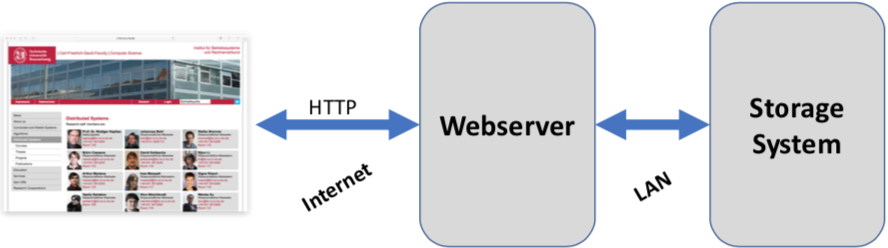
Web Server
Functionality
- Task:
- Communicate with browser
- Implement HTTP
- Possible architectures:
- Process-based
- Thread-based
- State machine
- Mixings/hybrid
- Main loop:
- Open a connection
- Read the request
- Process the request (and create the response)
- Send the response
- Close the connection
Common Gateway Interface
- Server uses
fork()for the executable- Pass the connection to the subprocess
- Programm fills a template by using database information
2nd Generation Framework (MVC)
- Web server executes the controller per request
- Workflow:
- Pass the request to the controller
- Parse the URL and the HTTP request to get them as parameters
- Use these parameters to retrieve the model from the database
- View component renders the template by using the model
- Result: HTML
- e.g., Ruby on Rails, Django
- Note: JavaScript is just a resource on server-side
3rd Generation Framework (JS)
- Usually, simple Web servers can be used to serve HTML, CSS and JS files
- Requirements:
- HTTP GET ist most dominant request type
- Database operation
- Further communication:
- Model data (CRUD operations)
- Access/modification of session data
- Result: Node.js
Node.js
- Concept:
- Basis: JavaScript Runtime environment (v8)
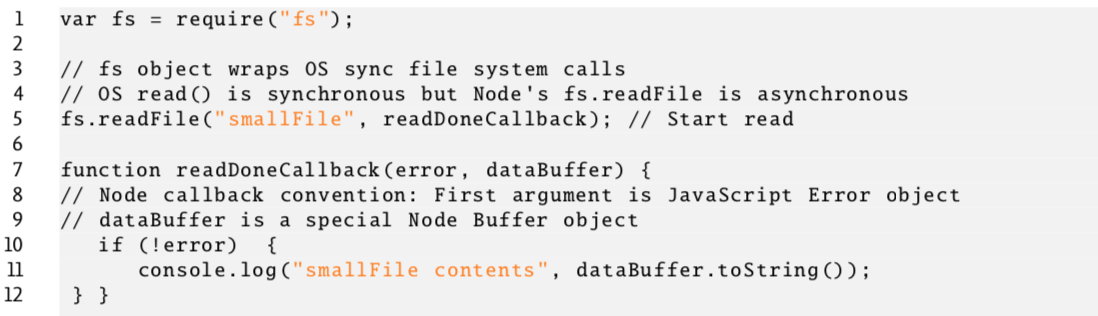
- Add events and management structures (handle all requests using the event loop)
- Add interfaces to the OS (sockets, files, event handling)
- Provide a useful module system (visibility of code)
- Goal:
- Single language used on client and server side
- Supports two paradigms:
- ==Really?==
- Threads:
- Requires scheduler
- Operations are blocking (transparent to waiting)
- Events:
- Non-blocking
- Fine-granular processing of events
- Main loop:
- Goal: Never wait or block in an event handling routine
- Non-blocking

Express.js
- Minimal framework for Node.js
- Features:
- HTTP (also provided by Node.js)
- Routing
- Map URLs to functions
- Routing table
- Middleware
- Manage sessions, cookies
- Security
- etc.
- Express app:
- Routing of HTTP requests
- Rendering of templates (create HTML)
- Interface to configure the middleware of the pre-processor

Routing
expressApp.get(urlPath, requestProcessfunction)urlPathmay contain parameters- Other methods:
get,post,put,delete,all
Request Handling
- e.g.,
expressApp.get('/users', (request, response) => {...}); - Request object:
params: Parameters of the requestquery: GET-Parameterbody: Contentget(field): HTTP Header Parameter
Response Handling
res.write(content): Write contentres.status(code): Set status coderes.set(prop, value): Set headersres.end(): Finish and send responseres.send(content): Equivalent towrite(content)andend()- Supports chaining:
res.status(code).write(c1).write(c2).end()
Middleware
- Important for flexibility (pre-process the request)
- e.g.,
app.all()
- e.g.,
- Examples:
- Check for user authentication
- Parse/convert request
- Session management
- Cookie management
- Compression
- Encryption
Storage Systems
- Requirements
- High availability (read and write)
- High scalability
- Concurrent access (e.g., transaction model)
- Fault-tolerant (data loss would be critical)
- Application data should be well-structured
- e.g., fast access for model data
- Easy usage
- Systems:
- Relational databases
- NoSQL databases
Relational Databases
- Concepts:
- Relations (tables)
- Attributes (column)
- Tuples (rows)
- Database schema: Describe the structure of the database
- Using SQL (descriptive query language)
- Object Relational Mapper
- Motivation: Relational model and web application do not always fit
- Idea: Map OO model to relational model
- Map objects to tuples
- Map classes to relations
- ORMs support the creation and evolution
- e.g., Rails Active Records, SQLAlchemy
NoSQL Database
- Not-only SQL
- Motivation:
- NoSQL database fits better to the object-/document-based model of current Web applications
- e.g., MongoDB
- Data model: JSON
- Expressive query language
- Supports indexing
- Scalable + reliable
- Schema-free or not?
- JSON-objects are flexible (no constraints)
- Problem:
<h1>{{ person.name }}</h1>person.nameshould be a character string and not too long
- Ensure schema using validators (integrity constraints)
- Push consistency-check into the application
- e.g., Mongoose, Object Definition Language (ODL)