History
Timeline
- 1988-1993: World Wide Web at CERN
- 1994: Netscape
- Since 1994: First Browser War
- 1994: Emergence of the W3C
- 2004: WHATWG
- 2004/05: Web 2.0
- 2007: iPhone (mobile revolution)
- 2007-18: Current developments and trends
1988-1993: World Wide Web at CERN
- 1980: Tim Berners-Lee developed application called Enquire at CERN
- Text file can be divided in of nodes
- Each node could be any type of info (address, note, idea,…)
- Nodes link to each other bidirectionally
- 1988: Berners-Lee tried to build a distributed system similar to Enquire
- 1989: Berners-Lee submits project proposal to CERN
- 1990: Name of project: World Wide Web
- 1990: Berners-Lee finalized core ideas:
- HTTP (specify communication between client and server)
- URI (specify addressing of arbitrary files/resources)
- HTML (specify the markup language of web documents)
- 1991: First Web page
- 1991: Project presented at a hypertext-conference
- 1993: WWW is published at CERN
1994: Netscape
- 1993: Browser Mosaic developed by Bina and Andreessen at the NCSA (National Center for Supercomputing Applications)
- 1994: Andreessen left the NCSA and created Netscape
- 1995-1996: Due to Netscape, web sites become more colorful, get tables and frames
- Private persons and companies go into the WWW
- Fast development of Mosaic and Netscape
Since 1994: The First Browser War
- 1995/96: Netscape has market share of 90 %
- 1995:
- Microsoft publishes IE (MS has ignored the Web market)
- Microsoft couples Windows and IE (fast growth)
- 1997: IE 4.0 equal to Netscape
- 1998: Netscape loses market share
- Slow development
- Missing compatibility with Stylesheets and Java
- 2005: Netscape is quit
1994: Emergence of the W3C
- Problem: Rapid and unstructured growth made application development hard
- 1994: First initiatives for developing Web standards
- 1995: Emergence of W3-consortium (W3C)
- Companies and institutions pay membership fees (3-year-contract)
- They can develop W3C standards
- Working groups for HTML, XML, CSS, …
- Recommendations are publicly available
2004: Web Hypertext Application Technology Working Group
- 2003: Apple publishes Safari
- Based on the KHTML-Engine
- Goal: Establish W3C standards
- 2004: Mozilla Foundations publishes Firefox
- 2004: Opera, Apple and Mozilla create the WHATWG
- Motivation: W3C is quite slow and has a big focus on XML
- Goal: Faster developments of Web standards (e.g., HTML5)
2004/05: Web 2.0
- 2004/05: Term Web 2.0 is coined
- Should describe an interactive WWW
- Location transparency
- Distinction local vs. remote storage is relaxed
- Browser as new OS (applications use the browser)
- Mashups: Web content of different services is re-combined (cf. remix in music)
- Users without technical knowledge can use the Web (e.g., blogs)
- But: Term is overloaded - basically it is a further development of the WWW
2007: iPhone
- 2007: Apple presented the iPhone
- Mobile revolution (touch-only, big screen)
- Safari could display normal websites
Current Developments and Trends
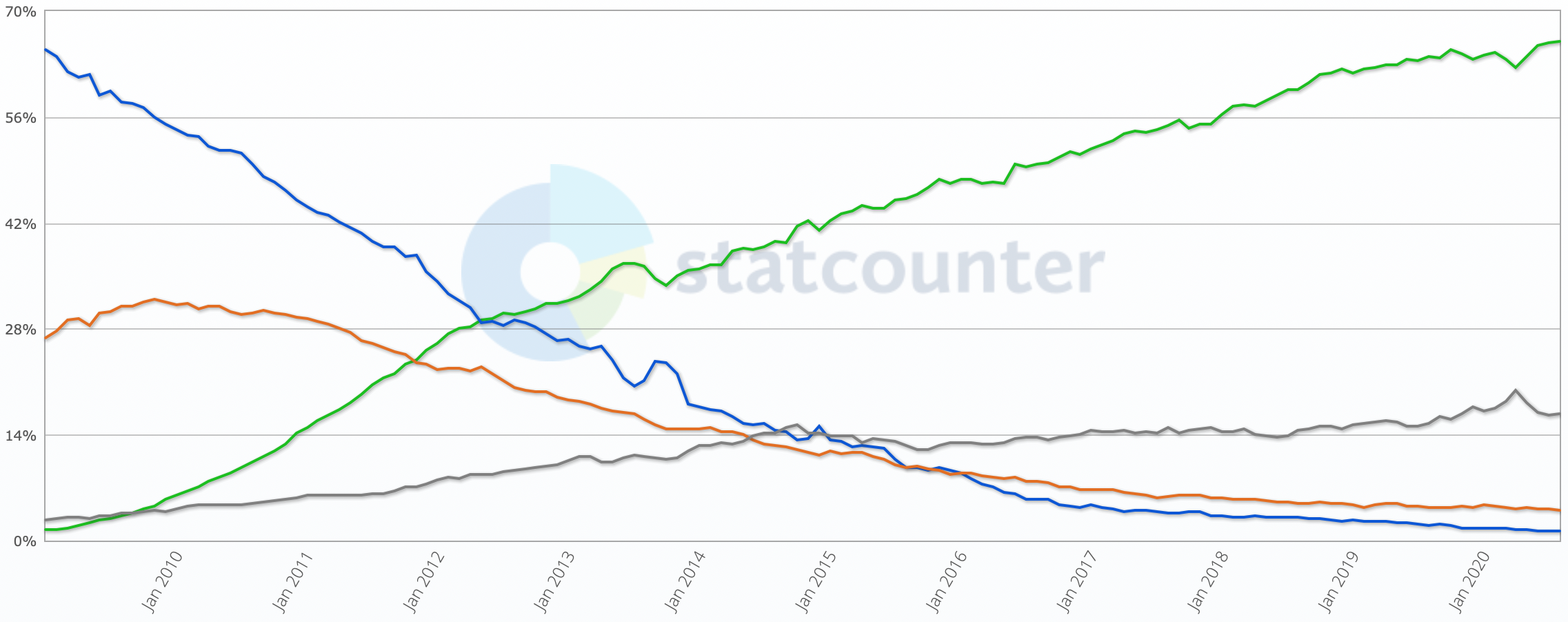
- Currently, Chrome is the market leader
- Desktop applications go into the browser
- Website instead of native applications
- Supporting multiple platforms
- Electron: Website as native application
- WebAssembly: Execute arbitrary code in browser
- Reactive apps:
- Requires low latency for asynchronous execution
- Data should be close to the user (e.g., Edge cloud)
- Content is moved towards the user
- e.g., video conferences using WebRTC
 .
.
References
- History: Entstehung des Internet
- HTTP/2: https://hpbn.co/http2/